Featuring market attractiveness scoring, total addressable market sizing, company benchmarking matrices, interactive Excel dashboards, deeper supply chain intelligence, emerging startup tracking, and granular product-level insights, The Business Research Company’s 2026 market reports are built to deliver research that is both more actionable and more strategically valuable.
#Angioplasty Balloons Market Set To Climb From $2.98 Billion In 2026 To $3.47 Billion By 2030#_x000D_
The angioplasty balloons market size has experienced steady expansion in recent years. This market is projected to increase from $2.85 billion in 2025 to $2.98 billion in 2026, demonstrating a compound annual growth rate (CAGR) of 4.6%. The historical growth of the market can be ascribed to several factors, including the rising prevalence of coronary artery disease, increased clinical adoption of percutaneous transluminal angioplasty, growth in hospital catheterization laboratory capacity, early availability of normal and compliant balloon catheters, and the expanding burden of peripheral artery disease._x000D_
_x000D_
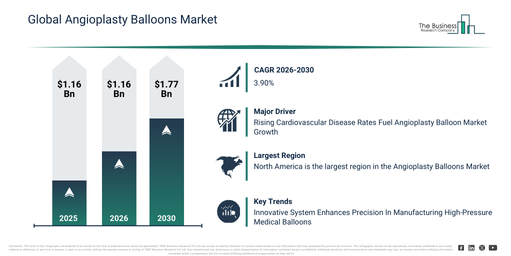
The angioplasty balloons market is anticipated to show steady expansion in the coming years, with its size projected to reach $3.47 billion by 2030, demonstrating a compound annual growth rate (CAGR) of 3.9%. This growth throughout the forecast period can be attributed to several factors: an increasing demand for drug-eluting and specialty balloons, a rise in the volume of peripheral angioplasty procedures, the growing need for treating complex lesions with scoring and cutting balloons, the broader adoption of minimally invasive cardiovascular therapies, and enhanced investments in interventional cardiology infrastructure. Furthermore, major trends expected during this period include the increased acceptance of drug-eluting balloons for complex coronary and peripheral lesions, a rising utilization of non-compliant and semi-compliant balloons to boost procedural precision, a growing preference for scoring and cutting balloons in cases of resistant and calcified stenoses, the expansion of minimally invasive angioplasty interventions across cardiology and vascular care, and an increasing clinical move towards balloon-based revascularization for patients unsuitable for stenting._x000D_
_x000D_
#Get A Free Sample Report With In-Depth Market Insights:#_x000D_
_x000D_
#Angioplasty Balloons Market Development Factors: What’s Supporting Demand?#_x000D_
The future growth of the angioplasty balloons market is anticipated to be driven by the rising occurrence of cardiovascular diseases. Cardiovascular disease encompasses various conditions impacting the heart and blood vessels, frequently resulting in serious complications like heart attacks or strokes. An upward trend in cardiovascular disease is observed, attributed to factors such as inactive lifestyles, poor eating habits, increasing obesity levels, and an aging demographic. Angioplasty balloons are employed in the treatment of cardiovascular disease to expand constricted or obstructed blood vessels, thereby re-establishing adequate blood flow and mitigating the likelihood of complications like heart attacks or strokes. An illustrative example from September 2024, based on data from the Minnesota Department of Health, a US-based state health agency, indicated that about 30% of adults in Minnesota reported high blood pressure in 2023, amounting to almost 1.4 million individuals. Furthermore, in 2022, hypertensive diseases were identified as the primary or contributing cause of death for 14,225 residents, accounting for nearly 28% of all fatalities within the state. Consequently, the rising prevalence of cardiovascular diseases serves as a key driver for the expansion of the angioplasty balloons market._x000D_
_x000D_
#Angioplasty Balloons Market Segments: Where Is Growth Concentrated?#_x000D_
The angioplasty balloons market covered in this report is segmented – _x000D_
_x000D_
1) By Product Type: Normal Balloons, Scoring Balloons, Drug-Eluting Balloons, Cutting Balloons_x000D_
2) By Material: Non-Compliant, Semi-Compliant_x000D_
3) By Application: Coronary Angioplasty, Peripheral Angioplasty_x000D_
4) By End User: Hospitals, Specialty Clinics, Catheterization Laboratories, Ambulatory Surgical Centers, Other End Users_x000D_
_x000D_
Subsegments:_x000D_
1) By Normal Balloons: Non-Compliant Balloons, Compliant Balloons _x000D_
2) By Scoring Balloons: Semi-Compliant Scoring Balloons, Non-Compliant Scoring Balloons _x000D_
3) By Drug-Eluting Balloons: Paclitaxel-Eluting Balloons, Sirolimus-Eluting Balloons, Everolimus-Eluting Balloons _x000D_
4) By Cutting Balloons: Balloon Catheters With Cutting Blades, Balloon Catheters With Radial Scoring Elements_x000D_
_x000D_
_x000D_
#Angioplasty Balloons Market Transformation Trends: What Innovations Are Driving Change?#_x000D_
Companies operating within the angioplasty balloons market are prioritizing the development of innovative products, such as advanced medical balloon forming systems, to enhance precision in manufacturing high-pressure balloons for critical cardiac procedures. The Advanced Medical Balloon Forming System is a specific technology for precisely producing compliant medical balloons utilized in catheter systems. For instance, in June 2024, Interface Catheter Solutions, an innovative US-based catheter technology company, introduced the BFM-5510 High Force Balloon Forming Machine. This sophisticated benchtop system is engineered for the production of low- and non-compliant polymer balloons used in angioplasty, stent placement, and other essential cardiac procedures. Building on the BFM-3310 platform, the BFM-5510 HF employs beryllium copper molds to precisely shape extruded balloon tubing, ensuring stringent quality and tight tolerances across a wide variety of sizes and shapes. This machine offers significantly enhanced production capabilities to accommodate the demands of manufacturing larger, thicker, and more complex medical balloons._x000D_
_x000D_
#Angioplasty Balloons Market Competitive Overview And Top Companies#_x000D_
Major companies operating in the angioplasty balloons market are Johnson & Johnson, Abbott Laboratories, Medtronic Plc, Boston Scientific Corporation, B. Braun SE, Terumo Corporation, Cook Medical, Biotronik SE, Merit Medical Systems Inc, Meril Life Sciences Pvt. Ltd., MicroPort Scientific Corporation, AngioDynamics, Cordis, iVascular, Hexacath, Balton Sp, Cardionovum, QualiMed Innovative Medizinprodukte GmbH, Translumina GmbH, Concept Medical Inc _x000D_
_x000D_
#View The Full Angioplasty Balloons Market Report:#_x000D_
_x000D_
#Angioplasty Balloons Market Leading Geography: Which Region Contributes The Most Revenue?#_x000D_
North America was the largest region in the angioplasty balloons market in 2025. Asia-Pacific is expected to be the fastest-growing region in the forecast period. The regions covered in the angioplasty balloons market report are Asia-Pacific, South East Asia, Western Europe, Eastern Europe, North America, South America, Middle East, Africa._x000D_
_x000D_
#Reach Out To Our Team:#_x000D_
_x000D_
The Business Research Company: https://www.thebusinessresearchcompany.com/_x000D_
Americas: +1 310-496-7795_x000D_
Asia: +44 7882 955267 & +91 8897263534_x000D_
Europe: +44 7882 955267_x000D_
Email us at: marketing@tbrc.info_x000D_
_x000D_
#Follow us on:#_x000D_
_x000D_
LinkedIn: https://in.linkedin.com/company/the-business-research-company_x000D_
YouTube: https://www.youtube.com/channel/UC24_fI0rV8cR5DxlCpgmyFQ_x000D_
Global Market Model: https://www.thebusinessresearchcompany.com/global-market-model

Wasay has over a decade of experience in market research, data modelling, and analytics, with prior experience at GlobalData and Decision Tree Consulting Services. At The Business Research Company , he leads research operations across syndicated studies, customized consulting engagements, and the Global Market Model platform. His professional experience includes supporting organizations such as Boston Consulting Group, KPMG, and Ernst & Young. Wasay holds a degree in Electronics and Communications Engineering, postgraduate management qualifications from International Management Institute Belgium and Indian School of Business and Entrepreneurship, and completed the Integrated Program in Business Analytics from Indian Institute of Management Indore.