
Delivering more actionable and strategically valuable research, The Business Research Company’s 2026 market reports feature market attractiveness analysis, total addressable market evaluation, company benchmarking matrices, interactive Excel dashboards, expanded supply chain intelligence, emerging startup coverage, and detailed product insights.
Military Gas Turbine Market Size, Value And Growth Trends Through 2030
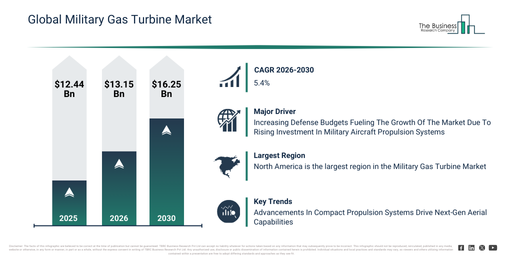
The military gas turbine market size has demonstrated robust growth in recent years. It is forecast to expand from $12.44 billion in 2025 to $13.15 billion in 2026, exhibiting a compound annual growth rate (CAGR) of 5.7%. The expansion witnessed in the past period can be attributed to factors such as the increasing global acquisition of fighter jets and military aircraft that require advanced turbine engines, the modernization of naval fleets driving demand for efficient marine gas turbines, the rising deployment of turboshaft engines in helicopters for combat and transport missions, ongoing improvements in turbine materials enhancing durability and performance, and the expansion of defense budgets facilitating large-scale engine upgrades and replacements.
The military gas turbine market is anticipated to experience substantial expansion over the upcoming years. This market is projected to reach a value of $16.25 billion by 2030, exhibiting a compound annual growth rate (CAGR) of 5.4%. This anticipated growth is primarily driven by several factors, including the increasing integration of next-generation turbofan engines that offer enhanced fuel efficiency and thrust. Furthermore, significant investments in hybrid-electric and low-emission propulsion technologies for military applications are contributing. The expanding need for high-performance APUs that support advanced avionics and mission systems, alongside the proliferation of unmanned combat aerial vehicles necessitating compact, high-power turbine solutions, also plays a role. Additionally, the accelerated development of lightweight turbine components through additive manufacturing for improved operational efficiency is a key contributor. Key trends anticipated during this forecast period involve an increasing demand for military gas turbines that deliver both high thrust and fuel efficiency. There’s also a growing adoption of modular and upgradeable turbine designs, coupled with a stronger focus on multi-fuel and battlefield fuel flexibility. The application of gas turbines is broadening across UAVs, rotorcraft, and naval platforms. Finally, a notable shift towards long-term, performance-based logistics and MRO (Maintenance, Repair, and Overhaul) contracts is expected.
Download A Free Sample Report For Comprehensive Market Insights:
Military Gas Turbine Market Development Factors: Which Trends Are Supporting Demand?
The military gas turbine market is anticipated to expand due to rising defense spending. Defense expenditure represents the complete financial commitment by governments towards maintaining and developing their armed forces and ensuring national security. This increase in defense spending stems from heightened geopolitical tensions, as escalating global conflicts, territorial disputes, and power rivalries necessitate nations to boost their military preparedness and deterrence capabilities. Larger budgets enable governments to acquire sophisticated aircraft, naval ships, and ground-based systems, all of which depend on gas turbines for their propulsion and power needs. These engines are preferred for their strong performance, dependable operation, and capability to function in challenging conditions. For example, a report from the Department of National Defense in Canada, published in January 2025, indicates that Canada’s defense spending is forecast to reach 1.37% of its Gross Domestic Product (GDP) in 2024–25, an increase from 1.31% in 2023–24. Furthermore, 18.6% of the defense budget is slated for significant equipment acquisitions, marking an increase from 14.8% the preceding year. Consequently, the expansion of defense expenditure is a key factor propelling the growth within the military gas turbine market.
Military Gas Turbine Market Segments: Where Are The Largest Growth Opportunities?
The military gas turbine market covered in this report is segmented –
1) By Type: Turbojet Engines, Turboprop Engines, Turbofan Engines, Turboshaft Engines
2) By Type Of Gas Turbine: Micro Gas Turbines, Heavy-Duty Gas Turbines, Light-Duty Gas Turbines
3) By Component Type: Compressor, Combustor, Gas Turbine Rotor, Generator, Control Systems
4) By Application: Fighter Aircraft, Helicopters, Unmanned Aerial Vehicles (UAVs), Naval Ships, Other Applications
5) By End User: Defense Agencies, Original Equipment Manufacturers (OEMs), Private Military Contractors
Subsegments:
1) By Turbojet Engines: Short-Range Missiles, Jet-Powered Target Drones, High-Speed Interceptor Aircraft, Supersonic Jet Fighters
2) By Turboprop Engines: Military Transport Aircraft, Maritime Patrol Aircraft, Reconnaissance Aircraft, Trainer Aircraft
3) By Turbofan Engines: Combat Aircraft, Unmanned Combat Aerial Vehicles (UCAVs), Strategic Bombers, Advanced Jet Trainers
4) By Turboshaft Engines: Type: Military Helicopters, Unmanned Rotorcraft Systems, Tiltrotor Aircraft, Naval Shipboard Auxiliary Power Units
Military Gas Turbine Market Industry Trends: What Changes Are Reshaping Demand?
Leading companies in the military gas turbine market are concentrating on creating innovative products, such as the micro turbojet engine, to improve propulsion efficiency, operational flexibility, and platform compatibility for modern defense systems. A micro turbojet engine is a compact jet propulsion unit that generates thrust by compressing air, combining it with fuel, igniting the mixture, and expelling it at high speed through a nozzle. For example, in February 2024, RVMT, an India-based aerospace firm, introduced the INDRA RV25: 240N, which is the first micro turbojet engine developed domestically. This advanced engine provides a thrust of 240 Newtons (approximately 25 kg) and was completely designed, developed, and manufactured in India, with backing from prominent institutions like IIT-Hyderabad. It possesses a compact structure, a high thrust-to-weight ratio, and components engineered with precision. The INDRA RV25 is particularly well-suited for applications involving unmanned aerial vehicles (UAVs), target drones, and loitering munitions.
Military Gas Turbine Market Major Participants And Competitive Dynamics
Major companies operating in the military gas turbine market are General Electric Company (GE), Honeywell Aerospace, Rolls-Royce North America Inc., Safran Aircraft Engines, GE Aerospace , Williams International Co L.L.C., Kawasaki Heavy Industries Ltd., Motor Sich JSC, MTU Aero Engines AG, John Wood Group PLC, Hindustan Aeronautics Limited (HAL), Bharat Heavy Electricals Limited, Avio Aero , Allison Engine Company , Safran S.A., Pratt & Whitney, ProEnergy Services LLC, Power Engineering International, Motor Sich JSC, IHI Corporation
Access The Complete Military Gas Turbine Market Report:
Military Gas Turbine Market Regional Distribution: Which Areas Drive Market Expansion?
North America was the largest region in the military gas turbine market in 2025. Asia-Pacific is expected to be the fastest-growing region in the forecast period. The regions covered in the military gas turbine market report are Asia-Pacific, South East Asia, Western Europe, Eastern Europe, North America, South America, Middle East, Africa.
Access a Customized Military Gas Turbine Market Report for Deeper Competitive Insights
https://www.thebusinessresearchcompany.com/customise?id=25409&type=smp
The Business Research Company: https://www.thebusinessresearchcompany.com/
Americas: +1 310-496-7795
Asia: +44 7882 955267 & +91 8897263534
Europe: +44 7882 955267
Email us at: marketing@tbrc.info
Follow us on:
LinkedIn: https://in.linkedin.com/company/the-business-research-company
YouTube: https://www.youtube.com/channel/UC24_fI0rV8cR5DxlCpgmyFQ
Global Market Model: https://www.thebusinessresearchcompany.com/global-market-model

Wasay has over a decade of experience in market research, data modelling, and analytics, with prior experience at GlobalData and Decision Tree Consulting Services. At The Business Research Company , he leads research operations across syndicated studies, customized consulting engagements, and the Global Market Model platform. His professional experience includes supporting organizations such as Boston Consulting Group, KPMG, and Ernst & Young. Wasay holds a degree in Electronics and Communications Engineering, postgraduate management qualifications from International Management Institute Belgium and Indian School of Business and Entrepreneurship, and completed the Integrated Program in Business Analytics from Indian Institute of Management Indore.
