
Featuring market attractiveness scoring, total addressable market sizing, company benchmarking matrices, interactive Excel dashboards, deeper supply chain intelligence, emerging startup tracking, and granular product-level insights, The Business Research Company’s 2026 market reports are built to deliver research that is both more actionable and more strategically valuable.
Music Similarity Search Artificial Intelligence (AI) Market Forecast: What Value Will The Market Reach By 2030?
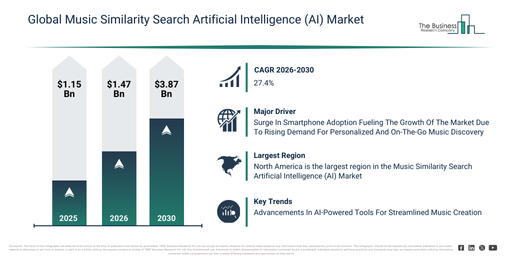
The market size for music similarity search artificial intelligence (AI) has experienced substantial growth in recent times. This market is projected to expand from $1.15 billion in 2025 to $1.47 billion by 2026, demonstrating a compound annual growth rate (CAGR) of 27.6%. Historically, this expansion has been driven by factors such as the increasing volume of digital music libraries, the proliferation of music streaming platforms, the initial embrace of AI in audio analytics, the need for effective copyright management tools, and a rising consumer desire for personalized playlists.
The music similarity search artificial intelligence (AI) market is anticipated to experience substantial expansion over the next few years. It is projected to grow to $3.87 billion in 2030, demonstrating a compound annual growth rate (CAGR) of 27.4%. This predicted growth is attributed to the proliferation of AI-driven music creation tools, the integration of augmented reality and virtual reality (AR/VR) for immersive music experiences, the expansion of cloud-based AI music services, a rising demand for real-time music similarity analysis, and the adoption of AI in global music cataloging. Key trends expected in the forecast period include AI-powered music analysis, personalized music recommendations, real-time audio fingerprinting, automated music tagging and cataloging, and enhanced cross-platform music discovery.
Get A Free Sample Report With In-Depth Market Insights:
Music Similarity Search Artificial Intelligence (AI) Market Growth Backed By Core Demand Fundamentals
The expansion of smartphone ownership is anticipated to boost the music similarity search artificial intelligence (AI) market in the coming years. A smartphone is a portable electronic device that merges communication features with computing capabilities, allowing individuals to make calls, browse the web, run various applications, and execute numerous digital operations. These devices are gaining increasing traction as ongoing technological progress delivers enhanced speed, superior connectivity, and diverse functionalities, positioning them as vital instruments for daily interaction and productivity. The extensive adoption of smartphones makes music similarity search AI crucial, as it empowers users to effortlessly locate, discover, and receive customized music suggestions whenever and wherever they are, directly on their devices. For instance, in February 2023, a report from Uswitch Limited, a UK-based online and telephone comparison service provider, indicated that there were 71.8 million active mobile connections in 2022, and it is projected that by 2025, 95% of the UK’s 68.3 million population will possess smartphones. Consequently, the rising proliferation of smartphones is fueling the expansion of the music similarity search artificial intelligence (AI) market.
Music Similarity Search Artificial Intelligence (AI) Market Segment Breakdown: Which Categories Lead On Revenue?
The music similarity search artificial intelligence (ai) market covered in this report is segmented –
1) By Component: Software, Hardware, Services
2) By Deployment Mode: On-Premises, Cloud
3) By Technology: Deep Learning, Machine Learning, Natural Language Processing, Other Technologies
4) By Application: Music Recommendation, Copyright Detection, Music Cataloging, Playlist Generation, Audio Fingerprinting, Other Applications
5) By End-User: Music Streaming Platforms, Record Labels, Broadcasters, Independent Artists, Other End-Users
Subsegments:
1) By Software: AI Music Composition Tools, Music Production Software, AI-Based Audio Editing And Mixing Software, AI-Driven Music Recommendation Systems, Music Streaming Platforms With AI Features, AI Music Analysis And Tagging Software, Virtual Instruments And Synthesizers Powered by AI
2) By Hardware: AI-Optimized Audio Processing Units, High-Performance Servers For AI Training, Edge Devices For Real-Time Music Analysis, Specialized Audio Input Devices, Integrated AI Music Systems
3) By Services: AI Consulting For Music Industry Applications, AI System Integration Services For Music Platforms, Custom AI Solutions For Music Creation, Music Data Analytics And Insights Services, Training And Workshops On AI In Music, Managed AI Services For Music Production And Distribution, Licensing And Copyright Services For AI-Generated Music
Music Similarity Search Artificial Intelligence (AI) Market Growth Trends Reshaping The Competitive Landscape
Companies operating in the music similarity search artificial intelligence (AI) market are prioritizing the development of advanced solutions, such as AI-powered sample discovery tools, to uncover nuanced sonic similarities that traditional search methods might miss. These AI-powered sample discovery tools are applications that leverage artificial intelligence to pinpoint and suggest audio samples featuring similar sounds or characteristics, thereby streamlining the music creation process. As an illustration, in September 2025, WAVS, a US-based music technology company, introduced AI Sample Finder, an AI-powered sample discovery tool. The AI Sample Finder enables users to search WAVS’ library for samples that closely resemble an uploaded audio file, utilizing music similarity search AI. Available both through its browser platform and as a VST/AU plugin, the tool allows creators to drag and drop samples directly from their DAW for rapid searches. This functionality ensures a seamless workflow by locating matching stems, loops, and one-shots without requiring users to leave their current project. Through AI-driven similarity, users can explore and discover sounds that complement their tracks or emulate favorite samples and synth patches.
Music Similarity Search Artificial Intelligence (AI) Market Leading Players And Competitive Positioning
Major companies operating in the music similarity search artificial intelligence (AI) market are Spotify AB, Deezer, Musixmatch, Audible Magic Corp., Qloo Inc., Sonosuite, LANDR, Aimi Inc., ACRCloud Ltd., Mubert Inc., Super Hi-Fi, Beatoven.ai, Jamahook, Synchtank Ltd., Audiosocket, WAVS Inc., Sony AI Inc., Chosic, Cyanite GmbH, Sound Ideas AI
View The Full Music Similarity Search Artificial Intelligence (AI) Market Report:
Music Similarity Search Artificial Intelligence (AI) Market Regional Distribution: Which Areas Power Market Growth?
North America was the largest region in the music similarity search artificial intelligence (AI) market in 2025. Asia-Pacific is expected to be the fastest-growing region in the forecast period. The regions covered in the music similarity search artificial intelligence (AI) market report are Asia-Pacific, South East Asia, Western Europe, Eastern Europe, North America, South America, Middle East, Africa.
Reach Out To Our Team:
The Business Research Company: https://www.thebusinessresearchcompany.com/
Americas: +1 310-496-7795
Asia: +44 7882 955267 & +91 8897263534
Europe: +44 7882 955267
Email us at: marketing@tbrc.info
Follow us on:
LinkedIn: https://in.linkedin.com/company/the-business-research-company
YouTube: https://www.youtube.com/channel/UC24_fI0rV8cR5DxlCpgmyFQ
Global Market Model: https://www.thebusinessresearchcompany.com/global-market-model

Wasay has over a decade of experience in market research, data modelling, and analytics, with prior experience at GlobalData and Decision Tree Consulting Services. At The Business Research Company , he leads research operations across syndicated studies, customized consulting engagements, and the Global Market Model platform. His professional experience includes supporting organizations such as Boston Consulting Group, KPMG, and Ernst & Young. Wasay holds a degree in Electronics and Communications Engineering, postgraduate management qualifications from International Management Institute Belgium and Indian School of Business and Entrepreneurship, and completed the Integrated Program in Business Analytics from Indian Institute of Management Indore.