Through market attractiveness analysis, total addressable market evaluation, company benchmarking matrices, interactive Excel dashboards, expanded supply chain intelligence, emerging startup coverage, and detailed product insights, The Business Research Company’s 2026 market reports provide more actionable and strategically valuable research.
Rocket Engine Cooling Systems Market CAGR Analysis And Future Market Development
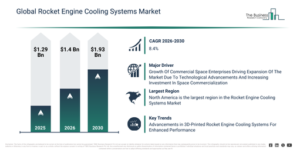
The market size for rocket engine cooling systems has demonstrated significant growth over recent years. This sector is anticipated to expand from $1.29 billion in 2025 to $1.4 billion in 2026, achieving a compound annual growth rate (CAGR) of 8.5%. The historical growth within this period is attributable to several key factors, including the increasing thermal loads from higher-thrust engines that spurred the early adoption of advanced cooling solutions, the ongoing development of regenerative and film cooling methods which improved engine durability, a heightened demand for cryogenic propulsion leading to increased utilization of specialized coolants, the introduction of high-performance heat shields and insulation materials designed for extreme operating conditions, and the expansion of government-led launch programs that require robust cooling pumps and valves.
The rocket engine cooling systems market is projected to experience substantial expansion in the coming years. By 2030, this market is anticipated to reach $1.93 billion, demonstrating a compound annual growth rate (CAGR) of 8.4%. This projected growth is driven by several factors, including the expansion of reusable rocket programs leading to a greater need for durable cooling components, progress in thermal management materials that boost insulation performance, a surge in commercial launch frequency increasing the call for efficient cooling subsystem production, breakthroughs in cryogenic fluid handling improving the reliability of pumps and valves, and the growing intricacy of missions demanding more advanced multi-mode engine cooling architectures. Key trends anticipated during this period encompass advanced heat-exchange and precooler technologies, new formulations and handling methods for cryogenic coolants, the application of additive manufacturing for cooling channels and jackets, integrated thermal management solutions for reusable engines, and high-fidelity thermal testing and qualification services.
Download A Free Sample Report For Comprehensive Market Insights:
#Rocket Engine Cooling Systems Market Growth Drivers And Industry Catalysts
The expanding count of commercial space enterprises is poised to drive the future growth of the rocket engine cooling systems market. These enterprises are private entities engaged in space-related activities like satellite launches, space tourism, and exploration, with the goal of capitalizing on space commercialization. Their increase is propelled by technological advancements that reduce the costs of space activities, making space more accessible to private companies. Rocket engine cooling systems are crucial for commercial space enterprises, as they prevent engines from overheating during launch, thereby ensuring optimal performance and safety, which is vital for the reliability and cost-efficiency of space missions. For instance, in May 2024, Primo Ventures, an Italy-based Venture Capital and Private Equity Principals company, reported that Revolv Space, a space tech startup operating in Italy and the Netherlands, secured €2.6 million in funding to enhance small satellite capabilities with advanced mechanisms and power systems. Thus, the rising number of commercial space enterprises is a key driver for the growth of the rocket engine cooling systems market.
Rocket Engine Cooling Systems Market Segmentation And Category Breakdown
The rocket engine cooling systems market covered in this report is segmented –
1) By Type: Regenerative Cooling, Film Cooling, Ablative Cooling, Radiation Cooling, Other Types
2) By Material: Metals, Ceramics, Composites, Other Materials
3) By Application: Spacecraft, Missiles, Launch Vehicles, Other Applications
4) By End User: Commercial, Military, Government
Subsegments:
1) By Regenerative Cooling: Liquid Propellant Regenerative Cooling, Gas Propellant Regenerative Cooling
2) By Film Cooling: Injection Film Cooling, Advanced Film Cooling, Bladed Film Cooling
3) By Ablative Cooling: Solid Ablative Cooling, Ablative Composite Materials
4) By Radiation Cooling: Thermal Radiation Cooling, Radiant Heat Dissipation Cooling
5) By Other Types: Magnetic Cooling, Active Cooling Systems
Rocket Engine Cooling Systems Market Trends Driving Strategic Industry Expansion
Major companies operating in the rocket engine cooling systems market are prioritizing the development of advanced innovations, such as additive manufacturing of high-performance alloys, to improve thermal efficiency, reduce weight, enhance durability, and optimize engine performance under extreme conditions. Additive manufacturing of high-performance alloys is defined as the 3D printing process for creating complex metal parts using sophisticated alloys that offer exceptional strength, heat resistance, and long-lasting quality for demanding applications. For instance, in March 2023, Relativity Space, a U.S.-based aerospace manufacturer, successfully launched its Terran 1 rocket, which featured nine engines with combustion chambers constructed entirely from 3D-printed NASA-developed copper alloys known as Glenn Research Copper (GRCop). These alloys, specifically designed for high thermal conductivity, strength, and creep resistance, enable rocket engines to withstand temperatures up to 40% higher than traditional materials, thereby enhancing cooling efficiency, extending engine life, and decreasing maintenance requirements. This represents a modern approach to boosting propulsion performance while simultaneously lowering manufacturing costs.
Rocket Engine Cooling Systems Market Competitive Analysis Of Major Industry Participants
Major companies operating in the rocket engine cooling systems market are Volvo Aero Corporation, Northrop Grumman Corporation, Space Exploration Technologies Corp, Blue Origin LLC, Ariane Group, Curtiss-Wright Corporation, Aerojet Rocketdyne Holdings Inc, Sierra Space Corporation, Japan Aerospace Exploration Agency, Rocket Lab company, Ursa Major Technologies Inc., Reaction Engines Ltd., PLD Space, Skyroot Aerospace Private Limited, Gilmour Space Technologies Pty Ltd, Firefly Aerospace Inc., Barber-Nichols LLC, ABL Space Systems Company Inc., Skyrora Ltd., Ad Astra Rocket Company, NPO Energomash, Masten Space Systems Inc.
Access The Complete Rocket Engine Cooling Systems Market Report:
Rocket Engine Cooling Systems Market Geographic Distribution And Regional Opportunities
North America was the largest region in the rocket engine cooling systems market in 2025. The regions covered in the rocket engine cooling systems market report are Asia-Pacific, South East Asia, Western Europe, Eastern Europe, North America, South America, Middle East, Africa.
Access a Customized Rocket Engine Cooling Systems Market Report for Deeper Competitive Insights
https://www.thebusinessresearchcompany.com/customise?id=25511&type=smp
The Business Research Company: https://www.thebusinessresearchcompany.com/
Americas: +1 310-496-7795
Asia: +44 7882 955267 & +91 8897263534
Europe: +44 7882 955267
Email us at: marketing@tbrc.info
Follow us on:
LinkedIn: https://in.linkedin.com/company/the-business-research-company
YouTube: https://www.youtube.com/channel/UC24_fI0rV8cR5DxlCpgmyFQ
Global Market Model: https://www.thebusinessresearchcompany.com/global-market-model

Wasay has over a decade of experience in market research, data modelling, and analytics, with prior experience at GlobalData and Decision Tree Consulting Services. At The Business Research Company , he leads research operations across syndicated studies, customized consulting engagements, and the Global Market Model platform. His professional experience includes supporting organizations such as Boston Consulting Group, KPMG, and Ernst & Young. Wasay holds a degree in Electronics and Communications Engineering, postgraduate management qualifications from International Management Institute Belgium and Indian School of Business and Entrepreneurship, and completed the Integrated Program in Business Analytics from Indian Institute of Management Indore.