Built to provide research that’s more actionable and strategically valuable, The Business Research Company’s 2026 market reports include market attractiveness analysis, total addressable market sizing, company benchmarking matrices, interactive Excel dashboards, broader supply chain intelligence, emerging startup tracking, and in-depth product insights.
Drone-Based Urban Air Quality Sensor Market Forecast: Value Set To Climb From $1.6 Billion To $3 Billion
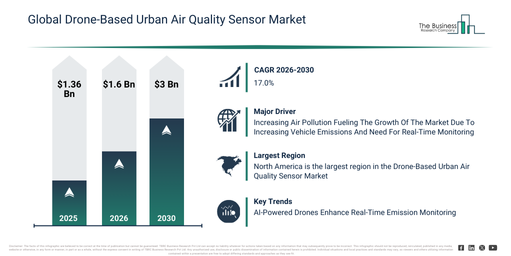
The market size for drone-based urban air quality sensors has expanded considerably in recent years. This sector is anticipated to increase from $1.36 billion in 2025 to $1.6 billion in 2026, achieving a compound annual growth rate (CAGR) of 17.6%. The historical growth of this market is attributable to rising urban air pollution, the wider use of drones in environmental monitoring, the initial adoption of portable air sensors, growing public health awareness, and the accessibility of compact sensor technologies.
The drone-based urban air quality sensor market is projected to experience substantial expansion over the coming years, reaching $3 billion by 2030, demonstrating a compound annual growth rate (CAGR) of 17.0%.
This expansion during the forecast timeframe is driven by several factors, including heightened investments in intelligent environmental monitoring, a greater need for immediate pollution information, wider acceptance of drone regulations for city operations, increasing adoption of AI-powered air quality analysis, and a heightened emphasis on strategies for climate resilience.
Key developments anticipated within this period involve the wider implementation of UAV-based air quality surveillance systems, an increase in the application of multi-sensor payloads on drones, greater incorporation of real-time pollution mapping capabilities, the growth of high-resolution urban air analytical tools, and a stronger emphasis on mobile environmental surveillance.
Get A Free Sample Report With In-Depth Market Insights:
Drone-Based Urban Air Quality Sensor Market Industry Drivers: What’s Behind The Revenue Growth?
The anticipated expansion of the drone-based urban air quality sensor market is linked to rising air pollution. Air pollution, characterized by harmful atmospheric elements such as gases, particulates, or biological molecules, poses threats to human health, the environment, and climate conditions. Vehicle emissions, discharging significant amounts of carbon dioxide, nitrogen oxides, and particulate matter into the air, are the primary contributors to this increasing pollution. These drone-based urban air quality sensors aid in mitigating air pollution through real-time surveillance of detrimental emissions throughout urban areas. Furthermore, they boost environmental oversight by pinpointing areas with high pollution, refining data precision, and facilitating prompt actions to foster healthier urban environments. An illustrative example highlights this concern: in May 2025, the United States Environmental Protection Agency, a US-based government agency, reported that approximately 66 million tons of pollutants entered the atmosphere in the United States during 2023. Consequently, the escalating levels of air pollution are propelling the growth of the drone-based urban air quality sensor market.
Drone-Based Urban Air Quality Sensor Market Segment Analysis: What Are The Core Market Categories?
The drone-based urban air quality sensor market covered in this report is segmented –
1) By Product Type: Fixed-Wing Drones, Rotary-Wing Drones, Hybrid Drones
2) By Sensor Type: Gas Sensors, Particulate Matter Sensors, Multi-Sensor Systems, Other Sensor Types
3) By Application: Air Pollution Monitoring, Emission Source Detection, Industrial Monitoring, Research And Academic, Other Applications
4) By End-User: Government And Municipalities, Environmental Agencies, Industrial, Research Institutes, Other End-Users
Subsegments:
1) By Fixed-Wing Drones: Small Fixed-Wing Drones, Medium Fixed-Wing Drones, Large Fixed-Wing Drones, Solar-Powered Fixed-Wing Drones
2) By Rotary-Wing Drones: Single-Rotor Drones, Multi-Rotor Drones, Coaxial Rotor Drones, Tilt-Rotor Drones
3) By Hybrid Drones: Vertical Take-Off And Landing (VTOL) Hybrid Drones, Fixed-Wing + Multi-Rotor Hybrid Drones, Tilt-Wing Hybrid Drones, Convertible Rotor Hybrid Drones
#Drone-Based Urban Air Quality Sensor Market Growth Trends: What’s Shaping The Future Outlook?
Leading companies active in the drone-based urban air quality sensor market are concentrating on developing technologically advanced solutions, such as AI-driven autonomous drone systems, to elevate detection accuracy and facilitate real-time monitoring of emissions. Artificial intelligence (AI)-enabled autonomous drone systems refer to drones that utilize AI for self-operation, navigation, and task execution without human intervention. For instance, in June 2025, Percepto Ltd., an autonomous inspection and monitoring company based in Israel, launched an AI-powered emission detector designed for remote, drone-based methane surveying. This innovative solution automates optical gas imaging (OGI) inspections by employing autonomous drones equipped with AI algorithms that identify and flag methane emissions in real time. This capability enables scalable, high-frequency monitoring across large areas without increasing the field workforce. The system delivers precise alerts, including geolocation, timestamps, and environmental data, thereby assisting operators in responding faster, enhancing safety, reducing operational costs, and ensuring compliance with upcoming Environmental Protection Agency (EPA) methane regulations.
Drone-Based Urban Air Quality Sensor Market Competitive Landscape: Which Companies Lead The Industry?
Major companies operating in the drone-based urban air quality sensor market are DJI Innovations, Parrot SA, AeroVironment Inc., Yuneec International, Delair, senseFly, Flyability SA, Atmos UAV, AirSense Analytics GmbH, Microdrones GmbH, Aeroqual Limited, Clarity Movement Co., ENVEA formerly Environnement S.A, ZainTech, Met One Instruments Inc., Volatus Aerospace Inc., Percepto Ltd., Black Swift Technologies LLC, EarthSense Systems Limited, Sniffer Robotics Inc.
View The Full Drone-Based Urban Air Quality Sensor Market Report:
Drone-Based Urban Air Quality Sensor Market Regional Outlook: Where Is Opportunity Concentrated?
North America was the largest region in the drone-based urban air quality sensor market in 2025. Asia-Pacific is expected to be the fastest-growing region in the forecast period. The regions covered in the drone-based urban air quality sensor market report are Asia-Pacific, South East Asia, Western Europe, Eastern Europe, North America, South America, Middle East, Africa.
Reach Out To Our Team:
The Business Research Company: https://www.thebusinessresearchcompany.com/
Americas: +1 310-496-7795
Asia: +44 7882 955267 & +91 8897263534
Europe: +44 7882 955267
Email us at: marketing@tbrc.info
Follow us on:
LinkedIn: https://in.linkedin.com/company/the-business-research-company
YouTube: https://www.youtube.com/channel/UC24_fI0rV8cR5DxlCpgmyFQ
Global Market Model: https://www.thebusinessresearchcompany.com/global-market-model

Wasay has over a decade of experience in market research, data modelling, and analytics, with prior experience at GlobalData and Decision Tree Consulting Services. At The Business Research Company , he leads research operations across syndicated studies, customized consulting engagements, and the Global Market Model platform. His professional experience includes supporting organizations such as Boston Consulting Group, KPMG, and Ernst & Young. Wasay holds a degree in Electronics and Communications Engineering, postgraduate management qualifications from International Management Institute Belgium and Indian School of Business and Entrepreneurship, and completed the Integrated Program in Business Analytics from Indian Institute of Management Indore.