Backed by market attractiveness analysis, total addressable market sizing, company benchmarking matrices, interactive Excel dashboards, wider supply chain intelligence, emerging startup coverage, and detailed product-level insights, The Business Research Company’s 2026 market reports are designed to offer research that is more actionable and strategically valuable than ever.
Automatic Train Control Market Size Forecast: How Big Could The Market Get By 2030?
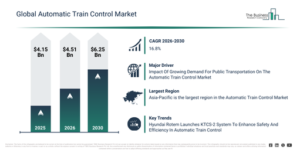
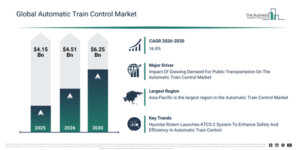
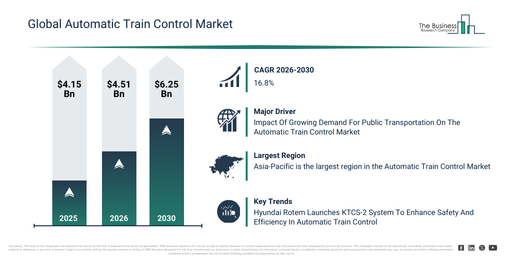
The automatic train control market size has grown strongly in recent years. It will grow from $4.15 billion in 2025 to $4.51 billion in 2026 at a compound annual growth rate (CAGR) of 8.8%. The growth in the historic period can be attributed to urban transit expansion, signaling system upgrades, demand for rail safety, adoption of ats and atp systems, rail capacity constraints.
The automatic train control market size is expected to see strong growth in the next few years. It will grow to $6.25 billion in 2030 at a compound annual growth rate (CAGR) of 8.5%. The growth in the forecast period can be attributed to driverless train adoption, smart mobility investments, real-time rail analytics, energy-efficient operations, government rail digitization. Major trends in the forecast period include adoption of fully automated train operations, expansion of communication-based control, integration of predictive safety systems, growth of urban rail automation, demand for network optimization.
Get A Free Sample Report With In-Depth Market Insights:
Automatic Train Control Market Growth Momentum: What Factors Are Shaping Demand?
The growing demand for public transportation is expected to fuel the growth of the automatic train control market going forward. Public transport refers to transportation services that are available for use by the general public and are typically operated by the government or private entities. The growing demand for public transportation is driven by the increasing need for sustainable and affordable mobility solutions in increasingly urbanized environments. The increasing need for public transport exerts a significant influence on the development and adoption of automatic train control systems by prioritizing safety, efficiency, capacity management, modernization, and integration within transportation networks. For instance, in April 2024, according to the American Public Transportation Association, a US-based non-profit group, transit travellers took 7.1 billion trips on public transportation in 2023, up 16% from 2022. Therefore, the growing demand for public transportation is driving the growth of the automatic train control market.
Automatic Train Control Market Segmentation And Category Overview
The automatic train control market covered in this report is segmented –
1) By Service: Consulting, Integration And Deployment, Support And Maintenance
2) By Automation: GoA 1, GoA 2, GoA 3, GoA 4
3) By Train Type: Urban, Mainline
Subsegments:
1) By Consulting: Feasibility Studies, System Design And Planning, Regulatory Compliance Consulting
2) By Integration And Deployment: System Integration Services, Hardware And Software Deployment, Testing And Commissioning Services
3) By Support And Maintenance: Technical Support Services, Maintenance And Repair Services, Upgrades And System Enhancements
Automatic Train Control Market Trends Redefining Industry Growth
Major companies operating in the automatic train control market are focusing on developing technologically advanced solutions. Such as KTCS-2 system along Jeolla line to address several critical industry demands. The KTCS-2 system on the Jeolla line enhances train safety and efficiency with automatic control features, allowing for better scheduling and reduced intervals between trains. For instance, in November 2023, according to the Hyundai Rotem, a Korean-based heavy industry company launched the Korean Train Control System 2 (KTCS-2) on a 180-kilometer section of the Jeolla Line between Iksan and Yeosu. This advanced LTE-based wireless signaling system enhances real-time communication between trains and control centers, improving operational efficiency and safety while reducing service headways by up to 23%. The KTCS-2 eliminates the need for track-mounted balises, leading to lower installation and maintenance costs. Following successful trials, Hyundai Rotem plans to expand the KTCS-2 system throughout South Korea and into international markets, aligning with European Train Control System (ETCS) standards. Additionally, the company is developing the next version, KTCS-3, which aims to support automatic train operations without track circuits.
Automatic Train Control Market Competitive Analysis Of Leading Industry Participants
Major companies operating in the automatic train control market report include Siemens AG, Alstom SA, Hitachi Ltd., Thales Group, Wabtec Corporation, Mitsubishi Electric Corporation, Toshiba Corporation, CAF Signalling S.A.U., Vossloh Signaling GmbH, Kyosan Electric Manufacturing Ltd, Ansaldo STS, CRRC Corporation Limited, China Railway Signal & Communication Corporation, Nippon Signal Co. Ltd., Union Switch & Signal, Scheidt & Bachmann GmbH, Bombardier Transportation, Hyundai Rotem Company, Talgo S.A., Siemens Mobility
View The Full Automatic Train Control Market Report:
Automatic Train Control Market Regional Split: Which Areas Are Fueling Growth?
Asia-Pacific was the largest region in the automatic train control market in 2025. It is expected to be the fastest-growing region in the forecast period. The regions covered in the automatic train control market report include Asia-Pacific, South East Asia, Western Europe, Eastern Europe, North America, South America, Middle East, Africa.
Reach Out To Our Team:
The Business Research Company: https://www.thebusinessresearchcompany.com/
Americas: +1 310-496-7795
Asia: +44 7882 955267 & +91 8897263534
Europe: +44 7882 955267
Email us at: marketing@tbrc.info
Follow us on:
LinkedIn: https://in.linkedin.com/company/the-business-research-company
YouTube: https://www.youtube.com/channel/UC24_fI0rV8cR5DxlCpgmyFQ
Global Market Model: https://www.thebusinessresearchcompany.com/global-market-model

Wasay has over a decade of experience in market research, data modelling, and analytics, with prior experience at GlobalData and Decision Tree Consulting Services. At The Business Research Company , he leads research operations across syndicated studies, customized consulting engagements, and the Global Market Model platform. His professional experience includes supporting organizations such as Boston Consulting Group, KPMG, and Ernst & Young. Wasay holds a degree in Electronics and Communications Engineering, postgraduate management qualifications from International Management Institute Belgium and Indian School of Business and Entrepreneurship, and completed the Integrated Program in Business Analytics from Indian Institute of Management Indore.