Built to provide research that’s more actionable and strategically valuable, The Business Research Company’s 2026 market reports include market attractiveness analysis, total addressable market sizing, company benchmarking matrices, interactive Excel dashboards, broader supply chain intelligence, emerging startup tracking, and in-depth product insights.
Automotive Ceramics Market Expansion Outlook: What Revenue Opportunities Are Ahead?
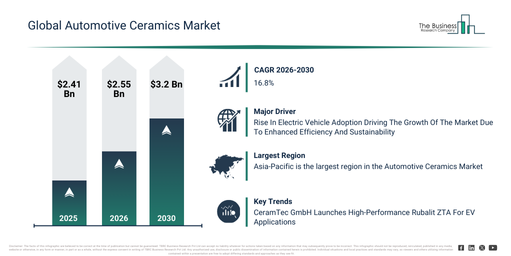
The automotive ceramics market size has grown strongly in recent years. It will grow from $2.41 billion in 2025 to $2.55 billion in 2026 at a compound annual growth rate (CAGR) of 5.7%. The growth in the historic period can be attributed to engine downsizing trends, demand for wear-resistant materials, growth of performance vehicles, adoption of ceramic coatings, emission control needs.
The automotive ceramics market size is expected to see strong growth in the next few years. It will grow to $3.2 billion in 2030 at a compound annual growth rate (CAGR) of 5.8%. The growth in the forecast period can be attributed to electric vehicle growth, demand for thermal management solutions, lightweighting initiatives, advanced material innovation, high-performance component demand. Major trends in the forecast period include growing use in ev powertrains, expansion of ceramic brake components, adoption in high-temperature engine parts, increased use in automotive sensors, focus on lightweight materials.
Get A Free Sample Report With In-Depth Market Insights:
Automotive Ceramics Market Opportunity Drivers: What’s Unlocking New Revenue Potential?
The growing adoption of electric vehicles (EVs) is expected to propel the growth of the automotive ceramics market going forward. Electric vehicles (EVs) are vehicles powered by electric motors using rechargeable batteries instead of internal combustion engines. The rise in the adoption of electric vehicles (EVs) is due to environmental concerns, government incentives and regulations, and advancements in EV technology. Growing awareness of climate change and the environmental impact of fossil fuels has prompted consumers to seek cleaner alternatives, such as electric vehicles, which produce zero emissions. Automotive ceramics are important in enhancing electric vehicles’ performance, durability, and efficiency (EVs). Their unique properties, such as high-temperature resistance, wear resistance, and lightweight nature, make them ideal for various EV applications. For instance, in December 2024, according to the International Energy Agency, a US-based intergovernmental organization, electric car sales in 2023 saw a year-on-year increase of 35%, with 3.5 million more units sold compared to 2022. Therefore, the growing adoption of electric vehicles is driving the growth of the automotive ceramics market.
Automotive Ceramics Market Segment Landscape: Which Areas Lead Development?
The automotive ceramics market covered in this report is segmented –
1) By Material: Alumina, Zirconia, Other Materials
2) By Vehicle Type: Passenger Vehicles, Commercial Vehicles
3) By Application: Engine parts, Automotive electronics, Exhaust systems
Subsegments:
1) By Alumina: High-Purity Alumina, Alumina-Based Composites, Toughened Alumina
2) By Zirconia: Yttria-Stabilized Zirconia (YSZ), Magnesia-Stabilized Zirconia (MSZ), Partially Stabilized Zirconia (PSZ)
3) By Other Materials: Silicon Carbide (SiC), Silicon Nitride (Si3N4), Titanate-Based Ceramics
Automotive Ceramics Market Innovation Trends Shaping Future Development
Major companies operating in the automotive ceramics market are focusing on developing innovative products, such as high-performance ceramic substrates, to enhance thermal management, improve efficiency, and support the growing adoption of electric vehicles. A high-performance ceramic substrate in the automotive industry refers to a specialized ceramic material used as a base or foundation in various automotive components, especially electronic systems. For instance, in May 2023, CeramTec GmbH, a Germany-based chemical company, launched Rub alit ZTA, a high-performance ceramic substrate. This new material offers high flexural strength, good thermal conductivity, excellent electrical insulation, and top-tier dielectric strength. Specifically tailored for use in highly electrified industries and e-mobility, Rub alit ZTA aims to support the growing demand for advanced ceramic solutions in electric vehicles and other high-performance automotive applications.
Automotive Ceramics Market Industry Leaders And Competitive Landscape
Major companies operating in the automotive ceramics market report include Saint-Gobain Ceramic Materials, Sumitomo Electric Industries Ltd., Kyocera Corporation, Corning Incorporated, Murata Manufacturing Co. Ltd., Hitachi Metals Ltd., Tosoh Corporation, NGK Insulators Ltd., Ibiden Co. Ltd., Denka Company Limited, CoorsTek Inc., Morgan Advanced Materials plc, Ferrotec Holdings Corporation, CeramTec GmbH, CTS Corporation, Schunk Ingenieurkeramik GmbH, 3M India Limited, Maruwa Co. Ltd., Ceradyne Inc., Nippon Carbon Co. Ltd.
View The Full Automotive Ceramics Market Report:
Automotive Ceramics Market Top Region By Revenue And Market Share
Asia-Pacific was the largest region in the automotive ceramics market in 2025. Asia-Pacific is expected to be the fastest-growing region in the forecast period. The regions covered in the automotive ceramics market report include Asia-Pacific, South East Asia, Western Europe, Eastern Europe, North America, South America, Middle East, Africa.
Reach Out To Our Team:
The Business Research Company: https://www.thebusinessresearchcompany.com/
Americas: +1 310-496-7795
Asia: +44 7882 955267 & +91 8897263534
Europe: +44 7882 955267
Email us at: marketing@tbrc.info
Follow us on:
LinkedIn: https://in.linkedin.com/company/the-business-research-company
YouTube: https://www.youtube.com/channel/UC24_fI0rV8cR5DxlCpgmyFQ
Global Market Model: https://www.thebusinessresearchcompany.com/global-market-model

Wasay has over a decade of experience in market research, data modelling, and analytics, with prior experience at GlobalData and Decision Tree Consulting Services. At The Business Research Company , he leads research operations across syndicated studies, customized consulting engagements, and the Global Market Model platform. His professional experience includes supporting organizations such as Boston Consulting Group, KPMG, and Ernst & Young. Wasay holds a degree in Electronics and Communications Engineering, postgraduate management qualifications from International Management Institute Belgium and Indian School of Business and Entrepreneurship, and completed the Integrated Program in Business Analytics from Indian Institute of Management Indore.