
Backed by market attractiveness analysis, total addressable market sizing, company benchmarking matrices, interactive Excel dashboards, wider supply chain intelligence, emerging startup coverage, and detailed product-level insights, The Business Research Company’s 2026 market reports are designed to offer research that is more actionable and strategically valuable than ever.
Floating Wind Power Market Value Analysis: What Growth Lies Ahead Over The Forecast Period?
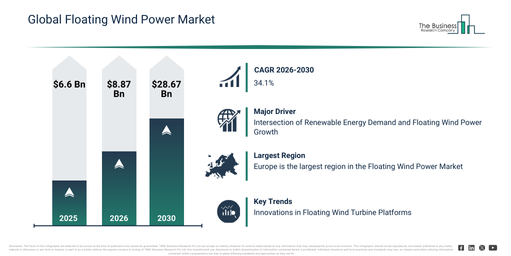
The floating wind power market size has experienced rapid growth in recent years. It is projected to expand from $6.6 billion in 2025 to $8.87 billion in 2026, achieving a compound annual growth rate (CAGR) of 34.4%. This historical growth can be linked to factors such as the constraints of fixed-bottom offshore wind sites, the initiation of early offshore wind pilot projects, developments in offshore engineering, a rising need for renewable offshore power, and governmental encouragement for offshore wind.
The floating wind power market is poised for significant expansion in the upcoming years. Its valuation is projected to reach $28.67 billion in 2030, growing at a compound annual growth rate (CAGR) of 34.1%. This anticipated growth is primarily driven by increasing investments in deepwater offshore wind farms, the rising demand for large-scale clean energy generation, technological advancements in floating foundations, the expansion of offshore transmission infrastructure, and the growing commercialization of floating wind technology. Key trends for the forecast period include the evolution of floating turbine platform designs, increasing deployment in deepwater locations, the wider adoption of large-capacity offshore turbines, the development of mooring and anchoring technologies, and an enhanced focus on offshore grid integration.
Get A Free Sample Report With In-Depth Market Insights:
Floating Wind Power Market Expansion Drivers: What’s Shaping Future Growth?
The rising need for renewable energy is anticipated to drive the expansion of the floating wind power market in the future. Renewable energy originates from natural resources that regenerate within a human timeframe, including sunlight, wind, rain, tides, waves, and geothermal heat. This energy type is linked to naturally recurring sources like solar, wind, hydro, geothermal, and biomass, offering sustainable and eco-friendly options instead of fossil fuels. Floating wind power boosts renewable energy by allowing electricity production in deep ocean areas, where more powerful winds result in greater energy generation, thereby broadening the global scope for clean, sustainable energy. As an illustration, in 2023, data from the International Energy Agency (IEA), an international affairs organization located in France, showed that worldwide annual renewable capacity additions climbed by almost 50% to about 510 gigawatts (GW), representing the quickest growth seen over the last two decades. Projections indicate that by 2028, the global renewable capacity is expected to hit 7,300 GW. Consequently, the rising requirement for renewable energy is propelling the expansion of the floating wind power market.
Floating Wind Power Market Segment Analysis: What Are The Core Market Categories?
The floating wind power market covered in this report is segmented –
1) By Foundation Type: Spar-Buoy Foundation, Tension-Leg Platform (TLP) Foundation, Semi-Submersible Foundation, Other Foundations
2) By Turbine Capacity: Up To 3 MW, 3 MW – 5 MW, Above 5 MW
3) By Water Depth: Shallow Water, Transitional Water, Deep Water
Subsegments:
1) By Spar-Buoy Foundation: Deep Water Spar Buoy Systems, Concrete Spar Buoy Foundations, Floating Turbines With Spar Buoy Anchoring, Hybrid Spar-Buoy Solutions, Lightweight Spar Buoy Designs
2) By Tension-Leg Platform (TLP) Foundation: Concrete TLP Foundations, Floating TLP For Deepwater Applications, Anchor-Based TLP Systems, Hybrid TLP Solutions With Concrete And Steel, TLP With Mooring Systems For Wind Turbines
3) By Semi-Submersible Foundation: Concrete Semi-Submersible Platforms, Steel Semi-Submersible Designs, Subsea Buoyancy-Based Semi-Submersible Platforms, Flexible Semi-Submersible Designs, Hybrid Semi-Submersible Platforms For Shallow And Deep Waters
4) By Other Foundations: Concrete Gravity-Based Foundations, Hybrid Floating Foundations, Submerged Buoy And Pontoon Systems, Mooring And Anchoring Solutions For Floating Wind, Innovative Foundation Designs For Harsh Marine Environments
Floating Wind Power Market Strategic Trends: What Defines The Next Growth Phase?
Companies operating within the floating wind power market are actively developing floating wind turbine platforms. These platforms are designed to harness offshore wind energy in deeper waters, regions where traditional fixed-bottom turbines are not viable, thereby increasing renewable energy capacity and fostering innovation in clean energy solutions. A floating wind turbine platform typically features two rotors mounted on a single floating structure, intended to enhance energy capture and improve stability in offshore conditions. For instance, in July 2024, Ming Yang Smart Energy Group Limited, a China-based renewable energy company, introduced the Ocean X, which stands as the biggest twin-rotor floating wind turbine platform. It incorporates two MySE8.3-180 hybrid drive wind turbines, each providing a capacity of 8.3 MW. This platform offers a high total capacity of 16.6 MW and achieves a reduced levelized cost of energy (LCOE) through better aerodynamic performance and less material usage. Additionally, it integrates advanced anti-typhoon technology, making it well-suited for demanding maritime environments. These advancements are expected to improve the efficiency and deployment of offshore wind projects, delivering significant energy output and cost-effectiveness benefits.
Floating Wind Power Market Key Participants And Competitive Landscape
Major companies operating in the floating wind power market are TotalEnergies SE, Mitsubishi Corporation, Engie SA, Hitachi Ltd., General Electric Company, Siemens Energy AG, Hyundai Engineering & Construction Co.Ltd., Shanghai Electric Wind Power Equipment Co., Vestas Wind Systems A/S, Goldwind Science & Technology Co. Ltd., Nordex SE, DEME Group, Taiyuan Heavy Industry Co. Ltd., Suzlon Energy Limited, Envision Group, Sinovel Wind Group Co. Ltd., EEW Group, Ming Yang Wind Power Group Limited, Doosan Group, BW Ideol AS, Flowocean AB
View The Full Floating Wind Power Market Report:
Floating Wind Power Market Geographic Analysis: Where Is Demand Accelerating Fastest?
Europe was the largest region in the floating wind power market in 2025. The regions covered in the floating wind power market report are Asia-Pacific, South East Asia, Western Europe, Eastern Europe, North America, South America, Middle East, Africa.
Reach Out To Our Team:
The Business Research Company: https://www.thebusinessresearchcompany.com/
Americas: +1 310-496-7795
Asia: +44 7882 955267 & +91 8897263534
Europe: +44 7882 955267
Email us at: marketing@tbrc.info
Follow us on:
LinkedIn: https://in.linkedin.com/company/the-business-research-company
YouTube: https://www.youtube.com/channel/UC24_fI0rV8cR5DxlCpgmyFQ
Global Market Model: https://www.thebusinessresearchcompany.com/global-market-model

Wasay has over a decade of experience in market research, data modelling, and analytics, with prior experience at GlobalData and Decision Tree Consulting Services. At The Business Research Company , he leads research operations across syndicated studies, customized consulting engagements, and the Global Market Model platform. His professional experience includes supporting organizations such as Boston Consulting Group, KPMG, and Ernst & Young. Wasay holds a degree in Electronics and Communications Engineering, postgraduate management qualifications from International Management Institute Belgium and Indian School of Business and Entrepreneurship, and completed the Integrated Program in Business Analytics from Indian Institute of Management Indore.