
Featuring market attractiveness scoring, total addressable market sizing, company benchmarking matrices, interactive Excel dashboards, deeper supply chain intelligence, emerging startup tracking, and granular product-level insights, The Business Research Company’s 2026 market reports are built to deliver research that is both more actionable and more strategically valuable.
Grid Forming Inverter Market Growth Analysis: How Will Revenue Trend Over The Forecast Period?
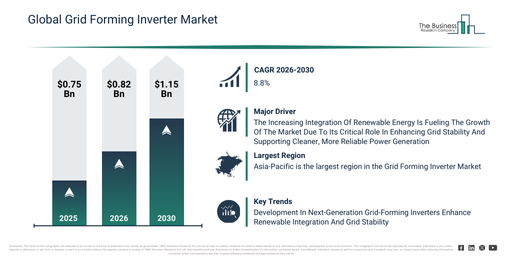
The grid forming inverter market size has experienced significant growth in recent years. It is anticipated to expand from $0.75 billion in 2025 to $0.82 billion in 2026, at a compound annual growth rate (CAGR) of 9.1%. The historical increase can be attributed to several factors including the expansion of renewable energy installations, the early implementation of microgrid systems, a rising adoption of inverter-based resources, increased initiatives for grid decentralization, and the availability of advanced power electronics.
The grid forming inverter market is projected to experience substantial expansion over the upcoming years. Its valuation is anticipated to reach $1.15 billion by 2030, demonstrating an 8.8% compound annual growth rate (CAGR). This expected expansion during the forecast period is primarily driven by heightened investments in grid resilience solutions, increasing uptake of battery-integrated power systems, the proliferation of distributed energy resources, a rising need for inverter-dominated grids, and a sharpened focus on grid-forming standards and interoperability. Key developments expected during this period include an increase in the deployment of grid-stabilizing inverter technologies, greater adoption of inverters within renewable-heavy grids, intensified integration of inverters with energy storage systems, an enlargement of microgrid and islanded grid applications, and a stronger emphasis on frequency and voltage control capabilities.
Get A Free Sample Report With In-Depth Market Insights:
Grid Forming Inverter Market Opportunity Drivers: What’s Unlocking New Revenue Potential?
The grid-forming inverter market is projected to grow significantly due to the increasing incorporation of renewable energy. Renewable energy sources include naturally replenishing options such as sunlight, wind, water, and geothermal heat. This increased integration of renewable energy is driven by governments and industries adopting cleaner sources to reduce carbon emissions and address climate change. Grid-forming inverters improve grid stability by mimicking conventional generator functions, enabling smoother integration of renewable energy. They regulate voltage and frequency, ensuring a consistent and reliable power supply despite variations from solar or wind sources. For instance, in February 2025, the International Energy Agency (IEA), a France-based autonomous intergovernmental organization, reported that solar photovoltaic (PV) power generation saw a remarkable increase of 320 TWh in 2023, representing a 25% rise compared to 2022. Therefore, the expanding integration of renewable energy is a key factor driving the growth of the grid-forming inverter market.
Grid Forming Inverter Market Segments: Where Is Growth Concentrated?
The grid forming inverter market covered in this report is segmented –
1) By Type: Micro Inverter, String Inverter, Central Inverter, Other Types
2) By Connectivity: Standalone, Grid-Connected
3) By Power Rating: Below 50 Kilowatt (KW), 50-100 Kilowatt (KW), Above 100 Kilowatt (KW)
4) By Application: Solar Photovoltaic (PV) Plants, Wind Power Plants, Energy Storage System, Electric Vehicles, Other Applications
5) By End-User: Residential, Commercial, Other End-Users
Subsegments:
1) By Micro Inverter: Residential Micro Inverters, Commercial Micro Inverters, Hybrid Micro Inverters, Off-Grid Micro Inverters
2) By String Inverter: Single-Phase String Inverters, Three-Phase String Inverters, Hybrid String Inverters, Transformerless String Inverters
3) By Central Inverter: Utility-Scale Central Inverters, Commercial Central Inverters, High Power Central Inverters, Medium Power Central Inverters
4) By Other Types: Hybrid Inverters, Battery Integrated Inverters, Modular Inverters, Bidirectional Inverters
Grid Forming Inverter Market Innovation Trends Shaping Future Development
Major companies operating in the grid-forming inverter market are concentrating on creating sophisticated products, such as the central grid inverter, to facilitate greater integration of renewable energy sources into power systems. A central grid inverter functions as a high-capacity unit, transforming direct current from various solar inputs into alternating current for grid use, thereby ensuring effective power handling. It also provides grid stability by managing voltage and frequency at a central location within extensive renewable energy systems. As an illustration, in April 2025, Hitachi Industrial Equipment Systems Co., Ltd., a Japanese industrial equipment supplier, introduced its advanced Grid Forming Inverter (GFM) system. This cutting-edge inverter technology aims to foster stable and robust power grids by replicating the stabilizing inertia effects typically offered by large conventional power plants, which is vital as renewable sources like solar and wind increasingly replace traditional generators. The GFM system allows for the establishment and stabilization of independent microgrids, boosts grid resilience, and maintains operations even during power instability or outages, thus supporting efforts in carbon reduction and disaster readiness.
Grid Forming Inverter Market Competitive Analysis Of Leading Industry Participants
Major companies operating in the grid forming inverter market are Huawei Technologies Co. Ltd., Siemens AG, ABB Ltd., Toshiba Corporation, Infineon Technologies AG, Delta Electronics Inc., Sungrow Power Supply Co. Ltd., Enphase Energy Inc., SMA Solar Technology AG, GoodWe, Sineng Electric, SolaX Power, Hitachi Energy Ltd, TMEIC Corporation, Growatt New Energy Co. Ltd., FIMER Group, Yaskawa Solectria Solar, Su-Kam Power Systems Ltd., NingBo Deye Inverter Technology Co. Ltd, Medha, Bharat Heavy Electricals Limited (BHEL)
View The Full Grid Forming Inverter Market Report:
Grid Forming Inverter Market Geographic Spread And Regional Opportunities
Asia-Pacific was the largest region in the grid-forming inverter market in 2025. The regions covered in the grid forming inverter market report are Asia-Pacific, South East Asia, Western Europe, Eastern Europe, North America, South America, Middle East, Africa.
Reach Out To Our Team:
The Business Research Company: https://www.thebusinessresearchcompany.com/
Americas: +1 310-496-7795
Asia: +44 7882 955267 & +91 8897263534
Europe: +44 7882 955267
Email us at: marketing@tbrc.info
Follow us on:
LinkedIn: https://in.linkedin.com/company/the-business-research-company
YouTube: https://www.youtube.com/channel/UC24_fI0rV8cR5DxlCpgmyFQ
Global Market Model: https://www.thebusinessresearchcompany.com/global-market-model

Wasay has over a decade of experience in market research, data modelling, and analytics, with prior experience at GlobalData and Decision Tree Consulting Services. At The Business Research Company , he leads research operations across syndicated studies, customized consulting engagements, and the Global Market Model platform. His professional experience includes supporting organizations such as Boston Consulting Group, KPMG, and Ernst & Young. Wasay holds a degree in Electronics and Communications Engineering, postgraduate management qualifications from International Management Institute Belgium and Indian School of Business and Entrepreneurship, and completed the Integrated Program in Business Analytics from Indian Institute of Management Indore.