Enhanced with market attractiveness analysis, total addressable market evaluation, company benchmarking matrices, interactive Excel dashboards, expanded supply chain intelligence, emerging startup coverage, and detailed product insights, The Business Research Company’s 2026 market reports deliver more actionable and strategically valuable research.
Rocket Electrical Power Systems Market Forecast Highlighting Growth From $1.69 Billion To $2.24 Billion
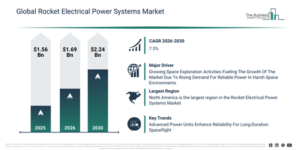
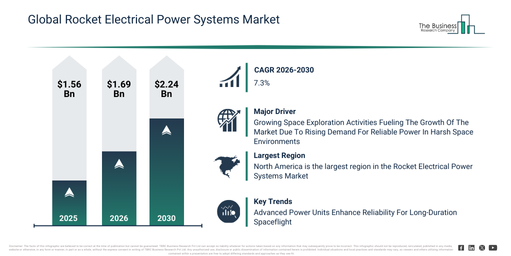
The rocket electrical power systems market size has experienced robust growth in recent years. It is projected to expand from $1.56 billion in 2025 to $1.69 billion in 2026, demonstrating a compound annual growth rate (CAGR) of 8.3%. This historical growth can be attributed to the escalating complexity of launch vehicles, driving an increased demand for reliable onboard power systems, alongside the early adoption of redundant power architectures to enhance mission safety. Additionally, the development of advanced converters and inverters to support evolving avionics loads, the integration of telemetry-driven monitoring units to improve mission diagnostics, and a rising dependence on electric subsystems in propulsion and guidance have collectively increased system requirements.
The market for rocket electrical power systems is projected to experience substantial expansion over the upcoming years. By 2030, this market is anticipated to reach a valuation of $2.24 billion, demonstrating a compound annual growth rate (CAGR) of 7.3%. This projected growth is driven by several factors, including the expansion of commercial and reusable rocket initiatives that demand more efficient power solutions, along with improvements in power electronics leading to lighter and more compact equipment, a rising requirement for highly reliable power distribution to support autonomous flight systems, the embrace of modular electrical power systems to lower manufacturing and integration expenses, and increasing investment in space missions featuring advanced payloads, which boosts the need for greater power capacity. Key developments expected during this period encompass sophisticated power optimization methods, a greater need for high-density energy storage, the miniaturization of power electronics, an increase in redundant power architectures, and the incorporation of radiation-hardened components.
Download A Free Sample Report For Comprehensive Market Insights:
Rocket Electrical Power Systems Market Growth Momentum: Which Factors Are Influencing Demand?
The expansion of space exploration is anticipated to boost the growth of the rocket electrical power systems market in the future. These activities encompass the pursuit of scientific understanding, technological progress, and commercial ventures beyond Earth, conducted via missions, research, and space-based operations. An increase in space exploration is being observed, driven by the rising need for sophisticated communication and Earth observation satellites, which facilitate worldwide connectivity, environmental oversight, and improved security. Rocket electrical power systems facilitate space exploration by providing continuous power to vital components like navigation, communication, and propulsion. Their role in maintaining mission reliability is crucial, as they support operations despite severe space environments. For example, data from Novaspace, a French space consulting firm, indicated that government expenditure on space exploration reached $27 billion in 2024 and is predicted to climb to almost $31 billion by 2034, as reported in September 2023. Consequently, the expanding scope of space exploration is a key driver for the growth of the rocket electrical power systems market.
Rocket Electrical Power Systems Market Segment Landscape: Which Areas Lead Market Development?
The rocket electrical power systems market covered in this report is segmented –
1) By Component: Power Generation, Power Storage, Power Distribution, Power Management
2) By Application: Launch Vehicles, Satellites, Space Probes, Space Stations
3) By End-User: Commercial, Military, Government, Research Organizations
Subsegments:
1) By Power Generation: Solar Arrays, Fuel Cells, Thermoelectric Generators, Turbogenerators, Radioisotope Power Systems (RPS)
2) By Power Storage: Lithium-Ion Batteries, Nickel-Cadmium Batteries, Nickel-Hydrogen Batteries, Supercapacitors, Solid-State Batteries
3) By Power Distribution: Power Distribution Units (PDUs), Electrical Bus Systems, Load Control Switches, Circuit Protection Devices, Power Harnesses And Cabling
4) By Power Management: Power Conditioning Units (PCUs), Voltage Regulators, Battery Management Systems (BMS), Energy Monitoring Systems, Redundant Power Controllers
#Rocket Electrical Power Systems Market Trends Influencing Long-Term Demand
Leading companies in the rocket electric power systems market are concentrating on developing sophisticated products, such as power generation units, to facilitate longer missions and guarantee dependable performance in extreme space environments. Power generation units in rockets are mechanisms that produce electrical energy, including solar panels, fuel cells, or thermoelectric generators, to energize onboard systems throughout missions. For instance, in April 2025, Rocket Lab USA Inc., an aerospace and defense firm situated in the US, introduced Standardized Array (STARRAY), a novel series of adaptable solar arrays designed for satellites. The STARRAY product line, which incorporates power generation units, provides tailored solar power solutions for specific missions, delivering power outputs from approximately 100 watts to exceeding 2,000 watts, achieved through modular panel setups and Rocket Lab’s highly efficient, radiation-resistant quadruple junction solar cells. This innovative product series employs integrated manufacturing processes to supply swift, economical, and trustworthy solar arrays customized for diverse satellite assignments.
Rocket Electrical Power Systems Market Industry Leaders And Market Competition
Major companies operating in the rocket electrical power systems market are RTX Corporation, Lockheed Martin Corporation, The Boeing Company, Airbus Group, Northrop Grumman Corporation, Honeywell International Inc., BAE Systems plc, Safran S.A., Leonardo S.p.A., Teledyne Technologies, Mitsubishi Electric Corporation, Moog Inc., Ball Aerospace & Technologies, Sierra Nevada Corporation, OHB SE, TERMA, Rocket Lab USA Inc., AAC Clyde Space, ZIN Technologies, RUAG Space.
Access The Complete Rocket Electrical Power Systems Market Report:
Rocket Electrical Power Systems Market Regional Analysis And Leading Geography
North America was the largest region in the rocket electrical power systems market in 2025. The regions covered in the rocket electrical power systems market report are Asia-Pacific, South East Asia, Western Europe, Eastern Europe, North America, South America, Middle East, Africa.
Access a Customized Rocket Electrical Power Systems Market Report for Deeper Competitive Insights
https://www.thebusinessresearchcompany.com/customise?id=25509&type=smp
The Business Research Company: https://www.thebusinessresearchcompany.com/
Americas: +1 310-496-7795
Asia: +44 7882 955267 & +91 8897263534
Europe: +44 7882 955267
Email us at: marketing@tbrc.info
Follow us on:
LinkedIn: https://in.linkedin.com/company/the-business-research-company
YouTube: https://www.youtube.com/channel/UC24_fI0rV8cR5DxlCpgmyFQ
Global Market Model: https://www.thebusinessresearchcompany.com/global-market-model

Wasay has over a decade of experience in market research, data modelling, and analytics, with prior experience at GlobalData and Decision Tree Consulting Services. At The Business Research Company , he leads research operations across syndicated studies, customized consulting engagements, and the Global Market Model platform. His professional experience includes supporting organizations such as Boston Consulting Group, KPMG, and Ernst & Young. Wasay holds a degree in Electronics and Communications Engineering, postgraduate management qualifications from International Management Institute Belgium and Indian School of Business and Entrepreneurship, and completed the Integrated Program in Business Analytics from Indian Institute of Management Indore.