Featuring market attractiveness scoring, total addressable market sizing, company benchmarking matrices, interactive Excel dashboards, deeper supply chain intelligence, emerging startup tracking, and granular product-level insights, The Business Research Company’s 2026 market reports are built to deliver research that is both more actionable and more strategically valuable.
Autonomous Delivery Vehicles Market Set To Climb From $1.62 Billion In 2026 To $3.82 Billion By 2030
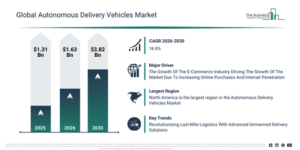
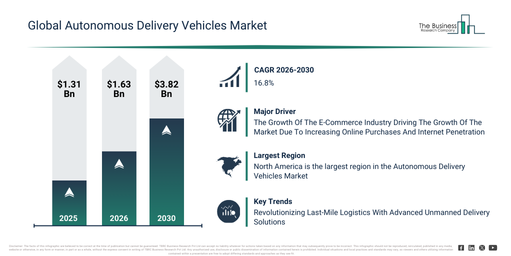
The autonomous delivery vehicles market size has grown exponentially in recent years. It will grow from $1.31 billion in 2025 to $1.63 billion in 2026 at a compound annual growth rate (CAGR) of 23.8%. The growth in the historic period can be attributed to e-commerce expansion, labor cost pressures, pilot delivery robot programs, urban congestion issues, consumer demand for fast delivery.
The autonomous delivery vehicles market size is expected to see exponential growth in the next few years. It will grow to $3.82 billion in 2030 at a compound annual growth rate (CAGR) of 23.8%. The growth in the forecast period can be attributed to scalable autonomous logistics, electric delivery platforms, smart city support, regulatory clarity for drones, AI-driven delivery optimization. Major trends in the forecast period include growth of autonomous last-mile robots, expansion of drone delivery networks, integration of ai route optimization, adoption of contactless delivery solutions, rise of urban micro-fulfillment.
Get A Free Sample Report With In-Depth Market Insights:
Autonomous Delivery Vehicles Market Growth Factors Behind Sustained Expansion
The growing e-commerce industry is expected to propel the growth of the autonomous delivery vehicles market going forward. E-commerce refers to the buying and selling goods and services over the internet, including online transactions, marketing, and customer interactions. The growth of the e-commerce industry is primarily driven by increasing internet penetration, which expands access to online shopping and enhances consumer convenience globally. Autonomous delivery vehicles are used in e-commerce for faster, more efficient, and cost-effective last-mile delivery, ultimately improving customer satisfaction and streamlining supply chains. For instance, in February 2025, according to the United States Census Bureau, a US-based government agency, total e-commerce sales were estimated at $1,192.6 billion in 2024, marking an 8.1% (±1.1) increase compared to 2023. Therefore, the growing e-commerce industry is driving the growth of the autonomous delivery vehicles market.
Autonomous Delivery Vehicles Market Breakdown By Product Type And Application
The autonomous delivery vehicles market covered in this report is segmented –
1) By Vehicle Type: Ground Delivery Vehicles, Aerial Delivery Drones
2) By Component: Hardware, Software, Services
3) By Propulsion Type: Electric, Hybrid
4) By Application: Retail And E-commerce, Food And Beverages, Healthcare, Logistics, Other Applications
Subsegments:
1) By Ground Delivery Vehicles: Autonomous Delivery Robots (ADRs), Self-Driving Vans, Self-Driving Trucks, Delivery Pods
2) By Aerial Delivery Drones: Fixed-Wing Drones, Rotary-Wing Drones, Hybrid Drones
Autonomous Delivery Vehicles Market Industry Trends Fueling Future Revenue Growth
Major companies operating in the autonomous delivery vehicles market are focusing on developing technologically advanced solutions, such as unmanned delivery systems, to enhance efficiency, reduce costs, and improve last-mile logistics. Unmanned delivery systems refer to autonomous vehicles or drones designed to transport goods without human operators, utilizing advanced technologies such as artificial intelligence, GPS, and sensors for navigation and delivery. For instance, in February 2025, WeRide Inc., a China-based autonomous driving technology company, launched the Robovan W5, an autonomous delivery vehicle designed for efficient, fully unmanned urban logistics and last-mile delivery. These vehicles feature Level 4 autonomous driving technology with a redundant 360-degree sensor system for fully unmanned, 24/7 operation in all weather and traffic conditions and offer the largest cargo capacity in their class at 5.5 cubic meters with a 1,000 kg payload and up to 220 km range. It also supports intelligent path optimization, modular cargo configurations, and multi-vehicle platooning for scalable, cost-effective urban logistics and express delivery solutions.
Autonomous Delivery Vehicles Market Company Landscape And Competitive Strategy
Major companies operating in the autonomous delivery vehicles market report include Amazon.com Inc., JD.com Inc., FedEx Corporation, Uber Technologies Inc., Yandex N.V., Cruise LLC, Zipline International Inc., Nuro Inc., Gatik AI Inc., Oxbotica Ltd., Relay Robotics Inc., Einride AB, Starship Technologies Inc., Kiwibot Inc., ZMP Inc., Matternet Inc., Flytrex Aviation Ltd., Udelv Inc., Neolix Technologies Co. Ltd., Drone Delivery Canada Corp., Flirtey Inc.
View The Full Autonomous Delivery Vehicles Market Report:
Autonomous Delivery Vehicles Market Top Region: Where Does Most Revenue Come From?
North America was the largest region in the autonomous delivery vehicles market in 2025. Asia-Pacific is expected to be the fastest-growing region in the forecast period. The regions covered in the autonomous delivery vehicles market report include Asia-Pacific, South East Asia, Western Europe, Eastern Europe, North America, South America, Middle East, Africa.
Reach Out To Our Team:
The Business Research Company: https://www.thebusinessresearchcompany.com/
Americas: +1 310-496-7795
Asia: +44 7882 955267 & +91 8897263534
Europe: +44 7882 955267
Email us at: marketing@tbrc.info
Follow us on:
LinkedIn: https://in.linkedin.com/company/the-business-research-company
YouTube: https://www.youtube.com/channel/UC24_fI0rV8cR5DxlCpgmyFQ
Global Market Model: https://www.thebusinessresearchcompany.com/global-market-model

Wasay has over a decade of experience in market research, data modelling, and analytics, with prior experience at GlobalData and Decision Tree Consulting Services. At The Business Research Company , he leads research operations across syndicated studies, customized consulting engagements, and the Global Market Model platform. His professional experience includes supporting organizations such as Boston Consulting Group, KPMG, and Ernst & Young. Wasay holds a degree in Electronics and Communications Engineering, postgraduate management qualifications from International Management Institute Belgium and Indian School of Business and Entrepreneurship, and completed the Integrated Program in Business Analytics from Indian Institute of Management Indore.