Built to provide research that’s more actionable and strategically valuable, The Business Research Company’s 2026 market reports include market attractiveness analysis, total addressable market sizing, company benchmarking matrices, interactive Excel dashboards, broader supply chain intelligence, emerging startup tracking, and in-depth product insights.
Car Carrier Market Expansion Outlook: What Revenue Opportunities Are Ahead?
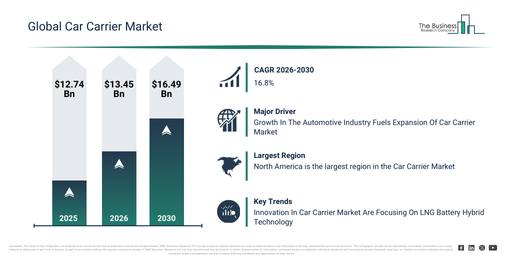
The car carrier market size has grown strongly in recent years. It will grow from $12.74 billion in 2025 to $13.45 billion in 2026 at a compound annual growth rate (CAGR) of 5.6%. The growth in the historic period can be attributed to automotive production growth, dealership network expansion, long-distance vehicle transport demand, steel trailer dominance, logistics outsourcing.
The car carrier market size is expected to see strong growth in the next few years. It will grow to $16.49 billion in 2030 at a compound annual growth rate (CAGR) of 5.2%. The growth in the forecast period can be attributed to electric vehicle logistics growth, aluminum carrier adoption, smart fleet tracking integration, cross-border vehicle trade, demand for enclosed carriers. Major trends in the forecast period include growth of multi-level car carriers, adoption of lightweight materials, expansion of automotive logistics networks, demand for high-capacity transport, focus on vehicle protection.
Get A Free Sample Report With In-Depth Market Insights:
Car Carrier Market Opportunity Drivers: What’s Unlocking New Revenue Potential?
The rising automotive industry is expected to propel the growth of the car carrier market going forward. The automotive industry is the sector that involves the manufacturing, sales, and maintenance of motor vehicles, including cars, trucks, and motorcycles. The rise in the automotive industry is due to several reasons, such as economic growth, environmental benefits, consumer benefits, global competitiveness, and infrastructure development. Automotive manufacturers use car carriers to deliver new cars to dealerships, dealerships to transfer inventory between locations, and individuals or companies to move vehicles over long distances. For instance, in January 2024, according to the Society of Motor Manufacturers and Traders (SMMT), a UK-based trade association, in 2023, total vehicle production in the UK (cars + commercial vehicles) reached about 1,025,474 units, up 17% from the year before. Therefore, the rising automotive industry is driving the growth of the car carrier market.
Car Carrier Market Segmentation: How Does The Market Break Down By Category?
The car carrier market covered in this report is segmented –
1) By Type: Open-Air Car Carrier, Enclosed Car Carrier
2) By Material: Steel, Aluminum, Fiber
3) By Vehicle Type: Passenger Cars, Sports Utility Vehicles (SUVs)
4) By End-User: Automotive OEMs, Vehicle Logistics And Transportation Companies, Dealership Networks And Distribution Centers, Rental And Fleet Operators
Subsegments:
1) By Open-Air Car Carrier: Single-Level Open-Air Car Carrier, Multi-Level Open-Air Car Carrier, Large Capacity Open-Air Car Carrier
2) By Enclosed Car Carrier: Standard Enclosed Car Carrier, Luxury Or High-End Enclosed Car Carrier, Customizable Enclosed Car Carrier
Car Carrier Market Innovation Trends Shaping Future Development
Major companies operating in the car carrier market are focusing on developing advanced alternative propulsion solutions such as photovoltaic (PV)-assisted liquefied natural gas hybrid systems to enhance fuel efficiency, reduce carbon emissions, and improve long-distance operational sustainability in maritime logistics. Photovoltaic (PV)-assisted liquefied natural gas hybrid propulsion integrates solar photovoltaic modules with liquefied natural gas engines to supply auxiliary power, lower reliance on traditional fuels, and optimize energy consumption throughout voyages. For instance, in May 2025, China launched its largest PV+LNG car carrier powered by LONGi Solar technology. The vessel features a high-capacity photovoltaic array that provides clean onboard electricity while the LNG propulsion system significantly cuts greenhouse gas emissions. This innovative dual-energy design supports cost-efficient green shipping, improves vessel endurance, and accelerates the transition toward low-carbon automotive transport by sea.
Car Carrier Market Competitive Overview And Top Companies
Major companies operating in the car carrier market report include Miller Industries Inc., Cottrell Trailer, Kässbohrer Transport Technik GmbH, Boydstun, T and E Auto Haulers, Wally-Mo Inc., Featherlite Trailers, ATC Trailers, Sundowner Trailers, Aluma, Haulmark Trailers, Cargo Mate Trailers, Big Tex Trailers, PJ Trailers, Load Trail LLC, Bravo Trailers, H&H Trailers, Sure-Trac Trailers, Appalachian Trailers, CIMC Vehicles (Group) Co. Ltd.
View The Full Car Carrier Market Report:
Car Carrier Market Top Region: Where Does Most Revenue Come From?
North America was the largest region in the car carrier market in 2025. Asia-Pacific is expected to be the fastest-growing region in the forecast period. The regions covered in the car carrier market report include Asia-Pacific, South East Asia, Western Europe, Eastern Europe, North America, South America, Middle East, Africa.
Reach Out To Our Team:
The Business Research Company: https://www.thebusinessresearchcompany.com/
Americas: +1 310-496-7795
Asia: +44 7882 955267 & +91 8897263534
Europe: +44 7882 955267
Email us at: marketing@tbrc.info
Follow us on:
LinkedIn: https://in.linkedin.com/company/the-business-research-company
YouTube: https://www.youtube.com/channel/UC24_fI0rV8cR5DxlCpgmyFQ
Global Market Model: https://www.thebusinessresearchcompany.com/global-market-model

Wasay has over a decade of experience in market research, data modelling, and analytics, with prior experience at GlobalData and Decision Tree Consulting Services. At The Business Research Company , he leads research operations across syndicated studies, customized consulting engagements, and the Global Market Model platform. His professional experience includes supporting organizations such as Boston Consulting Group, KPMG, and Ernst & Young. Wasay holds a degree in Electronics and Communications Engineering, postgraduate management qualifications from International Management Institute Belgium and Indian School of Business and Entrepreneurship, and completed the Integrated Program in Business Analytics from Indian Institute of Management Indore.