Delivering more actionable and strategically valuable research, The Business Research Company’s 2026 market reports feature market attractiveness analysis, total addressable market evaluation, company benchmarking matrices, interactive Excel dashboards, expanded supply chain intelligence, emerging startup coverage, and detailed product insights.
Milk Powder Market Expected To Reach $61.92 Billion By 2030 At 7.92% CAGR
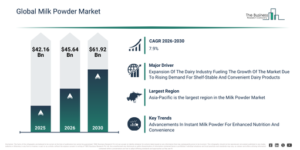
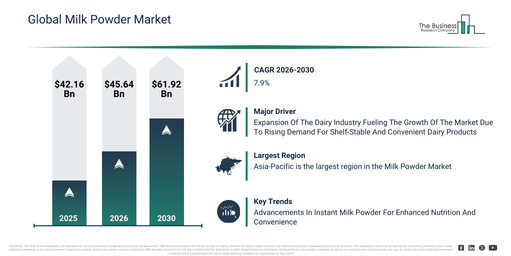
The milk powder market has experienced substantial growth in recent years. It is projected to expand from $42.16 billion in 2025 to $45.64 billion in 2026, achieving a compound annual growth rate (CAGR) of 8.3%. This historical growth can be attributed to several factors: an increasing demand for shelf-stable dairy products in areas with inadequate cold-chain infrastructure, a rise in infant formula consumption driving the need for specialized milk powders, augmented global trade of milk powder due to its transportability and extended shelf life, the expansion of food processing industries where milk powder is a key ingredient, and the growing adoption of non-fat dry milk in bakery and confectionery applications.
The milk powder market is projected to experience substantial expansion over the upcoming years, with its size anticipated to reach $61.92 billion by 2030, exhibiting a compound annual growth rate (CAGR) of 7.9%. This anticipated growth is driven by several factors, including a rising consumer inclination towards organic and lactose-free milk powders, an escalating need for high-protein whey and specialized dairy powders, the enlargement of infant nutrition sectors in developing nations propelling sales of premium milk powder, a surge in the application of milk powders in meal replacement and sports nutrition items, and ongoing advancements in drying techniques that enhance product quality and energy efficiency. Key trends during this period are expected to encompass an escalating demand for infant formula and pediatric nutrition powders, the broader availability of lactose-free and specific dietary milk powders, a developing preference for organic and clean-label varieties, an increased incorporation of milk powders into sports nutrition and functional foods, and a geographical movement towards developing regions for milk powder consumption.
Download A Free Sample Report For Comprehensive Market Insights:
#Milk Powder Market Demand Drivers Creating New Revenue Opportunities
The expansion of the dairy industry is projected to drive the growth of the milk powder market in the coming years. The dairy industry encompasses the agricultural sector dedicated to the production, processing, and distribution of milk and its related products. Its growth is primarily fueled by an increasing global demand for convenient and shelf-stable dairy items, which offer prolonged shelf life, simple storage, and suitability for modern, fast-paced living. Milk powder supports the dairy sector by serving as a shelf-stable, easily transportable substitute for liquid milk, thereby ensuring broader product availability and facilitating global distribution. This also enhances manufacturing flexibility and addresses consumer needs for convenient, long-lasting dairy choices. For instance, in May 2025, according to the National Agricultural Statistics Service (NASS), a US-based government agency, total cheese production reached $1,556.94 billion (£1,225,783 million) in March 2025, marking an increase from $1,534.96 billion (£1,209,415 million) in March 2024. Thus, the ongoing expansion of the dairy industry is a key factor propelling the milk powder market’s growth.
Milk Powder Market Segment Performance And Strategic Opportunities
The milk powder market covered in this report is segmented –
1) By Type: Whole Milk Powder, Skimmed Milk Powder, Dairy Whitener, Buttermilk Powder, Fat Filled Milk Powder, Other Types
2) By Function: Emulsification, Foaming, Flavouring, Thickening
3) By Application: Infant Formula, Confectionery, Sports and Nutrition Foods, Bakery Products, Dry Mixes, Fermented Milk Products, Meat Products, Other Applications
Subsegments:
1) By Whole Milk Powder: Organic Whole Milk Powder, Non-Organic Whole Milk Powder, Instant Whole Milk Powder, Non-Instant Whole Milk Powder
2) By Skimmed Milk Powder: Organic Skimmed Milk Powder, Non-Organic Skimmed Milk Powder, Instant Skimmed Milk Powder, Non-Instant Skimmed Milk Powder
3) By Dairy Whitener: Spray-Dried Dairy Whitener, Roller-Dried Dairy Whitener, Instant Dairy Whitener, Non-Instant Dairy Whitener
4) By Buttermilk Powder: Cultured Buttermilk Powder, Sweet Buttermilk Powder, Instant Buttermilk Powder, Non-Instant Buttermilk Powder
5) By Fat Filled Milk Powder: Vegetable Fat Filled Milk Powder, Animal Fat Filled Milk Powder, Blended Fat Filled Milk Powder, Instant Fat Filled Milk Powder
6) By Other Types: Infant Milk Powder, Lactose-Free Milk Powder, Flavored Milk Powder, Whey-Added Milk Powder
Milk Powder Market Trends Reshaping Industry Growth
Major companies in the milk powder market are concentrating on developing innovative products, such as instant milk powder, to enhance convenience, affordability, and nutritional value. Instant milk powder is a dairy item that dissolves quickly and preserves essential nutrients, making it more soluble than typical milk powders. For instance, in October 2023, Nestlé, a Switzerland-based food and beverage company, launched its Nido Milk & Soya instant powder mix. This product utilizes microencapsulation technology to prevent clumping and dissolve instantly in cold water. It is fortified with vitamins A and D and iron to help combat malnutrition. Nido Milk & Soya is specifically formulated to cater to the nutritional needs of children and families in Central and West Africa. It combines the benefits of milk and plant-based soy, delivering crucial nutrients like protein, iron, and calcium in a convenient instant powder format.
Milk Powder Market Competitive Analysis Of Major Industry Participants
Major companies operating in the milk powder market are Nestlé S.A., Abbott Laboratories, Lactalis Group, Danone S.A., Dairy Farmers of America Inc., Inner Mongolia Yili Industrial Group Co. Ltd., Land O’Lakes Inc., Arla Foods Amba, Fonterra Co-operative Group Limited, China Mengniu Dairy Company Limited, Saputo Inc., Royal FrieslandCampina N.V., Schreiber Foods Inc., Glanbia Public Limited Company, Almarai Company, Morinaga Milk Industry Co. Ltd., Bel Group, Feihe International Inc., Vietnam Dairy Products Joint Stock Company (Vinamilk), Mother Dairy Fruit & Vegetable Pvt. Ltd., Hatsun Agro Product Limited, Parag Milk Foods Limited, Agri-Mark Inc., California Dairies Inc.
Access The Complete Milk Powder Market Report:
Milk Powder Market Geographic Distribution And Regional Opportunities
Asia-Pacific was the largest region in the milk powder market in 2025. The regions covered in the milk powder market report are Asia-Pacific, South East Asia, Western Europe, Eastern Europe, North America, South America, Middle East, Africa.
Access a Customized Milk Powder Market Report for Deeper Competitive Insights
https://www.thebusinessresearchcompany.com/customise?id=25426&type=smp
The Business Research Company: https://www.thebusinessresearchcompany.com/
Americas: +1 310-496-7795
Asia: +44 7882 955267 & +91 8897263534
Europe: +44 7882 955267
Email us at: marketing@tbrc.info
Follow us on:
LinkedIn: https://in.linkedin.com/company/the-business-research-company
YouTube: https://www.youtube.com/channel/UC24_fI0rV8cR5DxlCpgmyFQ
Global Market Model: https://www.thebusinessresearchcompany.com/global-market-model

Wasay has over a decade of experience in market research, data modelling, and analytics, with prior experience at GlobalData and Decision Tree Consulting Services. At The Business Research Company , he leads research operations across syndicated studies, customized consulting engagements, and the Global Market Model platform. His professional experience includes supporting organizations such as Boston Consulting Group, KPMG, and Ernst & Young. Wasay holds a degree in Electronics and Communications Engineering, postgraduate management qualifications from International Management Institute Belgium and Indian School of Business and Entrepreneurship, and completed the Integrated Program in Business Analytics from Indian Institute of Management Indore.