Backed by market attractiveness analysis, total addressable market sizing, company benchmarking matrices, interactive Excel dashboards, wider supply chain intelligence, emerging startup coverage, and detailed product-level insights, The Business Research Company’s 2026 market reports are designed to offer research that is more actionable and strategically valuable than ever.
Electric Vehicle Lightweight Materials Market Size And Revenue Outlook Through 2030
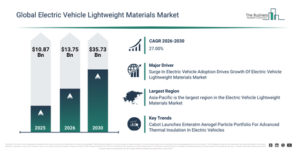
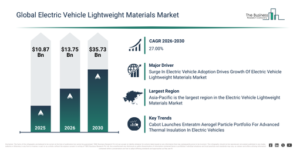
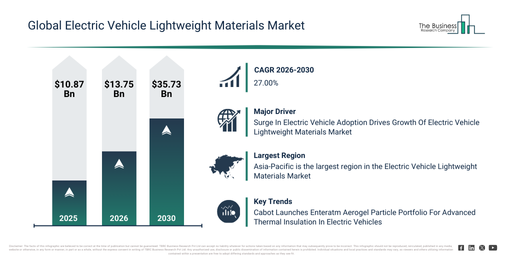
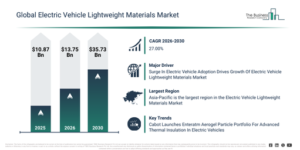
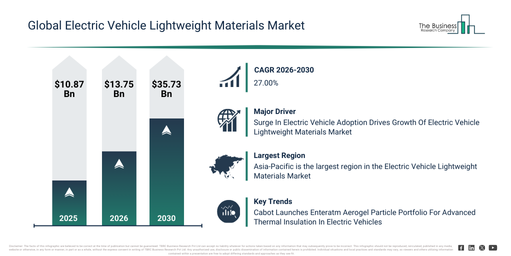
The electric vehicle lightweight materials market size has grown exponentially in recent years. It will grow from $10.87 billion in 2025 to $13.75 billion in 2026 at a compound annual growth rate (CAGR) of 26.5%. The growth in the historic period can be attributed to ev adoption growth, fuel efficiency improvement needs, regulatory emission norms, advancements in alloy processing, early adoption of lightweight metals.
The electric vehicle lightweight materials market size is expected to see exponential growth in the next few years. It will grow to $35.73 billion in 2030 at a compound annual growth rate (CAGR) of 27.0%. The growth in the forecast period can be attributed to range extension requirements, cost reduction in ev platforms, innovation in multi-material design, scalable lightweight manufacturing, sustainability targets. Major trends in the forecast period include increasing use of aluminum and magnesium alloys, growing adoption of composite materials, focus on vehicle weight reduction, integration of lightweight materials in battery systems, demand for structural optimization.
Get A Free Sample Report With In-Depth Market Insights:
Electric Vehicle Lightweight Materials Market Industry Drivers: What’s Behind The Revenue Growth?
The rise in the adoption of electric vehicles (EVs) is expected to boost the growth of the electric vehicle lightweight materials market going forward. An electric vehicle refers to one that can be propelled by an electric motor that gets power from a battery and can be recharged from an external source. The next generation of electric vehicles may be largely dependent on lightweight materials. Electric vehicles’ weight can be significantly decreased by using composite materials made of fiber-reinforced plastic polymers, which also improve their performance, longevity, and range. For instance, in March 2024, according to International Electric agency, a France-based intergovernmental organisation, in 2023, around 14 million electric cars were registered globally, marking a 35% increase over the 10.5 million registered in 2022. Electric vehicles (EVs) made up 18% of total car sales in 2023, up from 14% in 2022. This growth demonstrates strong momentum in the EV market, with weekly registrations in 2023 exceeding 250,000. Battery electric vehicles accounted for 70% of the total electric car stock in 2023. Therefore, the rise in the adoption of electric vehicles (EVs) is driving the growth of the electric vehicle lightweight materials market.
Electric Vehicle Lightweight Materials Market Segmentation: How Does The Market Break Down By Category?
The electric vehicle lightweight materials market covered in this report is segmented –
1) By Material Type: Metals And Alloys, Composites, Plastics, Elastomers
2) By Vehicle Type: Passenger Cars (Hatchbacks And Sedans), Utility Vehicles (SUVs, MPVs, Compact SUVs), Light Commercial Vehicles, Medium And Heavy-duty Vehicles, Buses And Coaches
3) By Application: Battery Packs, Electric Traction Motors, Electronic Components, Power Electronic Controllers, Body-In-White, Chassis And Suspension, Transmissions, Doors, Interiors, Other Applications
Subsegments:
1) By Metals And Alloys: Aluminum Alloys, Magnesium Alloys, High-Strength Steel
2) By Composites: Carbon Fiber Reinforced Polymers (CFRP), Glass Fiber Reinforced Polymers (GFRP), Natural Fiber Composites
3) By Plastics: Polypropylene (PP), Polycarbonate (PC), Acrylonitrile Butadiene Styrene (ABS)
4) By Elastomers: Thermoplastic Elastomers (TPE), Silicone Rubber, Natural Rubber
#Electric Vehicle Lightweight Materials Market Growth Trends: What’s Shaping The Future Outlook?
Major companies operating in the electric vehicle lightweight materials market are focusing on product developments, such as advanced thermal insulation additives, to sustain their position in the market. Advanced thermal insulation additives refer to materials or substances that, when added to a system or structure, enhance its ability to resist the transfer of heat. For instance, in May 2023, Cabot Corporation, a US-based specialty chemicals and performance materials company, unveiled its latest product innovation, the ENTERATM aerogel particle portfolio. This launch represents a strategic move by Cabot into the realm of electric vehicle (EV) technology, as the ENTERA aerogel particles serve as advanced thermal insulation additives. this is Specifically designed for the development of ultra-thin thermal barriers in EV lithium-ion batteries, these innovative aerogel products empower formulators with versatile options. Cabot’s portfolio includes three distinct ENTERA aerogel products that can be seamlessly incorporated into various thermal barrier forms such as blankets, pads, sheets, films, foams, and coatings. This strategic introduction aligns with the automotive industry’s ongoing pursuit of enhancing thermal management systems for EV batteries, aiming to optimize energy efficiency and extend the range of electric vehicles.
Electric Vehicle Lightweight Materials Market Competitive Overview And Top Companies
Major companies operating in the electric vehicle lightweight materials market report include Covestro AG, Toray Industries Inc., Saudi Basic Industries Corp., Solvay SA, Celanese Corporation, Novelis Inc, LyondellBasell Industries Holdings B.V., Constellium SE, SGL Carbon SE, ThyssenKrupp AG, Teijin Limited, Evonik Industries AG, Lanxess AG, Alcoa Corporation, ArcelorMittal, Hindalco Industries Limited, Norsk Hydro ASA, UACJ Corporation, Kobe Steel Ltd., AMG Advanced Metallurgical Group N.V., Materion Corporation, Mitsubishi Chemical Corporation, Sumitomo Bakelite Co. Ltd., Huntsman Corporation
View The Full Electric Vehicle Lightweight Materials Market Report:
Electric Vehicle Lightweight Materials Market Top Region By Revenue And Market Share
Asia-Pacific was the largest region in the electric vehicle lightweight materials market in 2025, and is expected to be the fastest-growing region in the electric vehicle lightweight materials market during the forecast period. The regions covered in the electric vehicle lightweight materials market report include Asia-Pacific, South East Asia, Western Europe, Eastern Europe, North America, South America, Middle East, Africa.
Reach Out To Our Team:
The Business Research Company: https://www.thebusinessresearchcompany.com/
Americas: +1 310-496-7795
Asia: +44 7882 955267 & +91 8897263534
Europe: +44 7882 955267
Email us at: marketing@tbrc.info
Follow us on:
LinkedIn: https://in.linkedin.com/company/the-business-research-company
YouTube: https://www.youtube.com/channel/UC24_fI0rV8cR5DxlCpgmyFQ
Global Market Model: https://www.thebusinessresearchcompany.com/global-market-model

Wasay has over a decade of experience in market research, data modelling, and analytics, with prior experience at GlobalData and Decision Tree Consulting Services. At The Business Research Company , he leads research operations across syndicated studies, customized consulting engagements, and the Global Market Model platform. His professional experience includes supporting organizations such as Boston Consulting Group, KPMG, and Ernst & Young. Wasay holds a degree in Electronics and Communications Engineering, postgraduate management qualifications from International Management Institute Belgium and Indian School of Business and Entrepreneurship, and completed the Integrated Program in Business Analytics from Indian Institute of Management Indore.