Backed by market attractiveness analysis, total addressable market sizing, company benchmarking matrices, interactive Excel dashboards, wider supply chain intelligence, emerging startup coverage, and detailed product-level insights, The Business Research Company’s 2026 market reports are designed to offer research that is more actionable and strategically valuable than ever.
Electric Vehicle Polymers Market Revenue Growth On Track For A 55.3% CAGR Through 2030
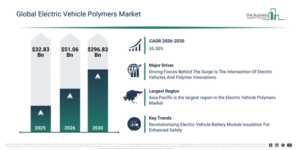
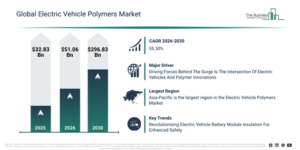
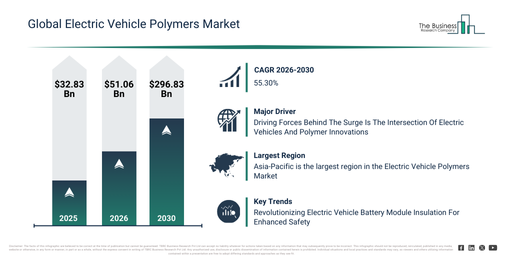
The electric vehicle polymers market size has grown exponentially in recent years. It will grow from $32.83 billion in 2025 to $51.06 billion in 2026 at a compound annual growth rate (CAGR) of 55.5%. The growth in the historic period can be attributed to ev lightweighting trends, polymer performance improvements, cost reduction needs, replacement of metals, component integration benefits.
The electric vehicle polymers market size is expected to see exponential growth in the next few years. It will grow to $296.83 billion in 2030 at a compound annual growth rate (CAGR) of 55.3%. The growth in the forecast period can be attributed to advanced polymer formulations, recyclability mandates, higher temperature resistance demand, scalable ev platforms, material innovation. Major trends in the forecast period include increasing adoption of engineering polymers, growth of elastomer applications in evs, demand for structural polymer components, integration of polymers in powertrain systems, focus on weight and range optimization.
Get A Free Sample Report With In-Depth Market Insights:
Electric Vehicle Polymers Market Growth Momentum: What Factors Are Shaping Demand?
The increasing demand for electric vehicles is expected to propel the growth of the electric vehicle polymers market going forward. An electric vehicle is a vehicle that runs on one or more electric motors that draw electricity from an external power source. Polymers are used in electric vehicles to reduce weight, boost efficiency, durability, and design flexibility. For instance, in January 2024, according to the U.S. Energy information administration, a US-based organization, in 2023, sales of hybrid vehicles, plug-in hybrid electric vehicles, and battery electric vehicles (BEVS) combined to make up 16.3% of total new light-duty vehicle (LDV) sales in the US. Therefore, the increasing demand for electric vehicles is driving the growth of the electric vehicle polymers market.
Electric Vehicle Polymers Market Segments: Where Is Growth Concentrated?
The electric vehicle polymers market covered in this report is segmented –
1) By Type: Engineering Plastics, Elastomers
2) By Component: Powertrain System, Exterior, Interior
3) By End User: Battery Electric Vehicles (BEVs), Plug-In Hybrid Electric Vehicles (PHEVs), Hybrid Electric Vehicles (HEVs), Fuel Cell Electric Vehicles (FCEVs)
Subsegments:
1) By Engineering Plastics: Polycarbonate (PC), Polyamide (PA), Polyethylene Terephthalate (PET), Polypropylene (PP), Acrylonitrile Butadiene Styrene (ABS)
2) By Elastomers: Thermoplastic Elastomers (TPE), Ethylene Propylene Diene Monomer (EPDM), Silicone Elastomers, Natural Rubber
Electric Vehicle Polymers Market Trends Redefining Industry Growth
Major companies operating in the electric vehicle polymers market are focusing on developing innovative products such as high-heat and flame-resistant polymers to enhance battery safety and thermal performance. High-heat and flame-resistant polymers are materials designed to withstand very high temperatures without melting or catching fire, helping to protect electric vehicle battery components, prevent thermal runaway, and improve overall safety. For instance, in March 2023, Solvay, a Belgium-based chemical company, launched Xydar LCP G-330 HH, a new polymer for high-heat electric vehicle battery module insulation. A new liquid crystal polymer grade, Xydar LCP G-330 HH, will boost passenger safety during a battery thermal runaway. It is a brand-new high-heat and flame-resistant grade explicitly designed for the battery module plates of electric vehicle models running on higher voltage systems. It fulfills demanding thermal and insulation requirements. It is an injection-molded glass-filled LCP that can maintain its electrical insulation after being exposed to 400°C for 30 minutes. Without the addition of halogen or bromine additives, Xydar LCP is a naturally flame-resistant polymer.
Electric Vehicle Polymers Market Key Participants And Competitive Landscape
Major companies operating in the electric vehicle polymers market report include BASF SE, Saudi Basic Industries Corporation, LG Chemical Ltd., Sumitomo Chemical Co Ltd., Toray Industries Inc., Evonik Industries AG, Covestro AG, Shin-Etsu Chemical Co Ltd., Asahi Kasei Corporation, Solvay S.A., Mitsui Chemicals Inc., DuPont de Nemours Inc., Arkema SA, Celanese Corporation, Koninklijke DSM NV, Lanxess AG, Tosoh Corporation, DIC Corporation, Teijin Limited, Kumho Petrochemical Co Ltd., Ube Industries Ltd., Zeon Corporation, JSR Corporation, Kuraray Co Ltd., Sumitomo Bakelite Co Ltd., Mitsubishi Engineering-Plastics Corporation, Polyplastics Co Ltd.
View The Full Electric Vehicle Polymers Market Report:
Electric Vehicle Polymers Market Largest Region: Which Geography Holds The Biggest Share?
Asia-Pacific was the largest region in the electric vehicle polymers market in 2025. The regions covered in the electric vehicle polymers market report include Asia-Pacific, South East Asia, Western Europe, Eastern Europe, North America, South America, Middle East, Africa.
Reach Out To Our Team:
The Business Research Company: https://www.thebusinessresearchcompany.com/
Americas: +1 310-496-7795
Asia: +44 7882 955267 & +91 8897263534
Europe: +44 7882 955267
Email us at: marketing@tbrc.info
Follow us on:
LinkedIn: https://in.linkedin.com/company/the-business-research-company
YouTube: https://www.youtube.com/channel/UC24_fI0rV8cR5DxlCpgmyFQ
Global Market Model: https://www.thebusinessresearchcompany.com/global-market-model

Wasay has over a decade of experience in market research, data modelling, and analytics, with prior experience at GlobalData and Decision Tree Consulting Services. At The Business Research Company , he leads research operations across syndicated studies, customized consulting engagements, and the Global Market Model platform. His professional experience includes supporting organizations such as Boston Consulting Group, KPMG, and Ernst & Young. Wasay holds a degree in Electronics and Communications Engineering, postgraduate management qualifications from International Management Institute Belgium and Indian School of Business and Entrepreneurship, and completed the Integrated Program in Business Analytics from Indian Institute of Management Indore.