Featuring market attractiveness scoring, total addressable market sizing, company benchmarking matrices, interactive Excel dashboards, deeper supply chain intelligence, emerging startup tracking, and granular product-level insights, The Business Research Company’s 2026 market reports are built to deliver research that is both more actionable and more strategically valuable.
Eco-Friendly Automotive Paint Market Revenue Outlook: What CAGR Lies Ahead Through 2030?
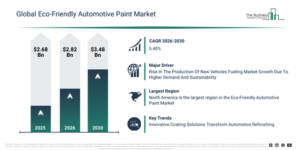
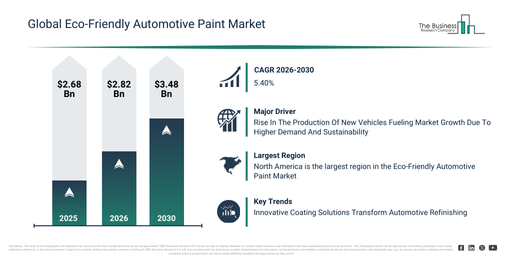
The eco-friendly automotive paint market size has grown strongly in recent years. It will grow from $2.68 billion in 2025 to $2.82 billion in 2026 at a compound annual growth rate (CAGR) of 5.5%. The growth in the historic period can be attributed to environmental regulations, automotive production growth, solvent reduction initiatives, coating technology advancements, refinish market expansion.
The eco-friendly automotive paint market size is expected to see strong growth in the next few years. It will grow to $3.48 billion in 2030 at a compound annual growth rate (CAGR) of 5.4%. The growth in the forecast period can be attributed to stricter emission norms, electric vehicle production growth, sustainable manufacturing adoption, bio-based resin innovation, circular coating solutions. Major trends in the forecast period include shift toward waterborne coatings, rising adoption of low-voc paints, growth in oem sustainable painting, expansion of automotive refinish demand, focus on regulatory compliance.
Get A Free Sample Report With In-Depth Market Insights:
Eco-Friendly Automotive Paint Market Growth Factors Behind Sustained Expansion
The rise in the production of new vehicles is expected to propel the growth of the eco-friendly automotive paint market going forward. The rise in production of new vehicles is increasing as automakers expand manufacturing capacity to meet rising demand, improve efficiency, and integrate advanced technologies for better performance and sustainability. Eco-friendly automotive paint enhances vehicle production by reducing harmful emissions, making it compliant with environmental regulations. It improves manufacturing efficiency with faster drying times and durable coatings, supporting sustainable automotive development. For instance, in March 2025, according to the European Automobile Manufacturers’ Association, a Belgium-based vehicle industry association, global car sales in 2024 totaled 74.6 million units, reflecting a 2.5% rise compared to 2023. Therefore, the rise in the production of new vehicles is driving the growth of the eco-friendly automotive paint market.
Eco-Friendly Automotive Paint Market Segment Trends And Revenue Contributors
The eco-friendly automotive paint market covered in this report is segmented –
1) By Resin Type: Acrylic, Epoxy, Polyurethane
2) By Application Method: Dip Coatings, Spray Coatings
3) By End-Use Industry: Automotive Original Equipment Manufacture (OEM), Automotive Refinish
Subsegments:
1) By Acrylic: Waterborne Acrylic, UV-Cured Acrylic
2) By Epoxy: Waterborne Epoxy, Powder Coating Epoxy
3) By Polyurethane: Waterborne Polyurethane, High-Solid Polyurethane
Eco-Friendly Automotive Paint Market Industry Trends Fueling Future Revenue Growth
Major companies operating in the eco-friendly automotive paint market are focusing on developing innovative offerings through paint repair service brands, to sustain their position in the market. Paint repair services in eco-friendly automotive paint help reduce waste and emissions by using sustainable materials and low-VOC formulations. For instance, in April 2024, Nippon Paint Holdings Co. Ltd., a Japan-based manufacturer of paint and coating products, introduced Mastercraft, a consumer-focused automotive body and paint repair service brand in India. Mastercraft integrates sustainability into its operations by utilizing eco-friendly materials, energy-efficient systems, and advanced technologies. Recognized as the world’s first carbon-neutral body shop, it sets a new benchmark for Environmental, Social, and Governance (ESG) leadership in the automotive refinish industry. This initiative aims to deliver high-performance automotive body and paint repair services while maintaining a strong commitment to environmental responsibility.
Eco-Friendly Automotive Paint Market Competitive Landscape: Which Companies Lead The Industry?
Major companies operating in the eco-friendly automotive paint market report include Toyota Motor Corporation, Bayerische Motoren Werke GmbH, BASF SE, Nissan Motor Co. Ltd., 3M Company, Sherwin-Williams Company, Pittsburgh Plate Glass Company, Solvay S.A., Akzo Nobel N.V., Nippon Paint Holdings Co. Ltd, Kumkang Korea Chemicals Co. Ltd., Axalta Coating Systems Ltd., Dürr Group, Kansai Paint, Valspar Corporation, Jotun, PPG Asian Paints Pvt Ltd, Tikkurilan Väritehtaat Oy, Sybon, The Eastwood Company.
View The Full Eco-Friendly Automotive Paint Market Report:
Eco-Friendly Automotive Paint Market Geographic Landscape: Which Region Leads Industry Growth?
North America was the largest region in the eco-friendly automotive paint market in 2025. The regions covered in the eco-friendly automotive paint market report include Asia-Pacific, South East Asia, Western Europe, Eastern Europe, North America, South America, Middle East, Africa.
Reach Out To Our Team:
The Business Research Company: https://www.thebusinessresearchcompany.com/
Americas: +1 310-496-7795
Asia: +44 7882 955267 & +91 8897263534
Europe: +44 7882 955267
Email us at: marketing@tbrc.info
Follow us on:
LinkedIn: https://in.linkedin.com/company/the-business-research-company
YouTube: https://www.youtube.com/channel/UC24_fI0rV8cR5DxlCpgmyFQ
Global Market Model: https://www.thebusinessresearchcompany.com/global-market-model

Wasay has over a decade of experience in market research, data modelling, and analytics, with prior experience at GlobalData and Decision Tree Consulting Services. At The Business Research Company , he leads research operations across syndicated studies, customized consulting engagements, and the Global Market Model platform. His professional experience includes supporting organizations such as Boston Consulting Group, KPMG, and Ernst & Young. Wasay holds a degree in Electronics and Communications Engineering, postgraduate management qualifications from International Management Institute Belgium and Indian School of Business and Entrepreneurship, and completed the Integrated Program in Business Analytics from Indian Institute of Management Indore.