Built to provide research that’s more actionable and strategically valuable, The Business Research Company’s 2026 market reports include market attractiveness analysis, total addressable market sizing, company benchmarking matrices, interactive Excel dashboards, broader supply chain intelligence, emerging startup tracking, and in-depth product insights.
Electric Commercial Vehicles Market Value Growth And Long-Term Outlook
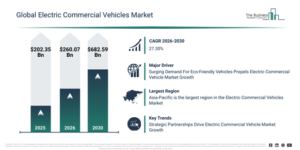
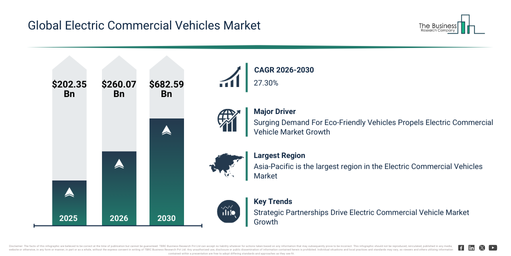
The electric commercial vehicles market size has grown exponentially in recent years. It will grow from $202.35 billion in 2025 to $260.07 billion in 2026 at a compound annual growth rate (CAGR) of 28.5%. The growth in the historic period can be attributed to emission regulations for fleets, fuel cost volatility, pilot electric fleet deployments, urban delivery demand, government subsidies.
The electric commercial vehicles market size is expected to see exponential growth in the next few years. It will grow to $682.59 billion in 2030 at a compound annual growth rate (CAGR) of 27.3%. The growth in the forecast period can be attributed to zero-emission fleet mandates, hydrogen fuel adoption, smart fleet optimization, battery cost reductions, large-scale fleet electrification. Major trends in the forecast period include rapid electrification of commercial fleets, expansion of charging infrastructure for logistics, growth of electric delivery vehicles, adoption of fleet telematics, integration of alternative fuel technologies.
Get A Free Sample Report With In-Depth Market Insights:
Electric Commercial Vehicles Market Opportunity Drivers: What’s Unlocking New Revenue Potential?
Increasing demand for eco-friendly vehicles is expected to propel the growth of the electric commercial vehicle market going forward. Eco-friendly vehicles refer to vehicles designed to have a reduced negative impact on the environment compared to traditional internal combustion engine vehicles. These vehicles include electric vehicles, hybrid vehicles, hydrogen vehicles, and natural gas vehicles. For instance, in 2024, according to the International Energy Agency is a France-based autonomous intergovernmental organization, electric vehicle sales in 2023 rose by 3.5 million units compared to 2022, marking a 35% year-on-year growth. Therefore, the increasing demand for eco-friendly vehicles is driving the growth of the electric commercial vehicle market.
Electric Commercial Vehicles Market Segment Analysis And Revenue Potential
The electric commercial vehicles market covered in this report is segmented –
1) By Propulsion Type: BEV, PHEV, FCEV.
2) By Vehicle Type: Electric Bus, Electric Truck, Electric Van, Other Vehicle Types
3) By Battery Type: Lithium-Iron-Phosphate (LFP), Lithium-Nickel-Manganese-Cobalt Oxide (NMC), Other Battery Types
Subsegments:
1) By BEV (Battery Electric Vehicle): Light Duty BEVs, Medium Duty BEVs, Heavy Duty BEVs
2) By PHEV (Plug-in Hybrid Electric Vehicle): Light Duty PHEVs, Medium Duty PHEVs, Heavy Duty PHEVs
3) By FCEV (Fuel Cell Electric Vehicle): Light Duty FCEVs, Medium Duty FCEVs, Heavy Duty FCEVs
Electric Commercial Vehicles Market Innovation Trends Shaping Future Development
Major companies operating in the electric commercial vehicles market are implementing strategic partnerships for the production of electric commercial vehicles. Strategic partnerships in electric commercial vehicles involve the sharing of resources and expertise that enhance the product and multiply the results. It attracts popularity from consumers and other stakeholders, helping to increase the investment while reducing costs. For instance, in July 2024, Uber Technologies Inc., a US-based transportation company, partnered with BYD Co. Ltd., a China-based electronic and automobile company. This partnership seeks to integrate 100,000 new BYD electric vehicles into the Uber platform across major global markets. It is expected that drivers will enjoy competitive pricing and financing options for BYD vehicles through Uber, with plans to expand this initiative to regions including the Middle East, Canada, Australia, and New Zealand.
Electric Commercial Vehicles Market Key Players Shaping Industry Direction
Major companies operating in the electric commercial vehicles market report include BYD Company Ltd., Zhengzhou Yutong Bus Co. Ltd, Daimler AG, Proterra, VDL Groep BV, Irizar, ZHONGTONGBUS Bus Holding Co., Ltd, Ebusco B.V., Navistar, Inc., Workhorse Group Incorporated, Mahindra Electric, Tata Motors, Ashok Leyland, SAIC Motor, Dongfeng Motor, FAW Group, BAIC Motor, Volkswagen, Renault, Mercedes Benz Motors, MAN Germany, DAF Trucks, Via Motors, Tesla Inc, Hyliion, Ford, General Motors, Bozankaya, Melex Electrovehicles, Jet Motors, El Nasr Automotive Manufacturing Company
View The Full Electric Commercial Vehicles Market Report:
Electric Commercial Vehicles Market Geographic Spread And Regional Opportunities
Asia-Pacific was the largest region in the electric commercial vehicles market in 2025. North America was the second largest region in the global electric commercial vehicles market share. The regions covered in the electric commercial vehicles market report include Asia-Pacific, South East Asia, Western Europe, Eastern Europe, North America, South America, Middle East, Africa.
Reach Out To Our Team:
The Business Research Company: https://www.thebusinessresearchcompany.com/
Americas: +1 310-496-7795
Asia: +44 7882 955267 & +91 8897263534
Europe: +44 7882 955267
Email us at: marketing@tbrc.info
Follow us on:
LinkedIn: https://in.linkedin.com/company/the-business-research-company
YouTube: https://www.youtube.com/channel/UC24_fI0rV8cR5DxlCpgmyFQ
Global Market Model: https://www.thebusinessresearchcompany.com/global-market-model

Wasay has over a decade of experience in market research, data modelling, and analytics, with prior experience at GlobalData and Decision Tree Consulting Services. At The Business Research Company , he leads research operations across syndicated studies, customized consulting engagements, and the Global Market Model platform. His professional experience includes supporting organizations such as Boston Consulting Group, KPMG, and Ernst & Young. Wasay holds a degree in Electronics and Communications Engineering, postgraduate management qualifications from International Management Institute Belgium and Indian School of Business and Entrepreneurship, and completed the Integrated Program in Business Analytics from Indian Institute of Management Indore.