Built to provide research that’s more actionable and strategically valuable, The Business Research Company’s 2026 market reports include market attractiveness analysis, total addressable market sizing, company benchmarking matrices, interactive Excel dashboards, broader supply chain intelligence, emerging startup tracking, and in-depth product insights.
Electric Light Commercial Vehicle Market Size Outlook: How Quickly Will Revenue Expand Through 2030?
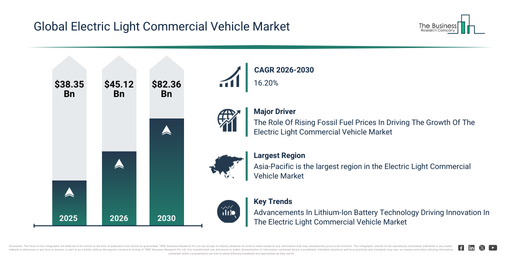
The electric light commercial vehicle market size has grown rapidly in recent years. It will grow from $38.35 billion in 2025 to $45.12 billion in 2026 at a compound annual growth rate (CAGR) of 17.7%. The growth in the historic period can be attributed to urban logistics growth, fuel cost volatility, demand for light commercial transport, pilot electric fleets, emission regulations.
The electric light commercial vehicle market size is expected to see rapid growth in the next few years. It will grow to $82.36 billion in 2030 at a compound annual growth rate (CAGR) of 16.2%. The growth in the forecast period can be attributed to decarbonization mandates, charging infrastructure expansion, battery cost decline, smart fleet management adoption, government incentives. Major trends in the forecast period include shift toward urban electric delivery fleets, growth of e-commerce logistics, adoption of fleet telematics, expansion of electric vans, demand for low operating cost vehicles.
Get A Free Sample Report With In-Depth Market Insights:
Electric Light Commercial Vehicle Market Demand Drivers: What’s Powering Industry Growth?
The rising fossil fuel prices are expected to propel the growth of the electric light commercial vehicle market going forward. Fossil fuel is a hydrocarbon-containing material of biological origin used as an energy source. The rising fossil fuel prices are due to fluctuations in global oil supply and demand, increasing production costs due to advanced extraction methods, and market speculation. Electric light commercial vehicles offer a compelling alternative to traditional fossil fuel-powered vehicles, providing cost savings, environmental benefits, and operational efficiency, which are particularly advantageous during periods of high fossil fuel prices. For instance, in September 2024, according to the U.S. Energy Information Administration, a US-based federal agency, in 2023, the national average annual price for midgrade gasoline was approximately 52 cents per gallon higher than regular gasoline, while premium gasoline averaged about 85 cents per gallon more than regular. Therefore, the rising fossil fuel prices are driving the growth of the electric light commercial vehicle market.
Electric Light Commercial Vehicle Market Segmentation: How Does The Market Break Down By Category?
The electric light commercial vehicle market covered in this report is segmented –
1) By Vehicle: Light-Duty Trucks, Vans, Pickup Trucks
2) By Gross Vehicle Weight (GVW): Below 6,000 lbs, 6,001 lbs- 10,000 lbs, 10,001 lbs – 14,000 lbs
3) By Application: Commercial, Industrial
Subsegments:
1) By Light-Duty Trucks: Electric Delivery Trucks, Electric Cargo Trucks, Electric Refrigerated Trucks
2) By Vans: Electric Cargo Vans, Electric Passenger Vans, Electric Delivery Vans
3) By Pickup Trucks: Electric Utility Pickup Trucks, Electric Light-Duty Pickup Trucks
Electric Light Commercial Vehicle Market Innovation Trends: What Developments Are Reshaping The Industry?
Major companies operating in the electric light commercial vehicle market are developing vehicles with lithium-ion battery packs to enhance performance, range, and durability. The lithium-ion battery pack offers several advantages over traditional lead-acid batteries, including higher energy density, faster charging times, and longer lifespan. For instance, in April 2024, Switch Mobility, a UK-based bus manufacturer, launched an IeV 4 electric light commercial vehicle powered by a 32.2 kWh lithium-ion battery pack. The IeV 4 is designed for various applications such as cargo transportation, container handling, waste collection, and refrigerated vans and is expected to produce approximately 3,000 units annually. The vehicle is tailored for urban transport, with a certified lifting capacity of 4000 kg (8800 lbs). It’s well-suited for smaller garages and tire centers, offering a lifting range from 230 mm to 1900 mm (9 to 75 in). You can find it for purchase on the Snap-on website and various other online platforms.
Electric Light Commercial Vehicle Market Competitive Overview And Top Companies
Major companies operating in the electric light commercial vehicle market report include Volkswagen Group, Toyota Motor Corporation, Mercedes-Benz Group AG, Ford Motor Company, General Motors, Hyundai Motor Company, Nissan Motor Corporation, BYD Company Ltd., Nikola Corporation, AB Volvo, Traton SE, Paccar Inc., Iveco S.p.A., Navistar International Corporation, Ashok Leyland, DAF Trucks, Rivian Automotive Inc., Proterra, Orange EV, Quantron AG, Alkè, London EV Company Limited
View The Full Electric Light Commercial Vehicle Market Report:
Electric Light Commercial Vehicle Market Regional Split: Which Areas Are Fueling Growth?
Asia-Pacific was the largest region in the electric light commercial vehicle market in 2025. North America is expected to be the fastest-growing region in the forecast period. The regions covered in the electric light commercial vehicle market report include Asia-Pacific, South East Asia, Western Europe, Eastern Europe, North America, South America, Middle East, Africa.
Reach Out To Our Team:
The Business Research Company: https://www.thebusinessresearchcompany.com/
Americas: +1 310-496-7795
Asia: +44 7882 955267 & +91 8897263534
Europe: +44 7882 955267
Email us at: marketing@tbrc.info
Follow us on:
LinkedIn: https://in.linkedin.com/company/the-business-research-company
YouTube: https://www.youtube.com/channel/UC24_fI0rV8cR5DxlCpgmyFQ
Global Market Model: https://www.thebusinessresearchcompany.com/global-market-model

Wasay has over a decade of experience in market research, data modelling, and analytics, with prior experience at GlobalData and Decision Tree Consulting Services. At The Business Research Company , he leads research operations across syndicated studies, customized consulting engagements, and the Global Market Model platform. His professional experience includes supporting organizations such as Boston Consulting Group, KPMG, and Ernst & Young. Wasay holds a degree in Electronics and Communications Engineering, postgraduate management qualifications from International Management Institute Belgium and Indian School of Business and Entrepreneurship, and completed the Integrated Program in Business Analytics from Indian Institute of Management Indore.