Through market attractiveness analysis, total addressable market evaluation, company benchmarking matrices, interactive Excel dashboards, expanded supply chain intelligence, emerging startup coverage, and detailed product insights, The Business Research Company’s 2026 market reports provide more actionable and strategically valuable research.
Orbital Waste Disposal Market Value Analysis: What Growth Is Expected Over The Forecast Period?
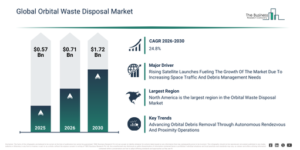
The orbital waste disposal market has experienced substantial growth in recent years. Its value is projected to expand from $0.57 billion in 2025 to $0.71 billion in 2026, at a compound annual growth rate (CAGR) of 24.6%. The historical surge in this market can be attributed to several factors: the increasing accumulation of legacy space debris which has heightened the demand for mitigation solutions; early government initiatives focused on monitoring and tracking orbital debris; the proliferation of satellite launches leading to greater awareness of collision risks; the initial development of active debris removal prototypes by public agencies; and regulatory requirements for end-of-life satellite deorbiting compliance.
The orbital waste disposal market is anticipated to undergo substantial expansion in the upcoming years, projected to reach $1.72 billion by 2030, demonstrating a compound annual growth rate (CAGR) of 24.8%. This projected increase is attributed to the expansion of commercial active debris removal services, driven by escalating orbital congestion, increasing adoption of autonomous detection and tracking technologies, the growth of mega-constellations necessitating continuous debris-removal operations, strengthening international regulations for mandatory deorbiting and disposal protocols, and rising investment in multi-mission spacecraft capable of debris capture and controlled deorbiting. Key trends during this period include a rising demand for active debris removal missions, increased deployment of end-of-life satellite deorbiting solutions, a growing focus on orbital sustainability regulations, the expansion of commercial debris mitigation services, and rising investment in multi-mission disposal platforms.
Download A Free Sample Report For Comprehensive Market Insights:
Orbital Waste Disposal Market Expansion Supported By Key Demand Factors
The escalating number of satellite launches is projected to stimulate the expansion of the orbital waste disposal market in the future. A satellite is a human-made apparatus that orbits a planet, supporting various communication, observation, or research endeavors. The increase in satellite launches stems from a growing global demand for connectivity and data services, propelled by requirements for quicker internet access, more robust communication networks, and the proliferation of remote sensing and Earth observation technologies. Within orbital waste disposal, satellites are utilized for tracking space debris and deploying solutions to capture, redirect, or deorbit defunct items. For instance, in April 2024, Slingshot Aerospace, a US-based software company, noted around 9,241 active satellites in orbit in 2023, up from 6,718 at the end of 2022. Thus, the increasing pace of satellite launches is a key factor driving the growth of the orbital waste disposal market.
Orbital Waste Disposal Market Segmentation And Category Breakdown
The orbital waste disposal market covered in this report is segmented –
1) By Service Type: Debris Removal, Satellite Deorbiting, Spacecraft Disposal
2) By Technology: Robotic Systems, Laser Systems, Tether Systems, Other Technologies
3) By End-User: Government, Commercial, Defense, Others End-Users
Subsegments:
1) By Debris Removal: Robotic Arm Systems, Harpoon-based Systems, Net-based Systems, Laser Ablation Systems
2) By Satellite Deorbiting: Controlled Re-entry Systems, Uncontrolled Re-entry Systems, Propulsion-based Systems, Tether-based Deorbiting
3) By Spacecraft Disposal: In-orbit Recycling, Controlled Burn-up Re-entry, Deep Space Disposal, Graveyard Orbit Relocation
Orbital Waste Disposal Market Industry Trends Shaping Future Revenue Growth
Major companies operating within the orbital waste disposal sector are focusing on technological advancements, particularly rendezvous and proximity operations (RPO), to facilitate precise debris identification, enhance safe removal capacities, and support the long-term sustainability of satellite operations and orbital environments. Rendezvous and proximity operations (RPO) involve a series of maneuvers and activities carried out by spacecraft to approach, operate in close proximity to, and at times, interact with other objects in space. As an illustration, in February 2024, Astroscale Holdings Inc., a Japan-based space technology company, initiated its Active Debris Removal by Astroscale-Japan (ADRAS-J) mission. This groundbreaking demonstration is specifically engineered to approach, scrutinize, and characterize large orbital debris, thereby contributing to future debris removal efforts and orbital sustainability programs. This advanced orbital waste disposal system is equipped with autonomous navigation, precise debris characterization, and real-time situational awareness, enabling it to safely identify, assess, and support the elimination of dangerous space debris to ensure a sustainable orbital environment. The Active Debris Removal by Astroscale-Japan (ADRAS-J) mission is remarkably versatile, permitting the secure inspection and evaluation of various categories of space debris by utilizing sophisticated autonomous navigation and imaging technologies for improved orbital sustainability.
Orbital Waste Disposal Market Leading Companies: Who Holds Significant Market Presence?
Major companies operating in the orbital waste disposal market are Lockheed Martin Corporation, Airbus SE, Northrop Grumman Corporation, Thales Group, Maxar Technologies, MDA Ltd., Rocket Lab USA Inc., Electro Optic Systems Holdings Limited, Electro Optic Systems Holdings Limited, Astroscale Holdings Inc., Surrey Satellite Technology Limited, ClearSpace SA, D-Orbit S.p.A, Starfish Space, Slingshot Aerospace Inc., Bellatrix Aerospace, Kall Morris Inc., Paladin Space Pty Ltd, Kurs Orbital S.r.l, Aviosonic Space Tech
Access The Complete Orbital Waste Disposal Market Report:
Orbital Waste Disposal Market Regional Analysis And Leading Geography
North America was the largest region in the orbital waste disposal market in 2025. Asia-Pacific and Europe is expected to be the fastest-growing region in the forecast period. The regions covered in the orbital waste disposal market report are Asia-Pacific, South East Asia, Western Europe, Eastern Europe, North America, South America, Middle East, Africa.
Access a Customized Orbital Waste Disposal Market Report for Deeper Competitive Insights
https://www.thebusinessresearchcompany.com/customise?id=25454&type=smp
The Business Research Company: https://www.thebusinessresearchcompany.com/
Americas: +1 310-496-7795
Asia: +44 7882 955267 & +91 8897263534
Europe: +44 7882 955267
Email us at: marketing@tbrc.info
Follow us on:
LinkedIn: https://in.linkedin.com/company/the-business-research-company
YouTube: https://www.youtube.com/channel/UC24_fI0rV8cR5DxlCpgmyFQ
Global Market Model: https://www.thebusinessresearchcompany.com/global-market-model

Wasay has over a decade of experience in market research, data modelling, and analytics, with prior experience at GlobalData and Decision Tree Consulting Services. At The Business Research Company , he leads research operations across syndicated studies, customized consulting engagements, and the Global Market Model platform. His professional experience includes supporting organizations such as Boston Consulting Group, KPMG, and Ernst & Young. Wasay holds a degree in Electronics and Communications Engineering, postgraduate management qualifications from International Management Institute Belgium and Indian School of Business and Entrepreneurship, and completed the Integrated Program in Business Analytics from Indian Institute of Management Indore.