Backed by market attractiveness analysis, total addressable market sizing, company benchmarking matrices, interactive Excel dashboards, wider supply chain intelligence, emerging startup coverage, and detailed product-level insights, The Business Research Company’s 2026 market reports are designed to offer research that is more actionable and strategically valuable than ever.
Passenger Car Market Growth Analysis: How Will Revenue Trend Over The Forecast Period?
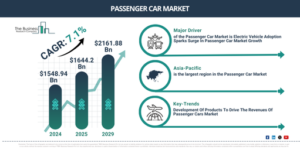
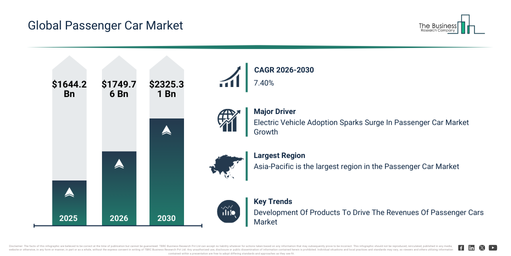
The passenger car market size has grown strongly in recent years. It will grow from $1644.2 billion in 2025 to $1749.76 billion in 2026 at a compound annual growth rate (CAGR) of 6.4%. The growth in the historic period can be attributed to urbanization growth, rising disposable income, expansion of road infrastructure, mass vehicle ownership trends, affordability of passenger cars.
The passenger car market size is expected to see strong growth in the next few years. It will grow to $2325.31 billion in 2030 at a compound annual growth rate (CAGR) of 7.4%. The growth in the forecast period can be attributed to electric vehicle incentives, autonomous driving adoption, emission reduction mandates, smart mobility ecosystems, consumer demand for connected features. Major trends in the forecast period include rising adoption of electric passenger cars, growing preference for utility vehicles, increasing integration of advanced safety features, higher demand for fuel efficient models, expansion of connected car technologies.
Get A Free Sample Report With In-Depth Market Insights:
Passenger Car Market Growth Momentum: What Factors Are Shaping Demand?
The growing adoption of electric vehicles is expected to boost the growth of the passenger car market going forward. An electric vehicle (EV) refers to a vehicle that can drive forward using an electric motor that is powered by a battery and can be externally charged. The rise in passenger car demand due to EVs is attributed to a combination of factors, including increasing affordability, government policies, environmental concerns, and technological advancements. Passenger cars play a pivotal role in supporting the adoption of electric vehicles by integrating advanced electrification technologies, improved battery systems, and efficient charging capabilities. For instance, in October 2024, according to Statistics Canada, the national data agency, in 2023 Electric Vehicle (EV) registrations accounted for 3.9% of all light duty vehicle registrations, up from 3.0% in 2022. Therefore, the growing adoption of electric vehicles is driving the growth of the passenger car market.
Passenger Car Market Segment Landscape And Growth Outlook
The passenger car market covered in this report is segmented –
1) By Type: Hatchback, Sedan, Utility Vehicle
2) By Fuel Type: Gasoline, Diesel, Other Fuel Types
3) By Engine Capacity: <1000 cc, <1000-1500 cc, <1500-2000 cc, >2000 cc
4) By Propulsion Type: IC Engine, Electric Vehicle
Subsegments:
1) By Hatchback: Compact Hatchback, Subcompact Hatchback
2) By Sedan: Compact Sedan, Midsize Sedan, Full-Size Sedan
3) By Utility Vehicle: Sport Utility Vehicle (SUV), Crossover Utility Vehicle (CUV), Minivan
Passenger Car Market Trends Redefining Industry Growth
Major companies operating in the passenger car market are focusing on developing new products, such as battery electric compact crossover SUVs built on dedicated EV architectures, to gain a competitive advantage. These EV SUVs combine zero emission drivetrains with SUV practicality, offering an efficient alternative to conventional vehicles. For instance, in September 2024, Zeekr, a China-based automaker, launched Zeekr 7X, a five seat all electric SUV. The 7X offers dual battery pack options (75 kWh LFP or 100 kWh NMC), supports an 800 volt charging architecture allowing 10–80 % charge in ~10.5 minutes, and delivers rapid 0–100 km/h acceleration in ~3.8 seconds. This shift broadens the SUV segment to include clean energy vehicles, enhancing appeal to environmentally conscious buyers while leveraging the global SUV demand; however, it introduces challenges such as higher production complexity and increased demand for charging infrastructure.
Passenger Car Market Competitive Landscape: Who Leads The Industry?
Major companies operating in the passenger car market report include Volkswagen AG, Toyoto Motor Corp, Daimler AG, Fiat Chrysler Automobiles NV, Ford Motor Co., General Motors Company, BMW AG, Honda Motor Co Ltd., Hyundai Motor Co. Ltd., SAIC Motor Co ltd., Groupe PSA, Tesla Inc., Nissan Motor Co Ltd., Kia Motors Corporation, BYD Company Limited, Renault SA, Jeep, Tata Motors Limited, Suzuki Motor Corporation, Subaru Corporation, Mazda Motor Corporation, FCA Italy S.p.A., Geely Automobile Holdings Limited, Great Wall Motor Company Limited, Mitsubishi Motors Corporation, Guangzhou Automobile Group Co. Ltd., Changan Automobile Co. Ltd., Dongfeng Motor Corporation, Maserati S.p.A., Brilliance China Automotive Holdings Limited
View The Full Passenger Car Market Report:
Passenger Car Market Geographic Landscape: Which Region Leads Industry Growth?
Asia-Pacific was the largest region in the passenger car market in 2025. Western Europe was the second-largest region in the passenger car market. The regions covered in the passenger car market report include Asia-Pacific, South East Asia, Western Europe, Eastern Europe, North America, South America, Middle East, Africa.
Reach Out To Our Team:
The Business Research Company: https://www.thebusinessresearchcompany.com/
Americas: +1 310-496-7795
Asia: +44 7882 955267 & +91 8897263534
Europe: +44 7882 955267
Email us at: marketing@tbrc.info
Follow us on:
LinkedIn: https://in.linkedin.com/company/the-business-research-company
YouTube: https://www.youtube.com/channel/UC24_fI0rV8cR5DxlCpgmyFQ
Global Market Model: https://www.thebusinessresearchcompany.com/global-market-model

Wasay has over a decade of experience in market research, data modelling, and analytics, with prior experience at GlobalData and Decision Tree Consulting Services. At The Business Research Company , he leads research operations across syndicated studies, customized consulting engagements, and the Global Market Model platform. His professional experience includes supporting organizations such as Boston Consulting Group, KPMG, and Ernst & Young. Wasay holds a degree in Electronics and Communications Engineering, postgraduate management qualifications from International Management Institute Belgium and Indian School of Business and Entrepreneurship, and completed the Integrated Program in Business Analytics from Indian Institute of Management Indore.