Built to provide research that’s more actionable and strategically valuable, The Business Research Company’s 2026 market reports include market attractiveness analysis, total addressable market sizing, company benchmarking matrices, interactive Excel dashboards, broader supply chain intelligence, emerging startup tracking, and in-depth product insights.
Ship Repairing Market Size Forecast: How Big Could The Market Get By 2030?
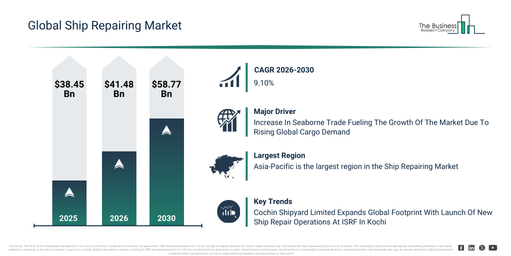
The ship repairing market size has grown strongly in recent years. It will grow from $38.45 billion in 2025 to $41.48 billion in 2026 at a compound annual growth rate (CAGR) of 7.9%. The growth in the historic period can be attributed to growth of global shipping operations, aging commercial and naval fleets, rising frequency of vessel maintenance cycles, expansion of maritime trade routes, availability of global repair dock networks.
The ship repairing market size is expected to see strong growth in the next few years. It will grow to $58.77 billion in 2030 at a compound annual growth rate (CAGR) of 9.1%. The growth in the forecast period can be attributed to increasing investments in advanced repair technologies, rising demand for quick turnaround repair services, expansion of offshore vessel maintenance, growing adoption of remote diagnostics, increasing regulatory compliance requirements. Major trends in the forecast period include increasing adoption of condition-based maintenance practices, rising demand for engine and hull repair services, growing use of digital inspection tools, expansion of emergency repair capabilities, enhanced focus on safety standards.
Get A Free Sample Report With In-Depth Market Insights:
Ship Repairing Market Development Factors: What’s Supporting Demand?
The increasing seaborne trade is expected to propel the growth of the ship repairing market going forward. Seaborne trade refers to the transportation of goods and commodities by sea, representing the backbone of international commerce, as it enables large-scale, cost-efficient movement of raw materials, energy resources, and manufactured products across global supply chains. The rise in seaborne trade is being driven by expanding global consumption, industrial output, and energy demand, which require a larger and more modern fleet to handle increasing cargo volumes. This growth in maritime transport directly boosts the need for new vessels and fleet expansion, supporting the expansion of the shipbuilding sector. For instance, in October 2024, according to the Review of Maritime Transport 2024, published by the United Nations Conference on Trade and Development (UNCTAD), a Switzerland-based intergovernmental organization, global seaborne trade reached 12,292 million tons in 2023, a 2.4% increase over 2022, reversing the earlier decline. Therefore, the increasing seaborne trade is driving the growth of the ship repairing market.
Ship Repairing Market Segment Breakdown: Which Categories Lead On Revenue?
The ship repairing market covered in this report is segmented –
1) By Vessel Type: General Cargo Ships, Bulk Cargo Carrier, Crude Oil Tankers, Chemical Tankers, Container Ships, Liquefied Natural Gas Tankers, Navy And Passenger Ships, Other Vessels
2) By Application: General Services, Dockage, Hull Part, Engine Parts, Electric Works, Auxiliary Services
3) By End-User: Transport Companies, Military, Other End-Users
Subsegments:
1) By General Cargo Ships: Multi-Purpose Vessels, Roll-On/Roll-Off (RoRo) Ships
2) By Bulk Cargo Carriers: Dry Bulk Carriers, Specialized Bulk Carriers
3) By Crude Oil Tankers: Very Large Crude Carriers (VLCCs), Suezmax And Aframax Tankers
4) By Chemical Tankers: Stainless Steel Tankers, Coated Tankers For Hazardous Materials
5) By Container Ships: Feeder, Panamax, And Post-Panamax Container Vessels
6) By Liquefied Natural Gas (LNG) Tankers: Conventional LNG Carriers, Membrane-Type LNG Carriers
7) By Navy And Passenger Ships: Naval Vessels, Cruise Ships And Ferries
8) By Other Vessels: Fishing Vessels, Offshore Support Vessels, Research And Survey Vessels
Ship Repairing Market Transformation Trends: What Innovations Are Driving Change?
Major companies in the ship repairing market are focusing on developing innovative solutions such as integrated smart docking optimization systems (ISDOS) to enhance repair efficiency, reduce vessel turnaround time, and improve workflow transparency across complex shipyard operations. Integrated smart docking optimization systems (ISDOS) refer to advanced, digitally enabled platforms that leverage artificial intelligence, internet of things (IoT) sensors, and predictive analytics to streamline dock planning, automate condition assessments, and optimize resource allocation during repair and maintenance activities. For instance, in August 2024, Cochin Shipyard Limited (CSL), an India-based shipbuilding and repair company, launched its commercial operation at the newly established International Ship Repair Facility (ISRF) in Kochi, and has successfully docked the HSC Parali, a vessel belonging to the Lakshadweep Administration. The Kerala state-owned shipyard is keen to position itself as a global center for ship repairs, catering to both commercial vessels and naval/military ships.
Ship Repairing Market Leading Players And Competitive Positioning
Major companies operating in the ship repairing market report include Fincantieri S.p.A., United Shipbuilding Corporation, Sembcorp Marine Ltd, China Shipbuilding Industry Corporation, Imabari Shipbuilding Co. Ltd., Hyundai Mipo Dockyard Co. Ltd., Damen Shipyards Group, Cochin Shipyard Limited, Hanjin Heavy Industries And Construction, Arab Shipbuilding and Repair Yard, Hindustan Shipyard Limited, Garden Reach Shipbuilders and Engineers, Mitsubishi Heavy Industries, Yangzijiang Shipbuilding (Holdings) Ltd., New Times Shipbuilding Co. Ltd., Daewoo Shipbuilding & Marine Engineering Co. Ltd (DSME), Tsuneishi Holdings, Naval Yards Kiel GmbH, Lloyd Werft Bremerhaven, Neptune Werft GmbH, Schiffswerft Hermann Barthel GmbH, Meyer Werft, Limited Liability Company Fesco Integrated Transport, Remontowa, Seatech Engineering, General Dynamics Corporation, International Ship Repair and Marine Services Inc., GMD Shipyard Corp., Irving Shipbuilding Inc., Victoria Shipyards, BAE Systems, Lyon Shipyard, Gulf Copper, Astillero Nacional, Servicios Industriales De La Marine S.A., Estaleiros sermetal ltd, Enavi & Renave, Caribbean Drydock Company, Damex Shipbuilding & Engineering, ShipTech, Dammam Shipyard, Zamil Offshore, Israel Shipyards Ltd., Gemak Group of Companies, Sefine Shipyard, Kuzey Star Shipyard, Desan Shipyard, Southern African Shipyards, Dormac Marine & Engineering, Southern Engineering Co. Ltd., West Atlantic Shipyard, Nigerdock FZE
View The Full Ship Repairing Market Report:
Ship Repairing Market Global Footprint: Which Region Leads The Market?
Asia-Pacific was the largest region in the global ship repairing market in 2025. Western Europe was the second largest market in the global ship repairing market share. The regions covered in the ship repairing market report include Asia-Pacific, South East Asia, Western Europe, Eastern Europe, North America, South America, Middle East, Africa.
Reach Out To Our Team:
The Business Research Company: https://www.thebusinessresearchcompany.com/
Americas: +1 310-496-7795
Asia: +44 7882 955267 & +91 8897263534
Europe: +44 7882 955267
Email us at: marketing@tbrc.info
Follow us on:
LinkedIn: https://in.linkedin.com/company/the-business-research-company
YouTube: https://www.youtube.com/channel/UC24_fI0rV8cR5DxlCpgmyFQ
Global Market Model: https://www.thebusinessresearchcompany.com/global-market-model

Wasay has over a decade of experience in market research, data modelling, and analytics, with prior experience at GlobalData and Decision Tree Consulting Services. At The Business Research Company , he leads research operations across syndicated studies, customized consulting engagements, and the Global Market Model platform. His professional experience includes supporting organizations such as Boston Consulting Group, KPMG, and Ernst & Young. Wasay holds a degree in Electronics and Communications Engineering, postgraduate management qualifications from International Management Institute Belgium and Indian School of Business and Entrepreneurship, and completed the Integrated Program in Business Analytics from Indian Institute of Management Indore.