Through market attractiveness analysis, total addressable market evaluation, company benchmarking matrices, interactive Excel dashboards, expanded supply chain intelligence, emerging startup coverage, and detailed product insights, The Business Research Company’s 2026 market reports provide more actionable and strategically valuable research.
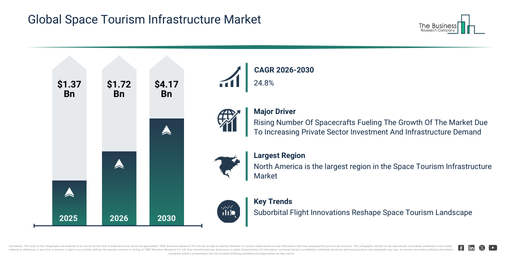
Space Tourism Infrastructure Market Expansion From $1.72 Billion In 2026 To $4.17 Billion In 2030
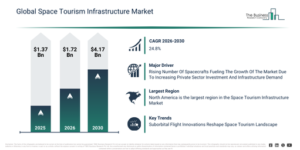
The space tourism infrastructure market is projected for rapid expansion over the coming years. This market is anticipated to reach $4.17 billion by 2030, exhibiting a compound annual growth rate (CAGR) of 24.8%. This projected increase can be ascribed to several factors, including the global proliferation of commercial spaceport networks, an escalating desire for both orbital and suborbital tourism, the incorporation of sophisticated life support and habitation modules, the embrace of autonomous and reusable launch systems, and strategic collaborations formed between aerospace companies and hospitality service providers. Key developments foreseen during this period encompass the establishment of new spaceports in developing areas, breakthroughs in reusable launch vehicle technologies, the creation of thorough astronaut training initiatives, the proliferation of space tourism habitats and lodging options, and improvements in safety and emergency protocols designed for space tourists.
The increasing count of spacecraft is anticipated to drive the expansion of the space tourism infrastructure market in the future. Spacecraft are defined as vehicles or machines engineered for journeys or operations beyond Earth’s atmosphere. This growth in spacecraft numbers stems from greater private sector funding in commercial space projects, which facilitates quick innovation, mass production capabilities, and lower costs for launches. Space tourism infrastructure assists spacecraft through the provision of launch, landing, and maintenance facilities, which are crucial for ensuring safe and recurring missions. Such infrastructure facilitates streamlined operations by incorporating cutting-edge technologies, thereby improving dependability and the passenger journey in commercial space flights. For example, the European Space Agency, an intergovernmental space agency based in France, reported in December 2024 that approximately 2,940 spacecraft entered orbit in 2023, representing a 17% rise from 2022. Consequently, the expanding fleet of spacecraft is fueling the development of the space tourism infrastructure market.
Download A Free Sample Report For Comprehensive Market Insights:
Space Tourism Infrastructure Market Development Factors: Which Trends Are Supporting Demand?
Leading firms within the space tourism infrastructure market are prioritizing the creation of innovative offerings, like suborbital flights, aimed at accelerating access to space, lowering the expenses of launches, and boosting both safety and comfort for passengers on brief space journeys. These suborbital journeys involve space missions that ascend to the boundary of space without achieving a complete orbit of Earth, providing a short celestial encounter before their return descent. An example of this is Virgin Galactic Holdings Inc., a US-based space tourism company, which commenced its commercial space tourism flights in June 2024, responding to sustained demand that exceeds availability, leading to expanding waiting lists and anticipated substantial increases in ticket costs. Such space tourism flights transport travelers on a suborbital excursion exceeding 50 miles above Earth, granting moments of zero gravity and stunning panoramas of the planet’s curve. These excursions utilize cutting-edge technologies, including mid-air launch capabilities and feathering wing systems, which guarantee a stable and managed re-entry into the atmosphere, thereby rendering the experience both exhilarating and secure.
Space Tourism Infrastructure Market Segment Analysis: What Are The Major Market Categories?
The space tourism infrastructure market covered in this report is segmented –
1) By Component: Spaceports, Spacecraft, Ground Facilities, Other Components
2) By Service Type: Orbital, Suborbital, Lunar
3) By End-User: Commercial, Government, Other End-User
Subsegments:
1) By Spaceports: Launch Pads, Runways For Spaceplanes, Passenger Terminals, Control And Operations Centers, Safety And Emergency Systems
2) By Spacecraft: Suborbital Spacecraft, Orbital Spacecraft, Reusable Launch Vehicles (RLVs), Spaceplanes, Capsules And Crew Modules
3) By Ground Facilities: Mission Control Centers, Astronaut Training Centers, Simulation And Testing Facilities, Ground Communication Infrastructure, Fueling And Maintenance Stations
4) By Other Components: Space Suits And Life Support Systems, Payload Integration Systems, Space Tourism Habitats, Transportation Systems, Data And Navigation Systems
#Space Tourism Infrastructure Market Growth Trends: What Is Influencing The Future Outlook?
Leading firms within the space tourism infrastructure market are prioritizing the creation of innovative offerings, like suborbital flights, aimed at accelerating access to space, lowering the expenses of launches, and boosting both safety and comfort for passengers on brief space journeys. These suborbital journeys involve space missions that ascend to the boundary of space without achieving a complete orbit of Earth, providing a short celestial encounter before their return descent. An example of this is Virgin Galactic Holdings Inc., a US-based space tourism company, which commenced its commercial space tourism flights in June 2024, responding to sustained demand that exceeds availability, leading to expanding waiting lists and anticipated substantial increases in ticket costs. Such space tourism flights transport travelers on a suborbital excursion exceeding 50 miles above Earth, granting moments of zero gravity and stunning panoramas of the planet’s curve. These excursions utilize cutting-edge technologies, including mid-air launch capabilities and feathering wing systems, which guarantee a stable and managed re-entry into the atmosphere, thereby rendering the experience both exhilarating and secure.
Space Tourism Infrastructure Market Leading Companies: Who Holds Significant Market Presence?
Major companies operating in the space tourism infrastructure market are The Boeing Company, Lockheed Martin Corporation, Airbus SE, Northrop Grumman Corporation, Thales Group, Space Perspective Inc., Blue Origin LLC, United Launch Alliance L.L.C., ILC Dover LP, Sierra Space Corporation , Space Exploration Technologies Corp. , Jiangsu Deep Blue Aerospace Technology Co Ltd., Axiom Space Inc., Rocket Lab USA Inc., Orion Span Inc., Zero 2 Infinity SL, PD Aerospace Ltd., Bigelow Aerospace LLC, Vast Space LLC, Virgin Galactic Holdings, Inc., Orion Span, AdamWorks LLC, Zhongke Aerospace Exploration Technology Co Ltd., RocketBreaks Ltd.
Access The Complete Space Tourism Infrastructure Market Report:
Space Tourism Infrastructure Market Global Footprint: Which Region Holds Market Leadership?
North America was the largest region in the space tourism infrastructure market in 2025. The regions covered in the space tourism infrastructure market report are Asia-Pacific, South East Asia, Western Europe, Eastern Europe, North America, South America, Middle East, Africa.
Access a Customized Space Tourism Infrastructure Market Report for Deeper Competitive Insights
https://www.thebusinessresearchcompany.com/customise?id=25610&type=smp
The Business Research Company: https://www.thebusinessresearchcompany.com/
Americas: +1 310-496-7795
Asia: +44 7882 955267 & +91 8897263534
Europe: +44 7882 955267
Email us at: marketing@tbrc.info
Follow us on:
LinkedIn: https://in.linkedin.com/company/the-business-research-company
YouTube: https://www.youtube.com/channel/UC24_fI0rV8cR5DxlCpgmyFQ
Global Market Model: https://www.thebusinessresearchcompany.com/global-market-model

Wasay has over a decade of experience in market research, data modelling, and analytics, with prior experience at GlobalData and Decision Tree Consulting Services. At The Business Research Company , he leads research operations across syndicated studies, customized consulting engagements, and the Global Market Model platform. His professional experience includes supporting organizations such as Boston Consulting Group, KPMG, and Ernst & Young. Wasay holds a degree in Electronics and Communications Engineering, postgraduate management qualifications from International Management Institute Belgium and Indian School of Business and Entrepreneurship, and completed the Integrated Program in Business Analytics from Indian Institute of Management Indore.