Built to provide research that’s more actionable and strategically valuable, The Business Research Company’s 2026 market reports include market attractiveness analysis, total addressable market sizing, company benchmarking matrices, interactive Excel dashboards, broader supply chain intelligence, emerging startup tracking, and in-depth product insights.
Carbon Intensity Monitoring For Shipping Market Growth From $1.4 Billion In 2026 To $2.58 Billion By 2030 At A CAGR Of 16.4%
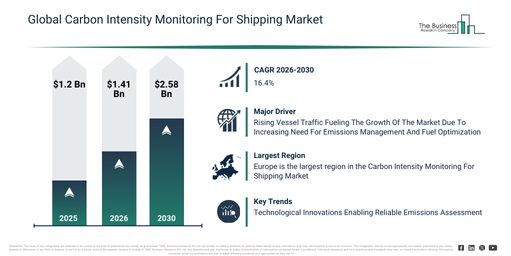
The carbon intensity monitoring for shipping market has experienced substantial expansion in its size during recent years. Its value is projected to rise from $1.2 billion in 2025 to $1.41 billion in 2026, advancing at a compound annual growth rate (CAGR) of 16.7%. This historical progression can be attributed to several factors, including the introduction of maritime emission regulations, a growing awareness of shipping emissions, the adoption of onboard fuel monitoring systems, the expansion of digital fleet management solutions, and increasing transparency in maritime operations.
The market size for carbon intensity monitoring in shipping is projected to experience substantial expansion over the coming years. This market is anticipated to reach $2.58 billion by 2030, demonstrating a compound annual growth rate (CAGR) of 16.4%. This projected growth is driven by factors such as stricter enforcement of carbon intensity regulations, increased funding for low-emission shipping technologies, the proliferation of cloud-based monitoring platforms, a rising need for automated compliance reporting, and the greater incorporation of AI-powered emission analytics. Key trends expected during this period involve the wider deployment of real-time emission monitoring systems, increased embrace of digital carbon reporting platforms, deeper integration of fuel consumption analytics, an expansion of regulatory compliance monitoring tools, and a heightened emphasis on optimizing emissions at the voyage level.
Get A Free Sample Report With In-Depth Market Insights:
Carbon Intensity Monitoring For Shipping Market Demand Drivers Opening New Revenue Streams
The increasing vessel traffic is projected to drive the expansion of the carbon intensity monitoring for shipping market. This refers to a growing number of ships calling at ports, harbors, and terminals as global trade expands. The post-pandemic surge in container and bulk cargo volumes, propelled by growth in international trade and port throughput, is responsible for this rise in vessel traffic. Amid this growing traffic, carbon intensity monitoring for shipping aids in managing and reducing emissions per voyage, optimizing fuel efficiency, and ensuring regulatory compliance. For instance, in February 2025, the Port Authority of New York and New Jersey, a US-based bi-state agency, recorded monthly twenty-foot equivalent unit (TEU) volumes at its facilities reaching 718,826, which was a 12% jump from February 2024. Furthermore, December’s TEU total of 688,180 marked a 9% increase over December 2023. Consequently, the escalating vessel traffic is a significant driver for the growth of the carbon intensity monitoring for shipping market.
Carbon Intensity Monitoring For Shipping Market Segment Performance And Emerging Opportunities
The carbon intensity monitoring for shipping market covered in this report is segmented –
1) By Component: Software, Hardware, Services
2) By Vessel Type: Bulk Carriers, Tankers, Container Ships, General Cargo Ships, Other Vessel Types
3) By Deployment Mode: On-Premises, Cloud
4) By Application: Fleet Management, Regulatory Compliance, Emissions Reporting, Performance Optimization, Other Applications
5) By End-User: Commercial Shipping, Passenger Shipping, Offshore Support Vessels, Other End-Users
Subsegments:
1) By Software: Emissions Tracking And Reporting Software, Data Analytics And Visualization Platforms, Compliance Management Software, Voyage Optimization Software, Predictive Maintenance And Performance Monitoring Tools, Cloud-Based Carbon Monitoring Platforms
2) By Hardware: Emission Sensors And Analyzers, Data Acquisition Systems, Satellite And Global Positioning System (GPS) Tracking Devices, Onboard Monitoring Units, Internet Of Things (IoT) Gateways And Edge Devices, Communication And Networking Equipment
3) By Services: Installation And Integration Services, Calibration And Maintenance Services, Data Collection And Validation Services, Regulatory Consulting And Compliance Services, Training And Support Services, Fleet Performance Assessment And Optimization Services
Carbon Intensity Monitoring For Shipping Market Trends Powering Strategic Industry Growth
Leading companies active in the carbon intensity monitoring for the shipping market are focusing on technological advancements, such as updated methodologies, to improve emissions measurement accuracy, increase data transparency, and aid compliance with evolving maritime decarbonization regulations. An updated methodology refers to the revised calculation frameworks, measurement standards, and assessment criteria developed to more precisely evaluate and benchmark a vessel’s greenhouse gas emissions and carbon intensity performance. For instance, in September 2023, RightShip, a UK-based maritime risk management and environmental performance platform, introduced the updated GHG 2.0 Rating, which features an improved methodology designed to enhance transparency and accuracy in assessing the greenhouse gas performance of vessels, thereby supporting efforts toward maritime decarbonization. This revised methodology integrates new data sources and more rigorous evaluation criteria to offer more reliable and meaningful insights for shipowners, charterers, and regulators striving to reduce shipping’s carbon footprint.
Carbon Intensity Monitoring For Shipping Market Key Players: Which Companies Lead Industry Competition?
Major companies operating in the carbon intensity monitoring for shipping market are Hanwha Group, Wärtsilä Corporation, Bureau Veritas S.A., American Bureau of Shipping (ABS), DNV AS, Lloyd’s Register Group Limited, Gaztransport & Technigaz S.A. (GTT), Kongsberg Digital AS, ZeroNorth A/S, RightShip Pty Ltd, Veson Nautical Corporation, Marine Benchmark AB, Danfoss IXA A/S, Spinergie SAS, Blue Water Trade Winds Private Limited, CargoMetrics Technologies LLC, ClassNK (Nippon Kaiji Kyokai), Everimpact SAS, Raymetrics S.A., Tunable AS
View The Full Carbon Intensity Monitoring For Shipping Market Report:
Carbon Intensity Monitoring For Shipping Market Top Region By Revenue And Market Share
Europe was the largest region in the carbon intensity monitoring for shipping market in 2025. Asia-Pacific is expected to be the fastest-growing region in the forecast period. The regions covered in the carbon intensity monitoring for shipping market report are Asia-Pacific, South East Asia, Western Europe, Eastern Europe, North America, South America, Middle East, Africa.
Reach Out To Our Team:
The Business Research Company: https://www.thebusinessresearchcompany.com/
Americas: +1 310-496-7795
Asia: +44 7882 955267 & +91 8897263534
Europe: +44 7882 955267
Email us at: marketing@tbrc.info
Follow us on:
LinkedIn: https://in.linkedin.com/company/the-business-research-company
YouTube: https://www.youtube.com/channel/UC24_fI0rV8cR5DxlCpgmyFQ
Global Market Model: https://www.thebusinessresearchcompany.com/global-market-model

Wasay has over a decade of experience in market research, data modelling, and analytics, with prior experience at GlobalData and Decision Tree Consulting Services. At The Business Research Company , he leads research operations across syndicated studies, customized consulting engagements, and the Global Market Model platform. His professional experience includes supporting organizations such as Boston Consulting Group, KPMG, and Ernst & Young. Wasay holds a degree in Electronics and Communications Engineering, postgraduate management qualifications from International Management Institute Belgium and Indian School of Business and Entrepreneurship, and completed the Integrated Program in Business Analytics from Indian Institute of Management Indore.