Featuring market attractiveness scoring, total addressable market sizing, company benchmarking matrices, interactive Excel dashboards, deeper supply chain intelligence, emerging startup tracking, and granular product-level insights, The Business Research Company’s 2026 market reports are built to deliver research that is both more actionable and more strategically valuable.
Reverse Logistics Market Revenue Outlook: What CAGR Lies Ahead Through 2030?
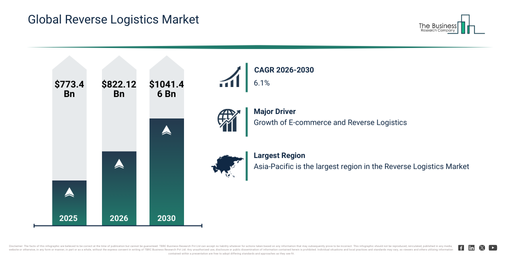
The reverse logistics market has experienced significant expansion in recent years. It is projected to grow from $773.4 billion in 2025 to $822.12 billion in 2026, at a compound annual growth rate (CAGR) of 6.3%. The market’s historical growth can be attributed to several factors, including the expansion of e-commerce activities, an increase in product return volumes, a heightened focus on warranty and recall management, growth in retail and consumer electronics sales, and the development of centralized logistics networks.
The reverse logistics market is projected to experience substantial expansion over the coming years, reaching a valuation of $1041.46 billion by 2030, driven by a compound annual growth rate (CAGR) of 6.1%. This anticipated growth can be linked to a heightened emphasis on circular economy principles, increased funding for automated reverse logistics infrastructure, the expansion of recycling and reuse initiatives, a stronger regulatory focus on minimizing waste, and the growing incorporation of AI-powered return analytics. Key developments during this period are expected to include the broader implementation of organized return management systems, the increased use of digital platforms for tracking returns, an expansion in repair and refurbishment activities, a greater focus on extracting value from returned merchandise, and improved optimization of reverse supply chains.
Get A Free Sample Report With In-Depth Market Insights:
Reverse Logistics Market Growth Factors: What’s Supporting Expansion?
The rapid expansion of e-commerce is projected to fuel the growth of the reverse logistics market in the foreseeable future. E-commerce, or electronic commerce, denotes the transaction of goods and services via the Internet. In e-commerce, reverse logistics is employed to handle the movement of products returned by customers back to their origin point, such as a warehouse or store, thereby helping to sustain customer trust, reduce losses, and promote sustainable business practices. For example, in November 2023, the United States Census Bureau, a US-based government agency, reported an increase in e-commerce, reaching 7.6% in the 3rd quarter of 2023, compared to 6.9% in the 4th quarter of 2022. Additionally, 15.4% of all sales in the second quarter of 2023 occurred through online channels. Therefore, the increasing prevalence of e-commerce is a key driver for the reverse logistics market’s expansion.
Reverse Logistics Market Segment Analysis: What Are The Core Market Categories?
The reverse logistics market covered in this report is segmented –
1) By Return Type: Recalls, Commercial Returns, Repairable Returns, End-Of-Use Returns, End Of Life Returns
2) By Service: Transportation, Warehousing, Reselling, Replacement Management, Refund Management Authorization, Other Services
3) By End User: E-Commerce, Automotive, Pharmaceutical, Consumer Electronic, Retail, Luxury Goods, Reusable Packaging
Subsegments:
1) By Recalls: Product Safety Recalls, Regulatory Recalls, Voluntary Recalls, Mandatory Recalls
2) By Commercial Returns: Customer-Initiated Returns, Retail Returns, Warranty Returns, Promotional Returns
3) By Repairable Returns: Defective Product Returns, Refurbishment Returns, Component Repair Returns, Manufacturer Repair Returns
4) By End-Of-Use Returns: Product Trade-In Returns, Upgrade Returns, Leasing Returns, Subscription-End Returns
5) By End-Of-Life Returns: Disposal Returns, Recycling Returns, Scrapping Returns, E-Waste Returns
Reverse Logistics Market Industry Trends: What’s Reshaping Demand?
Leading companies active in the reverse logistics market are concentrating on developing innovative logistics infrastructure, such as pickup point-based reverse logistics platforms, to bolster efficiency, reliability, and control within time-sensitive healthcare logistics. These pickup point-based reverse logistics platforms are predefined physical locations integrated into logistics networks where shipments, returns, or samples are consolidated, which facilitates streamlined collection, reduces handling complexity, and improves shipment coordination. For instance, in October 2023, UPS Healthcare, a US-based reverse logistics company, introduced a new reverse logistics service in Europe. This service, known as UPS Pickup Point locations, serves as a fresh reverse logistics solution for health laboratory customers. These pickup points are designed to streamline the collection and shipment of samples to a central lab, offering healthcare companies a more efficient solution by reducing the number of collection sites and enhancing both reliability and control. This initiative directly addresses the challenges posed by healthcare-related logistics, particularly in managing the reverse logistics of healthcare-related shipments. Moreover, these benefits position UPS Pickup Point locations as a convenient and efficient choice for managing shipping and receiving needs.
Reverse Logistics Market Top Companies Driving Competitive Growth
Major companies operating in the reverse logistics market are Deutsche Post DHL Group, United Parcel Service Inc., FedEx Corporation, Schenker AG, Kuehne + Nagel International AG, DSV Panalpina A/S, C.H. Robinson Worldwide, Dachser SE, Nippon Express Co. Ltd., Expeditors International of Washington Inc., J.B. Hunt Transport Services Inc., Ryder System Inc., Kerry Logistics Network Limited, XPO Logistics Inc, Landstar System Inc., Kintetsu World Express Inc., ArcBest Corporation, Zebra Technologies Corp, Hellmann Worldwide Logistics, Echo Global Logistics Inc., Yusen Logistics Co. Ltd., Agility Logistics, Safexpress Pvt. Ltd, CEVA Logistics AG, RLG Systems AG
View The Full Reverse Logistics Market Report:
Reverse Logistics Market Regional Breakdown: Where Is Demand Concentrated?
Asia-Pacific was the largest region in the reverse logistics market in 2025. The regions covered in the reverse logistics market report are Asia-Pacific, South East Asia, Western Europe, Eastern Europe, North America, South America, Middle East, Africa.
Reach Out To Our Team:
The Business Research Company: https://www.thebusinessresearchcompany.com/
Americas: +1 310-496-7795
Asia: +44 7882 955267 & +91 8897263534
Europe: +44 7882 955267
Email us at: marketing@tbrc.info
Follow us on:
LinkedIn: https://in.linkedin.com/company/the-business-research-company
YouTube: https://www.youtube.com/channel/UC24_fI0rV8cR5DxlCpgmyFQ
Global Market Model: https://www.thebusinessresearchcompany.com/global-market-model

Wasay has over a decade of experience in market research, data modelling, and analytics, with prior experience at GlobalData and Decision Tree Consulting Services. At The Business Research Company , he leads research operations across syndicated studies, customized consulting engagements, and the Global Market Model platform. His professional experience includes supporting organizations such as Boston Consulting Group, KPMG, and Ernst & Young. Wasay holds a degree in Electronics and Communications Engineering, postgraduate management qualifications from International Management Institute Belgium and Indian School of Business and Entrepreneurship, and completed the Integrated Program in Business Analytics from Indian Institute of Management Indore.