Backed by market attractiveness analysis, total addressable market sizing, company benchmarking matrices, interactive Excel dashboards, wider supply chain intelligence, emerging startup coverage, and detailed product-level insights, The Business Research Company’s 2026 market reports are designed to offer research that is more actionable and strategically valuable than ever.
Reverse-Logistics Sorting-Display Market Size Forecast: How Big Could The Market Get By 2030?
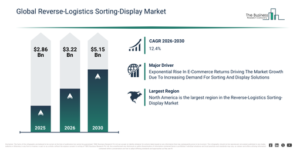
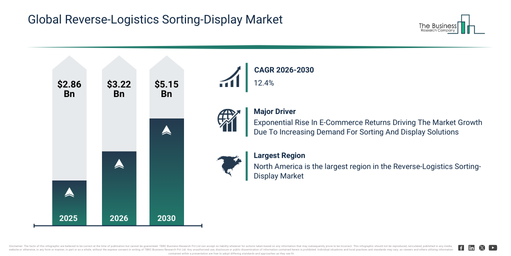
The reverse-logistics sorting-display market has seen significant growth in recent years. Its value is projected to increase from $2.86 billion in 2025 to $3.22 billion in 2026, exhibiting a compound annual growth rate (CAGR) of 12.7%. Historically, this expansion was fueled by the growing volume of e-commerce returns, the proliferation of omnichannel retail operations, a heightened focus on resale and refurbishment, the widespread adoption of barcode and tracking systems, and the increasing complexity associated with return workflows.
The reverse-logistics sorting-display market size is anticipated to undergo substantial growth in the upcoming years. It is projected to climb to $5.15 billion by 2030, exhibiting a compound annual growth rate (CAGR) of 12.4%. This expansion during the forecast period is driven by growing investments in circular economy logistics, the increasing adoption of AI-assisted returns processing, the expansion of automated reverse logistics facilities, a heightened focus on cost recovery from returned goods, and a greater demand for real-time return visibility. Noteworthy trends expected in this timeframe encompass the increasing adoption of structured return classification systems, a rise in the use of automated sorting and display interfaces, the growing integration of condition-based routing logic, the expansion of centralized reverse logistics hubs, and an enhanced emphasis on reducing errors in returns processing.
Get A Free Sample Report With In-Depth Market Insights:
Reverse-Logistics Sorting-Display Market Industry Drivers: What’s Behind The Revenue Growth?
The increasing volume of e-commerce returns is anticipated to drive the expansion of the reverse-logistics sorting-display market. E-commerce returns are defined as goods bought online that consumers send back to sellers for reasons like incorrect sizing, faults, or general dissatisfaction. This surge in returns stems from the general increase in online shopping, where more digital transactions result in a greater quantity of items needing to be returned and processed. Reverse-logistics sorting-display systems facilitate the management of these e-commerce returns by streamlining the categorization and arrangement of returned products, which allows for quicker processing, lower operational expenditures, better inventory control, and ultimately improved customer satisfaction through faster refunds or exchanges. For example, in December 2024, data from the National Retail Federation, a US-based retail industry trade association, indicated that total retail returns climbed from $816 billion in 2022 to a projected $890 billion in 2024, demonstrating a significant increase in returned goods. Consequently, the rapid growth in e-commerce returns is fueling the demand for the reverse-logistics sorting-display market.
Reverse-Logistics Sorting-Display Market Segments: Where Is Growth Concentrated?
The reverse-logistics sorting-display market covered in this report is segmented –
1) By Component: Services, Hardware, Software
2) By Sorting Technology: Semi-Automated Sorting, Automated Sorting, Manual Sorting
3) By Application: Pharmaceuticals, E-commerce, Retail, Automotive, Electronics
4) By End-User: Retailers, Third-Party Logistics Providers, Manufacturers
Subsegments:
1) By Services: Transportation Services, Warehousing Services, Inventory Management Services, Packaging Services, Other Service Types
2) By Hardware: Sorting Equipment, Conveyor Systems, Barcode Scanners, Storage Racks
3) By Software: Inventory Management Software, Tracking And Monitoring Software, Route Optimization Software, Logistics Management Software
Reverse-Logistics Sorting-Display Market Key Participants And Competitive Landscape
Major companies operating in the reverse-logistics sorting-display market are FedEx Corporation, United Parcel Service Inc., Deutsche Post AG (DHL Supply Chain), XPO Logistics Inc., C.H. Robinson Worldwide Inc., Ryder System Inc., GEODIS SA, ALOM Technologies Inc., Kuehne + Nagel International AG, CEVA Logistics AG, Reverse Logistics Group Inc. (RLG), Hollingsworth & Vose Company, Iron Mountain Incorporated, B-Stock Solutions Inc., Optoro Inc., Inmar Intelligence Inc., ReturnLogic Inc., GXO Logistics Inc., LiquiDonate Inc., Productiv Inc.
View The Full Reverse-Logistics Sorting-Display Market Report:
Reverse-Logistics Sorting-Display Market Top Region: Where Does Most Revenue Come From?
North America was the largest region in the reverse-logistics sorting-display market in 2025. Asia-Pacific is expected to be the fastest-growing region in the forecast period. The regions covered in the reverse-logistics sorting-display market report are Asia-Pacific, South East Asia, Western Europe, Eastern Europe, North America, South America, Middle East, Africa.
Reach Out To Our Team:
The Business Research Company: https://www.thebusinessresearchcompany.com/
Americas: +1 310-496-7795
Asia: +44 7882 955267 & +91 8897263534
Europe: +44 7882 955267
Email us at: marketing@tbrc.info
Follow us on:
LinkedIn: https://in.linkedin.com/company/the-business-research-company
YouTube: https://www.youtube.com/channel/UC24_fI0rV8cR5DxlCpgmyFQ
Global Market Model: https://www.thebusinessresearchcompany.com/global-market-model

Wasay has over a decade of experience in market research, data modelling, and analytics, with prior experience at GlobalData and Decision Tree Consulting Services. At The Business Research Company , he leads research operations across syndicated studies, customized consulting engagements, and the Global Market Model platform. His professional experience includes supporting organizations such as Boston Consulting Group, KPMG, and Ernst & Young. Wasay holds a degree in Electronics and Communications Engineering, postgraduate management qualifications from International Management Institute Belgium and Indian School of Business and Entrepreneurship, and completed the Integrated Program in Business Analytics from Indian Institute of Management Indore.