Through market attractiveness analysis, total addressable market evaluation, company benchmarking matrices, interactive Excel dashboards, expanded supply chain intelligence, emerging startup coverage, and detailed product insights, The Business Research Company’s 2026 market reports provide more actionable and strategically valuable research.
Strategic Bomber Market Growth Analysis: How Will Revenue Expand During The Forecast Period?
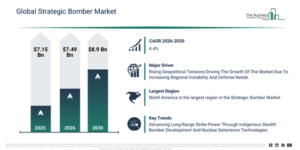
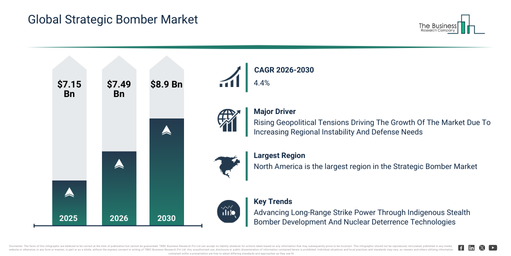
The strategic bomber market size is anticipated to experience consistent expansion over the upcoming years. It is projected to reach $8.9 billion by 2030, growing at a compound annual growth rate (CAGR) of 4.4%. This expansion during the forecast period is primarily driven by the increasing demand for next-generation long-range and hypersonic strategic bombers, the adoption of advanced propulsion technologies to enhance range and efficiency, the development of improved stealth and survivability features, the enlargement of global defense budgets supporting strategic bomber acquisition, and greater collaboration between aerospace firms and military agencies for innovative bomber platforms. Significant trends anticipated in the forecast period include advancements in hypersonic bomber technologies, the integration of stealth and low observability features, a rising demand for multi-role strategic bombers, the broadening of drone bomber (UAV) capabilities, and a strong focus on upgradable and modular bomber systems.
The future expansion of the strategic bomber market is anticipated to be driven by increasing geopolitical tensions. Geopolitical tensions encompass political, economic, or military rivalries and strains among nations or regions, potentially resulting in instability, conflict, or shifts in global power balances and alliances. These tensions are escalating, frequently fueled by disagreements over territory, national sovereignty, access to vital natural resources, and critical military interests. Strategic bombers possess long-range strike capabilities that serve as a deterrent against potential aggression. Their capacity to project power into disputed areas contributes to maintaining equilibrium and lessening the chance of direct confrontations. An instance highlighting this is a report from Ukraine and the United Nations in February 2025, published by a Ukraine-based government organization, which indicated a 30% rise in civilian casualties in 2024 compared to 2023. This increase occurred as frontline hostilities intensified anew, and the Russian Federation stepped up its deployment of aerial bombs, short-range drones, long-range missiles, and loitering munitions. Consequently, the escalating geopolitical tensions are propelling the growth of the strategic bomber market.
Download A Free Sample Report For Comprehensive Market Insights:
Strategic Bomber Market Growth Momentum: Which Factors Are Influencing Demand?
Major companies in the strategic bomber market are concentrating on innovating sophisticated technologies, notably survivable second-strike nuclear capabilities, to empower the Indian Air Force in executing precise, long-range global strikes. This survivable second-strike capacity enables a nation to endure an initial nuclear assault and still mount a counter-attack, thereby guaranteeing reliable deterrence. As of July 2025, it was reported that India’s Defence Research & Development Organisation (DRDO) and Hindustan Aeronautics Limited (HAL) were engaged in creating the Ultra Long-Range Strike Aircraft (ULRA), a stealth strategic bomber designed to fly over 12,000 km without refueling and capable of carrying approximately 12 tons of payload. Drawing inspiration from Russia’s Tu-160 and the U.S.’s B-2 Spirit and B-21 Raider, the ULRA is anticipated to incorporate cutting-edge stealth technology, a swing-wing configuration, and an internal weapons bay, housing armaments such as BrahMos-NG, Agni-1P, laser-guided bombs, and anti-radiation missiles. Should it come to fruition, the ULRA would furnish India with a survivable second-strike nuclear capability, substantially bolstering its strategic deterrence and global power projection, with a prototype projected for completion between 2032 and 2035.
Strategic Bomber Market Segments: Where Are The Largest Growth Opportunities?
The strategic bomber market covered in this report is segmented –
1) By Type: Turbofan, Turbojet, Turboprop
2) By Platform Type: Fixed-Wing Bombers, Drone Bombers (UAVs), Strategic Missile Systems, Hybrid Bombers
3) By Technology Adoption Level: High-Tech Or Mode Systems, Legacy Systems, Upgradable Systems, Prototype Innovations
4) By End-user: Military, Defense Contractors
Subsegments:
1) By Turbofan: Low-Bypass Turbofan Engines, High-Bypass Turbofan Engines, Afterburning Turbofan Engines, Stealth-Optimized Turbofans
2) By Turbojet: Single-Spool Turbojets, Twin-Spool Turbojets, Afterburning Turbojets, Compact Or Lightweight Turbojets
3) By Turboprop: Single-Shaft Turboprop Engines, Free-Turbine Turboprop Engines, High-Performance Military Turboprops, Propfan Variants
Strategic Bomber Market Innovation Trends: Which Developments Are Transforming The Industry?
Major companies in the strategic bomber market are concentrating on innovating sophisticated technologies, notably survivable second-strike nuclear capabilities, to empower the Indian Air Force in executing precise, long-range global strikes. This survivable second-strike capacity enables a nation to endure an initial nuclear assault and still mount a counter-attack, thereby guaranteeing reliable deterrence. As of July 2025, it was reported that India’s Defence Research & Development Organisation (DRDO) and Hindustan Aeronautics Limited (HAL) were engaged in creating the Ultra Long-Range Strike Aircraft (ULRA), a stealth strategic bomber designed to fly over 12,000 km without refueling and capable of carrying approximately 12 tons of payload. Drawing inspiration from Russia’s Tu-160 and the U.S.’s B-2 Spirit and B-21 Raider, the ULRA is anticipated to incorporate cutting-edge stealth technology, a swing-wing configuration, and an internal weapons bay, housing armaments such as BrahMos-NG, Agni-1P, laser-guided bombs, and anti-radiation missiles. Should it come to fruition, the ULRA would furnish India with a survivable second-strike nuclear capability, substantially bolstering its strategic deterrence and global power projection, with a prototype projected for completion between 2032 and 2035.
Strategic Bomber Market Company Landscape And Strategic Competition
Major companies operating in the strategic bomber market are RTX Corporation, The Boeing Company, Lockheed Martin Corporation, General Electric Company, General Dynamics Corporation, Northrop Grumman Corporation, Honeywell International Inc., BAE Systems plc, Rolls-Royce Holdings plc, L3Harris Technologies Inc., Dassault Aviation S.A., Xi’an Aircraft Industrial Corporation, MBDA Missile Systems, Chengdu Aircraft Industry Group, Tupolev Public Joint Stock Company, Sukhoi Company, Convair, Handley Page Aircraft Company, Heinkel Flugzeugwerke, Myasishchev Company.
Access The Complete Strategic Bomber Market Report:
Strategic Bomber Market Regional Distribution: Which Areas Drive Market Expansion?
North America was the largest region in the strategic bomber market in 2025. Asia-Pacific is expected to be the fastest-growing region in the forecast period. The regions covered in the strategic bomber market report are Asia-Pacific, South East Asia, Western Europe, Eastern Europe, North America, South America, Middle East, Africa.
Access a Customized Strategic Bomber Market Report for Deeper Competitive Insights
https://www.thebusinessresearchcompany.com/customise?id=25645&type=smp
The Business Research Company: https://www.thebusinessresearchcompany.com/
Americas: +1 310-496-7795
Asia: +44 7882 955267 & +91 8897263534
Europe: +44 7882 955267
Email us at: marketing@tbrc.info
Follow us on:
LinkedIn: https://in.linkedin.com/company/the-business-research-company
YouTube: https://www.youtube.com/channel/UC24_fI0rV8cR5DxlCpgmyFQ
Global Market Model: https://www.thebusinessresearchcompany.com/global-market-model

Wasay has over a decade of experience in market research, data modelling, and analytics, with prior experience at GlobalData and Decision Tree Consulting Services. At The Business Research Company , he leads research operations across syndicated studies, customized consulting engagements, and the Global Market Model platform. His professional experience includes supporting organizations such as Boston Consulting Group, KPMG, and Ernst & Young. Wasay holds a degree in Electronics and Communications Engineering, postgraduate management qualifications from International Management Institute Belgium and Indian School of Business and Entrepreneurship, and completed the Integrated Program in Business Analytics from Indian Institute of Management Indore.