Delivering more actionable and strategically valuable research, The Business Research Company’s 2026 market reports feature market attractiveness analysis, total addressable market evaluation, company benchmarking matrices, interactive Excel dashboards, expanded supply chain intelligence, emerging startup coverage, and detailed product insights.
Surveillance Towed Array Sensor System Market Forecast Highlighting Growth From $2.63 Billion To $3.74 Billion
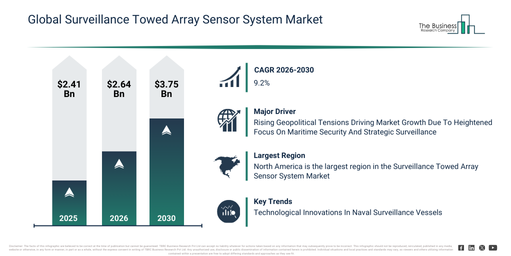
The surveillance towed array sensor system market is poised for substantial growth over the next few years, with its size projected to reach $3.75 billion in 2030, demonstrating a compound annual growth rate (CAGR) of 9.2%. This anticipated expansion during the forecast period is driven by the integration with AI and predictive analytics for real-time threat detection, an increase in deployment within unmanned underwater vehicles and autonomous platforms, a greater emphasis on environmental impact monitoring compliance, the expansion of mobile surveillance platforms, and the demand for higher-resolution acoustic signal processing systems. Key developments expected in this period include the continued enhancement of long-range underwater acoustic detection, a growing adoption of low-noise towed hydrophone array designs, the expansion of real-time underwater threat tracking capabilities, an increasing integration of modular and scalable sonar array architectures, and a strengthened focus on environmental noise reduction and signal clarity.
Rising global political strains are anticipated to fuel expansion in the surveillance towed array sensor system market in the future. These tensions represent difficult relationships among nations or regions, frequently stemming from political, economic, or land-related issues. Such situations typically emerge from competition for resources, power, or security, impacting worldwide stability and collaborative efforts. The escalation of geopolitical tensions is attributed to competitive power dynamics among countries, escalating mistrust and strategic rivalry, ultimately resulting in strained international ties. The surveillance towed array sensor system enhances naval security and boosts awareness of situations, aiding countries in overseeing vital waterways and mitigating misinterpretations that could intensify geopolitical disputes. For example, data from January 2025, cited by the World Economic Forum (WEF), a Swiss-based non-profit promoting public-private collaboration, reveals that in 2023, almost 60 armed conflicts were active, an unprecedented peak, and civilian fatalities rose by over 30% annually from 2023 to 2024. Consequently, the heightened geopolitical tensions are stimulating the expansion of the surveillance towed array sensor system market.
Download A Free Sample Report For Comprehensive Market Insights:
Surveillance Towed Array Sensor System Market Expansion Drivers: What Is Shaping Future Growth?
Companies within the surveillance towed array sensor system market are increasingly focusing on technological breakthroughs, such as the small waterplane area twin hull form, to boost stability, sonar capabilities, and operational effectiveness amidst difficult maritime environments. The small waterplane area twin hull (SWATH) design is a specialized naval architecture concept characterized by two slim submerged hulls linked by narrow supports to an upper deck, which significantly reduces the vessel’s waterplane area. As an illustration, in February 2025, Mitsubishi Heavy Industries (MHI), a Japanese manufacturing firm, launched the fourth Hibiki-class vessel for the Japan Maritime Self-Defense Force (JMSDF). This initiative significantly reinforces Japan’s advanced maritime surveillance capacity and marks a crucial development in bolstering the nation’s naval defense and anti-submarine warfare operations. The vessel incorporates towed-array sonar systems, and its introduction is intended to refine maritime situational understanding, improve the detection of underwater threats, and strengthen the JMSDF’s ability to perform efficiently in intricate and disputed naval settings.
Surveillance Towed Array Sensor System Market Segment Breakdown: Which Categories Generate The Most Revenue?
The surveillance towed array sensor system market covered in this report is segmented –
1) By Type: Passive Acoustic Sensor, Active Acoustic Sensor
2) By Component: Hydrophones, Towed Array Cables, Signal Processing Units, Other Supporting Components
3) By Application: Surface Vessels, Submarines, Unmanned Underwater Vehicles (UUVs)
4) By End-User: Defense, Commercial Maritime, Research And Oceanographic Institutions
Subsegments:
1) By Passive Acoustic Sensor: Broadband Passive Sensors, Narrowband Passive Sensors, Fiber-Optic Passive Sensors, Deep-Water Passive Sensors, Shallow-Water Passive Sensors
2) By Active Acoustic Sensor: Low-Frequency Active Sonar (LFAS), Medium-Frequency Active Sonar (MFAS), High-Frequency Active Sonar (HFAS), Variable Depth Active Sonar, Multi-Static Active Sonar Systems
Surveillance Towed Array Sensor System Market Trends: What Is Shaping Future Industry Growth?
Companies within the surveillance towed array sensor system market are increasingly focusing on technological breakthroughs, such as the small waterplane area twin hull form, to boost stability, sonar capabilities, and operational effectiveness amidst difficult maritime environments. The small waterplane area twin hull (SWATH) design is a specialized naval architecture concept characterized by two slim submerged hulls linked by narrow supports to an upper deck, which significantly reduces the vessel’s waterplane area. As an illustration, in February 2025, Mitsubishi Heavy Industries (MHI), a Japanese manufacturing firm, launched the fourth Hibiki-class vessel for the Japan Maritime Self-Defense Force (JMSDF). This initiative significantly reinforces Japan’s advanced maritime surveillance capacity and marks a crucial development in bolstering the nation’s naval defense and anti-submarine warfare operations. The vessel incorporates towed-array sonar systems, and its introduction is intended to refine maritime situational understanding, improve the detection of underwater threats, and strengthen the JMSDF’s ability to perform efficiently in intricate and disputed naval settings.
Surveillance Towed Array Sensor System Market Competitive Analysis Of Major Industry Participants
Major companies operating in the surveillance towed array sensor system market are RTX Corporation, Lockheed Martin Corporation, Thales Group, L3Harris Technologies Inc., Leidos Holdings Inc., Wärtsilä ELAC Nautik GmbH, Teledyne Instruments Inc., Kongsberg Gruppen ASA, Aselsan Elektronik Sanayi ve Ticaret A.Ş., Curtiss-Wright Corporation, QinetiQ Group plc, ATLAS ELEKTRONIK GmbH, Exail Technologies SA, Cohort plc, Sonardyne International Limited, MacArtney A/S, DSIT Solutions Ltd., GeoSpectrum Technologies Inc., Optics11 B.V., Concept Cables Ltd.
Access The Complete Surveillance Towed Array Sensor System Market Report:
Surveillance Towed Array Sensor System Market Regional Distribution: Which Areas Drive Market Expansion?
North America was the largest region in the surveillance towed array sensor system market in 2025. The regions covered in the surveillance towed array sensor system market report are Asia-Pacific, South East Asia, Western Europe, Eastern Europe, North America, South America, Middle East, Africa.
Access a Customized Surveillance Towed Array Sensor System Market Report for Deeper Competitive Insights
https://www.thebusinessresearchcompany.com/customise?id=29221&type=smp
The Business Research Company: https://www.thebusinessresearchcompany.com/
Americas: +1 310-496-7795
Asia: +44 7882 955267 & +91 8897263534
Europe: +44 7882 955267
Email us at: marketing@tbrc.info
Follow us on:
LinkedIn: https://in.linkedin.com/company/the-business-research-company
YouTube: https://www.youtube.com/channel/UC24_fI0rV8cR5DxlCpgmyFQ
Global Market Model: https://www.thebusinessresearchcompany.com/global-market-model

Wasay has over a decade of experience in market research, data modelling, and analytics, with prior experience at GlobalData and Decision Tree Consulting Services. At The Business Research Company , he leads research operations across syndicated studies, customized consulting engagements, and the Global Market Model platform. His professional experience includes supporting organizations such as Boston Consulting Group, KPMG, and Ernst & Young. Wasay holds a degree in Electronics and Communications Engineering, postgraduate management qualifications from International Management Institute Belgium and Indian School of Business and Entrepreneurship, and completed the Integrated Program in Business Analytics from Indian Institute of Management Indore.