Enhanced with market attractiveness analysis, total addressable market evaluation, company benchmarking matrices, interactive Excel dashboards, expanded supply chain intelligence, emerging startup coverage, and detailed product insights, The Business Research Company’s 2026 market reports deliver more actionable and strategically valuable research.
Surveillance Unmanned Aerial Vehicles (UAVs) Market Size Outlook: How Fast Will Revenue Grow Through 2030?
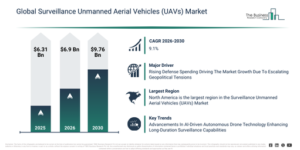
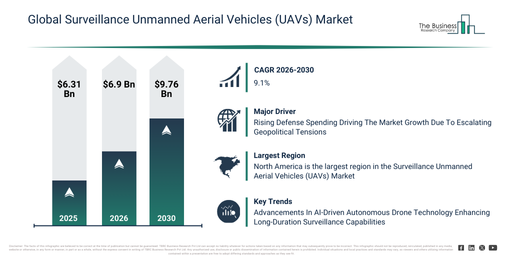
The market for surveillance unmanned aerial vehicles (uavs) is projected to experience robust expansion over the coming years. This market is anticipated to reach $9.76 billion by 2030, demonstrating a compound annual growth rate (CAGR) of 9.1%. Key drivers for this growth during the forecast period include rising demand for real-time aerial monitoring and infrastructure inspection, the expansion of UAV fleets for perimeter and crowd surveillance, the adoption of advanced lidar and sensor fusion technologies, the development of autonomous and AI-assisted surveillance UAVs, and increased collaboration between UAV manufacturers and defense or civil agencies for large-scale monitoring solutions. Significant trends expected in the forecast period involve increased adoption of long-endurance uav platforms, rising demand for advanced sensor fusion capabilities, expansion of uav-based infrastructure inspection services, growth in commercial and civilian surveillance applications, and increased integration of lightweight, high-efficiency payload systems.
The growth of the surveillance UAVs market is anticipated to be propelled by increasing defense spending in the coming years. This government allocation for military forces, operations, and defense activities, crucial for safeguarding national interests, is escalating due to rising geopolitical tensions. Countries are consequently augmenting their military budgets to strengthen defense capabilities amidst regional conflicts and global power rivalries. Such increased spending significantly boosts surveillance unmanned aerial vehicles (UAVs) through enhanced technological capabilities, fleet expansion, and improved operational effectiveness. Specifically, greater budgets facilitate advanced research and development, leading to more sophisticated sensors, AI-driven systems, and stealth features. Illustratively, in April 2025, the Stockholm International Peace Research Institute reported that global military spending reached 2,718 billion dollars in 2024, marking a 9.4% increase in real terms from the prior year. Therefore, the expansion of defense spending is poised to stimulate the growth of the surveillance UAVs market.
Download A Free Sample Report For Comprehensive Market Insights:
Surveillance Unmanned Aerial Vehicles (UAVs) Market Growth Momentum: Which Factors Are Influencing Demand?
Key players within the surveillance UAVs market are concentrating on developing sophisticated solutions, including artificial intelligence-powered drones, to efficiently process extensive data sets. These artificial intelligence-powered drones are unmanned aerial vehicles integrated with AI technologies, allowing them to execute autonomous operations like navigation, data analysis, and decision-making without human involvement. For instance, in May 2025, Helsing, a Germany-based defense company, unveiled Fathom, an underwater surveillance drone. This underwater surveillance system employs artificial intelligence to identify adversarial submarines and vessels for extended durations at sea. The AI-powered tool, Lura, then processes information gathered from SG-1 Fathom drones. Lura can precisely detect and differentiate underwater threats by utilizing an extensive acoustic model derived from their distinct sound signatures. Furthermore, the Fathom drones are equipped with swarming capabilities, which facilitates the deployment of hundreds of units to continuously monitor underwater areas for up to three months.
Surveillance Unmanned Aerial Vehicles (UAVs) Market Segment Analysis: What Are The Major Market Categories?
The surveillance unmanned aerial vehicles (uavs) market covered in this report is segmented –
1) By Type: Rotary Airfoil, Fixed-Wing, Other Types
2) By Technology: Electro-Optical Or Infrared Systems, Radar Systems, Signal Intelligence (SIGINT), Acoustic Sensors, Multispectral Sensors
3) By End-User: Government And Defense, Agriculture, Commercial Enterprises, Research Institutions, Non-Governmental Organizations (NGOs)
Subsegments:
1) By Rotary Airfoil: Single Rotor, Multi-Rotor, Helicopters, Quadcopters
2) By Fixed-Wing: Conventional Fixed-Wing, Flying Wing, Blended Wing Body
3) By Other Types: Hybrid VTOL, Tethered UAVs, Solar-Powered UAVs
Surveillance Unmanned Aerial Vehicles (UAVs) Market Innovation Trends: Which Developments Are Transforming The Industry?
Key players within the surveillance UAVs market are concentrating on developing sophisticated solutions, including artificial intelligence-powered drones, to efficiently process extensive data sets. These artificial intelligence-powered drones are unmanned aerial vehicles integrated with AI technologies, allowing them to execute autonomous operations like navigation, data analysis, and decision-making without human involvement. For instance, in May 2025, Helsing, a Germany-based defense company, unveiled Fathom, an underwater surveillance drone. This underwater surveillance system employs artificial intelligence to identify adversarial submarines and vessels for extended durations at sea. The AI-powered tool, Lura, then processes information gathered from SG-1 Fathom drones. Lura can precisely detect and differentiate underwater threats by utilizing an extensive acoustic model derived from their distinct sound signatures. Furthermore, the Fathom drones are equipped with swarming capabilities, which facilitates the deployment of hundreds of units to continuously monitor underwater areas for up to three months.
Surveillance Unmanned Aerial Vehicles (UAVs) Market Leading Players Shaping Industry Direction
Major companies operating in the surveillance unmanned aerial vehicles (uavs) market are Lockheed Martin Corporation, Airbus SE, Northrop Grumman Corporation, BAE Systems plc, Thales Group, Textron Inc., Elbit Systems Ltd., Israel Aerospace Industries Ltd., Saab AB, DJI Service LLC, General Atomics Aeronautical Systems Inc., Anduril Industries, AeroVironment Inc., Yuneec International Co. Ltd., Autel Robotics Co., Skydio Inc., Parrot SA, Baykar Makina Sanayi ve Ticaret A.Ş., AgEagle Aerial Systems Inc., Teal Drones Inc.
Access The Complete Surveillance Unmanned Aerial Vehicles (UAVs) Market Report:
Surveillance Unmanned Aerial Vehicles (UAVs) Market Global Footprint: Which Region Holds Market Leadership?
North America was the largest region in the surveillance unmanned aerial vehicles (UAVs) market in 2025. Asia-Pacific is expected to be the fastest-growing region in the forecast period. The regions covered in the surveillance unmanned aerial vehicles (uavs) market report are Asia-Pacific, South East Asia, Western Europe, Eastern Europe, North America, South America, Middle East, Africa.
Access a Customized Surveillance Unmanned Aerial Vehicles (UAVs) Market Report for Deeper Competitive Insights
https://www.thebusinessresearchcompany.com/customise?id=25651&type=smp
The Business Research Company: https://www.thebusinessresearchcompany.com/
Americas: +1 310-496-7795
Asia: +44 7882 955267 & +91 8897263534
Europe: +44 7882 955267
Email us at: marketing@tbrc.info
Follow us on:
LinkedIn: https://in.linkedin.com/company/the-business-research-company
YouTube: https://www.youtube.com/channel/UC24_fI0rV8cR5DxlCpgmyFQ
Global Market Model: https://www.thebusinessresearchcompany.com/global-market-model

Wasay has over a decade of experience in market research, data modelling, and analytics, with prior experience at GlobalData and Decision Tree Consulting Services. At The Business Research Company , he leads research operations across syndicated studies, customized consulting engagements, and the Global Market Model platform. His professional experience includes supporting organizations such as Boston Consulting Group, KPMG, and Ernst & Young. Wasay holds a degree in Electronics and Communications Engineering, postgraduate management qualifications from International Management Institute Belgium and Indian School of Business and Entrepreneurship, and completed the Integrated Program in Business Analytics from Indian Institute of Management Indore.