
Delivering more actionable and strategically valuable research, The Business Research Company’s 2026 market reports feature market attractiveness analysis, total addressable market evaluation, company benchmarking matrices, interactive Excel dashboards, expanded supply chain intelligence, emerging startup coverage, and detailed product insights.
Rocket Reusability Testing Market Forecast: What Market Value Is Expected By 2030?
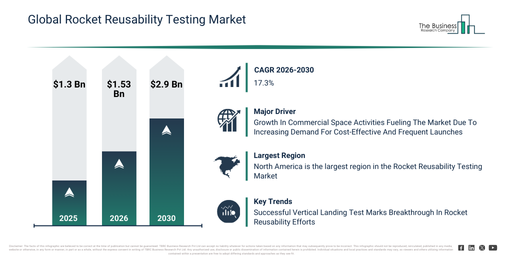
The market size for rocket reusability testing has seen swift growth in recent years. This market is anticipated to rise from $1.3 billion in 2025 to $1.53 billion in 2026, achieving a compound annual growth rate (CAGR) of 17.7%. The expansion observed in the past can be credited to an escalated focus on cost reduction, which stimulated the early stages of reusability testing programs. Furthermore, advancements in propulsion endurance testing facilitated multi-cycle engine validation, alongside the implementation of thermal protection system evaluations to gauge heat shield durability. The development of structural integrity assessment methods for reusable rocket stages, and the creation of avionics and landing gear testing equipment to aid safe booster recovery, also contributed to this growth.
The rocket reusability testing market size is anticipated to experience rapid expansion in the upcoming years, with projections indicating it will reach $2.9 billion by 2030, exhibiting a compound annual growth rate (CAGR) of 17.3%. This growth during the forecast period stems from several factors, including the expansion of reusable launch fleets increasing the need for comprehensive reusability testing services, innovation in simulation tools enhancing the accuracy of multi-cycle performance predictions, the growing adoption of advanced materials demanding new structural and thermal testing protocols, an intensified focus on rapid vehicle turnaround driving the necessity for accelerated reusability qualification, and rising commercial and government investments in next-generation reusable rockets expanding testing infrastructure requirements. Major trends expected in this period encompass increased multi-cycle engine endurance validation, a rising demand for advanced thermal protection assessment, the expansion of high-fidelity structural stress simulation, growth in precision landing system reusability testing, and the development of modular reusability certification frameworks.
Download A Free Sample Report For Comprehensive Market Insights:
Rocket Reusability Testing Market Industry Drivers: What Is Driving Revenue Growth?
The expanding commercial space industry is projected to drive forward the growth of the rocket reusability testing market. This industry encompasses the private sector’s engagement in creating, launching, and managing space technologies and services for profit. Its rapid expansion is fueled by decreasing launch expenses, largely due to advancements in reusable rocket technology, making space access more affordable for private enterprises. Rocket reusability testing plays a crucial role by lowering launch costs and increasing the frequency of missions, thereby fostering scalable and sustainable development within the commercial space industry. For example, as reported by Payload Space, a US-based space news publishing company, in January 2025, commercially operated rockets accounted for 70% of worldwide launch attempts in 2024, a rise from 65% in 2023 and 55% in 2022. Consequently, the flourishing commercial space industry is a key factor propelling the rocket reusability testing market.
Rocket Reusability Testing Market Segment Analysis: What Are The Major Market Categories?
The rocket reusability testing market covered in this report is segmented –
1) By Testing Type: Structural Testing, Propulsion Testing, Thermal Testing, Avionics Testing, Other Types
2) By Stage: First Stage, Second Stage, Other Stages
3) By End-User: Commercial, Military, Government
Subsegments:
1) By Structural Testing: Fatigue Testing, Load Testing, Vibration Testing, Shock Testing, Material Stress Testing
2) By Propulsion Testing: Static Fire Tests, Engine Ignition Cycle Testing, Throttle Response Testing, Re-Ignition Testing, Thrust Vector Control (TVC) Testing
3) By Thermal Testing: Thermal Cycle Testing, Heat Shield Reusability Testing, Ablative Material Testing, Cryogenic Temperature Testing, Thermal Vacuum Testing
4) By Avionics Testing: Hardware-In-The-Loop (HIL) Testing, Flight Control System Validation, Sensor And Telemetry System Testing, Software Simulation Testing, Communication System Testing.
5) By Other Testing: Acoustic Testing, Electromagnetic Interference (EMI) Testing, Environmental Stress Screening (ESS), Integration Testing, Inspection And Non-Destructive Testing (NDT)
Rocket Reusability Testing Market Innovation Trends: Which Developments Are Transforming The Industry?
Leading companies within the **rocket reusability testing market** are prioritizing advanced testing solutions, such as reusable rocket landing testing, to confirm the efficacy, steadiness, and accuracy of vertical landings, guaranteeing the secure re-utilization of launch vehicles. Reusable rocket landing testing involves assessing a rocket’s capability to return and touch down vertically in a controlled fashion, thereby making it suitable for safe deployment across numerous missions. As an illustration, in **June 2025**, **Honda Motor Co., Ltd.**, an automotive manufacturer based in **Japan**, successfully carried out its inaugural launch and landing trial of an experimental reusable rocket at its facility in **Taiki Town, Hokkaido, Japan**, signifying a crucial advancement for the company’s foray into space technology. The rocket, measuring **6.3-meter** and weighing **1,312 kg** with its fuel load, ascended to an altitude of **271.4 meters** and, following a **56.6-second** flight, landed merely **37 centimeters** off its mark, showcasing vital reusability technologies like flight stability and pinpoint landing. This accomplishment underscores Honda’s drive to expand beyond automotive advancements, placing it among a select group of firms working on reusable rockets, with future aspirations encompassing suborbital spaceflight by **2029** and potential uses in satellite deployment and space-based communication.
Rocket Reusability Testing Market Leading Companies: Who Holds Significant Market Presence?
Major companies operating in the rocket reusability testing market are The Boeing Company, SpaceX Technologies Corp., Blue Origin LLC, ArianeGroup SAS, Relativity Space Inc., Rocket Lab USA Inc., Firefly Aerospace Inc., Rocket Factory Augsburg AG, Orbex Space Ltd., Stoke Space Technologies Inc., Beijing Galactic Energy Co. Ltd., Stratolaunch LLC, LandSpace Technology Corporation Ltd., Astrobotic Technology Inc., Deimos-One Inc., Exos Aerospace Systems & Technologies Inc., Innovative Rocket Technologies Inc., Payload Aerospace S.L., Radian Aerospace Inc., Skyrora Limited
Access The Complete Rocket Reusability Testing Market Report:
Rocket Reusability Testing Market Leading Geography: Which Region Generates The Most Revenue?
North America was the largest region in the rocket reusability testing market in 2025. The regions covered in the rocket reusability testing market report are Asia-Pacific, South East Asia, Western Europe, Eastern Europe, North America, South America, Middle East, Africa.
Access a Customized Rocket Reusability Testing Market Report for Deeper Competitive Insights
https://www.thebusinessresearchcompany.com/customise?id=25538&type=smp
The Business Research Company: https://www.thebusinessresearchcompany.com/
Americas: +1 310-496-7795
Asia: +44 7882 955267 & +91 8897263534
Europe: +44 7882 955267
Email us at: marketing@tbrc.info
Follow us on:
LinkedIn: https://in.linkedin.com/company/the-business-research-company
YouTube: https://www.youtube.com/channel/UC24_fI0rV8cR5DxlCpgmyFQ
Global Market Model: https://www.thebusinessresearchcompany.com/global-market-model

Wasay has over a decade of experience in market research, data modelling, and analytics, with prior experience at GlobalData and Decision Tree Consulting Services. At The Business Research Company , he leads research operations across syndicated studies, customized consulting engagements, and the Global Market Model platform. His professional experience includes supporting organizations such as Boston Consulting Group, KPMG, and Ernst & Young. Wasay holds a degree in Electronics and Communications Engineering, postgraduate management qualifications from International Management Institute Belgium and Indian School of Business and Entrepreneurship, and completed the Integrated Program in Business Analytics from Indian Institute of Management Indore.
