
Featuring market attractiveness scoring, total addressable market sizing, company benchmarking matrices, interactive Excel dashboards, deeper supply chain intelligence, emerging startup tracking, and granular product-level insights, The Business Research Company’s 2026 market reports are built to deliver research that is both more actionable and more strategically valuable.
Lab Automation Market Size, Value And Growth Trajectory Through 2030
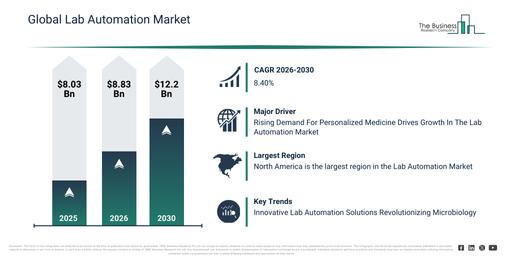
The lab automation market size has experienced robust growth in recent years. It is anticipated to increase from $8.03 billion in 2025 to $8.83 billion in 2026, reflecting a compound annual growth rate (CAGR) of 9.9%. This historical expansion can be linked to the increasing complexity of laboratory research, the growing requirement for swifter testing processes, a heightened emphasis on precision and reproducibility, the expansion of pharmaceutical and biotech research, and the early adoption of mechanical lab assistance.
The lab automation market is projected to experience robust expansion over the coming years. Its valuation is anticipated to reach $12.2 billion by 2030, demonstrating a compound annual growth rate (CAGR) of 8.4%. This projected growth is driven by several factors including an increased demand for automated diagnostic systems, ongoing laboratory modernization efforts, a heightened requirement for high throughput testing, an expansion of clinical and genomic research, and strengthened investment in advanced laboratory infrastructure. Key trends anticipated during this period involve a rising move towards decreasing manual laboratory tasks, a greater emphasis on enhancing testing efficiency and throughput, an increasing embrace of automated diagnostic systems, the expansion of automated workflows throughout research settings, and a reinforced focus on accuracy, consistency, and reliability within laboratories.
Get A Free Sample Report With In-Depth Market Insights:
Lab Automation Market Growth Catalysts And Demand Drivers
The increasing need for personalized medicine is projected to propel the expansion of the lab automation market moving forward. Personalized medicine, also known as precision medicine, represents a medical approach designed to customize healthcare decisions, practices, interventions, and treatments for individual patients. The escalating demand for personalized medicine stems from several factors, including breakthroughs in genomics and molecular diagnostics, enhanced public awareness and education, the escalating burden of chronic diseases, and its inherent cost-effectiveness. Lab automation significantly boosts the efficiency, accuracy, and scalability of laboratory procedures, thereby empowering healthcare professionals and researchers to develop personalized medicine strategies that improve patient outcomes and optimize treatment efficacy. As an illustration, in February 2024, the Personalized Medicine Coalition (PMC), a US-based advocacy organization, reported that in 2023, the FDA approved 16 new personalized treatments for rare disease patients, marking an increase from just six approvals in 2022. Hence, the rising demand for personalized medicine is a key driver for the growth of the lab automation market.
Lab Automation Market Segmentation And Category Overview
The lab automation market covered in this report is segmented –
1) By Stage Of Automation: Pre-Analytical Stage, Analytical Stage, Post-Analytical Stage, Total Lab Automation
2) By Process: Discrete Processing, Continuous Flow
3) By Application: Diagnostics, Genomic Solutions, Microbiology, Drug Discovery, Proteomic Solutions, Other Applications
4) By End-User: Pharmaceutical and Biotechnology Companies, Research and Diagnostic Laboratories, Other End-Users
Subsegments:
1) By Pre-Analytical Stage: Sample Collection, Sample Preparation, Sample Storage
2) By Analytical Stage: Sample Analysis, Data Collection, Testing & Measurement
3) By Post-Analytical Stage: Data Interpretation, Reporting Results, Quality Control
4) By Total Lab Automation: End-To-End Automation Of Lab Processes, Integration Of Pre, Analytical, And Post-Analytical Stages
Lab Automation Market Trends Shaping Long-Term Demand
Leading firms within the lab automation market are creating cutting-edge solutions, including lab automation systems specifically for microbiology laboratories, with the aim of optimizing laboratory space and streamlining operational workflows. These lab automation systems for microbiology laboratories represent sophisticated technological advancements engineered to simplify and improve the processing, analysis, and overall management of microbiological specimens and their associated data. An example is the launch in January 2023 by Becton, Dickinson, and Company, a US-based medical technology firm, of its new third-generation BD Kiestra Total Lab Automation System, designed for microbiology laboratories. This particular system is modular, enabling it to adapt to and fulfill the diverse needs of laboratories, which in turn leads to improved operational efficiency, greater financial savings, and enhanced overall laboratory results. It functions as an advanced, fully automated robotic system, making microbiology laboratory tasks like sample processing, digital imaging, incubation, and result analysis more efficient and effective. Moreover, its various attributes, including automated microbiology processes, a modular and scalable design, the BD Synapys microbiology informatics solution, and high throughput processing, are poised to revolutionize clinical bacteriological testing, elevate laboratory performance, and address the evolving demands of contemporary microbiology laboratories.
Lab Automation Market Competitive Analysis Of Leading Industry Participants
Major companies operating in the lab automation market report are Thermo Fisher Scientific, Becton Dickinson And Company (BD), Agilent Technologies Inc., PerkinElmer LLC, Beckman Coulter Inc., Biomek Inc., Bio-Rad Laboratories, QIAGEN N.V., Tecan Group, Brooks Life Sciences, Hamilton Company, Promega Corporation, Opentrons Labworks Inc, Analytik Jena AG, Gilson Inc., Eppendorf Corporate, Hudson Robotics, Beckman Coulter Life Sciences, Zymo Research Corp., Perceptive Instruments Ltd., Synthace Ltd., Festo Corp., Roche Diagnostics, Peak Analysis & Automation (PAA)
View The Full Lab Automation Market Report:
Lab Automation Market Regional Analysis: Which Geography Leads On Revenue?
North America was the largest region in the lab automation market in 2025. Asia-Pacific is expected to be the fastest-growing region in the forecast period. The regions covered in the lab automation market report are Asia-Pacific, South East Asia, Western Europe, Eastern Europe, North America, South America, Middle East, Africa.
Reach Out To Our Team:
The Business Research Company: https://www.thebusinessresearchcompany.com/
Americas: +1 310-496-7795
Asia: +44 7882 955267 & +91 8897263534
Europe: +44 7882 955267
Email us at: marketing@tbrc.info
Follow us on:
LinkedIn: https://in.linkedin.com/company/the-business-research-company
YouTube: https://www.youtube.com/channel/UC24_fI0rV8cR5DxlCpgmyFQ
Global Market Model: https://www.thebusinessresearchcompany.com/global-market-model

Wasay has over a decade of experience in market research, data modelling, and analytics, with prior experience at GlobalData and Decision Tree Consulting Services. At The Business Research Company , he leads research operations across syndicated studies, customized consulting engagements, and the Global Market Model platform. His professional experience includes supporting organizations such as Boston Consulting Group, KPMG, and Ernst & Young. Wasay holds a degree in Electronics and Communications Engineering, postgraduate management qualifications from International Management Institute Belgium and Indian School of Business and Entrepreneurship, and completed the Integrated Program in Business Analytics from Indian Institute of Management Indore.