Backed by market attractiveness analysis, total addressable market sizing, company benchmarking matrices, interactive Excel dashboards, wider supply chain intelligence, emerging startup coverage, and detailed product-level insights, The Business Research Company’s 2026 market reports are designed to offer research that is more actionable and strategically valuable than ever.
Automotive Chassis System Market Set To Climb From $85.39 Billion In 2026 To $113.36 Billion By 2030
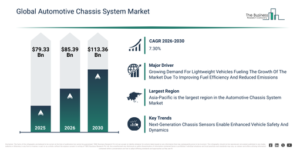
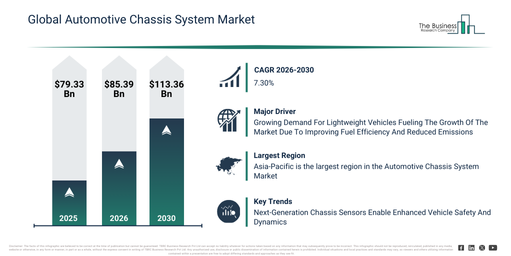
The automotive chassis system market has demonstrated significant expansion in recent years. It is expected to advance from $79.33 billion in 2025 to $85.39 billion in 2026, registering a compound annual growth rate (CAGR) of 7.6%. The market’s growth in the past can be ascribed to a surge in vehicle manufacturing, increased demand for vehicles with better fuel efficiency, the growing integration of lightweight materials for chassis, an expanding fleet of commercial vehicles, and heightened demands for safety and stability.
The automotive chassis system market is projected to experience robust expansion over the coming years. Its valuation is set to reach $113.36 billion by 2030, progressing at a compound annual growth rate (CAGR) of 7.3%. This anticipated growth during the forecast period is primarily driven by the increasing uptake of electric vehicles, the rising incorporation of sophisticated suspension technologies, escalating investments in vehicle lightweighting, the expanding development of autonomous vehicles, and the increasing need for modular chassis platforms. Key trends expected during this period encompass enhancements in smart chassis technologies, the creation of lightweight composite materials, intensified research and development efforts in EV-specific chassis designs, the growing incorporation of digital and sensor-based chassis systems, and breakthroughs in autonomous and connected chassis solutions.
Get A Free Sample Report With In-Depth Market Insights:
Automotive Chassis System Market Growth Factors: What’s Supporting Expansion?
The increasing requirement for lightweight vehicles is projected to boost the expansion of the automotive chassis system market in the future. These vehicles are defined as automobiles constructed with less dense materials like aluminum, high-strength steel, carbon fiber, and various composites, aiming to decrease the total weight of the vehicle. This rising demand stems from the greater necessity for enhanced fuel efficiency and lower emissions. Automotive chassis systems contribute to lightweight vehicles through the incorporation of advanced materials and streamlined designs, which effectively lower the overall vehicle weight while maintaining structural integrity and safety standards. Such systems boost fuel efficiency and performance by facilitating improved handling, decreasing emissions, and extending the driving range. An illustrative example is seen in December 2024, where data from the American Chemistry Council, a US-based trade association, indicated that an average automobile incorporates 429 pounds of plastics and polymer composites, representing 9.7% of the vehicle’s total mass, and the quantity of polypropylene per vehicle escalated from 97 pounds in 2022 to 100 pounds in 2023. Consequently, the expanding demand for lightweight vehicles is a key factor propelling the expansion of the automotive chassis system market.
Automotive Chassis System Market Segment Analysis Spotlighting Growth Areas
The automotive chassis system market covered in this report is segmented –
1) By Component: Suspension Systems, Steering Mechanisms, Wheel Assemblies And Hubs, Braking Structures And Components, Frame And Structural Members, Cross-Axis And Stabilizer Links, Control Arms And Tie-Rods
2) By Vehicle Type: Passenger Cars, Light Commercial Vehicles, Heavy Commercial Vehicles, Construction Equipment Vehicles, Defense Vehicles, Farm Tractors
3) By Material: High-Strength Steel, Aluminum, Composite Materials, Other Alloys
4) By Chassis System: Front Axle, Rear Axle, Corner Modules, Active Kinematics
Subsegments:
1) By Suspension Systems: Coil Springs, Leaf Springs, Air Springs, Torsion Bars, Shock Absorbers
2) By Steering Mechanisms: Rack And Pinion, Recirculating Ball, Electric Power Steering, Hydraulic Power Steering, Manual Steering
3) By Wheel Assemblies And Hubs: Wheel Rims, Wheel Bearings, Wheel Hubs, Wheel Nuts And Bolts, Hub Caps
4) By Braking Structures And Components: Disc Brakes, Drum Brakes, Brake Calipers, Brake Pads, Brake Rotors, Brake Lines
5) By Frame And Structural Members: Chassis Frames, Subframes, Crossmembers, Rails, Reinforcements
6) By Cross-Axis And Stabilizer Links: Sway Bars, Stabilizer Links, Anti-Roll Bars, Torsion Bars
7) By Control Arms And Tie-Rods: Upper Control Arms, Lower Control Arms, Ball Joints, Tie Rod Ends, Idler Arms
Automotive Chassis System Market Industry Trends: What’s Reshaping Demand?
Leading companies in the automotive chassis system market are prioritizing the development of advanced intelligent systems, such as next-generation chassis sensors, to bolster vehicle safety, driving dynamics, and comfort. These next-generation chassis sensors are sophisticated sensing devices integrated into a vehicle’s chassis, engineered to monitor, measure, and report real-time data related to the vehicle’s dynamics, suspension, wheel movement, and interactions with the road. For instance, in July 2025, ZF Friedrichshafen AG, a Germany-based automotive systems supplier, unveiled its new Smart Chassis Sensor. This enhanced component not only gauges wheel height but also captures three-dimensional acceleration, enabling advanced functionalities like real-time ‘Chassis Health’ monitoring, vehicle load detection, and support for active noise cancellation. Its design, integrated within a standard ball joint, serves to reduce system complexity, cut costs, and ensure seamless integration with other ZF systems, such as steer-by-wire, aligning with the company’s overarching ‘Chassis 2.0’ strategy.
Automotive Chassis System Market Leading Players And Competitive Positioning
Major companies operating in the automotive chassis system market are Hyundai Mobis Co. Ltd., ZF Friedrichshafen AG, Magna International Inc., AISIN Corporation, Schaeffler Group, Gestamp Automoción S.A., Dana Incorporated, BENTELER AG, Knorr-Bremse AG, NTN Corporation, CIE Automotive S.A., HL Mando Corporation, Martinrea International Inc., Metalsa S.A. de C.V., F‑Tech Inc., Sogefi S.p.A., Multimatic Inc., Hitachi Astemo Ltd, KLT Automotive & Tubular Products Ltd., ALF Engineering Pvt. Ltd.
View The Full Automotive Chassis System Market Report:
Automotive Chassis System Market Regional Split: Which Areas Are Fueling Growth?
Asia-Pacific was the largest region in the automotive chassis system market in 2025, and it is expected to be the fastest-growing region in the forecast period. The regions covered in the automotive chassis system market report are Asia-Pacific, South East Asia, Western Europe, Eastern Europe, North America, South America, Middle East, Africa.
Reach Out To Our Team:
The Business Research Company: https://www.thebusinessresearchcompany.com/
Americas: +1 310-496-7795
Asia: +44 7882 955267 & +91 8897263534
Europe: +44 7882 955267
Email us at: marketing@tbrc.info
Follow us on:
LinkedIn: https://in.linkedin.com/company/the-business-research-company
YouTube: https://www.youtube.com/channel/UC24_fI0rV8cR5DxlCpgmyFQ
Global Market Model: https://www.thebusinessresearchcompany.com/global-market-model

Wasay has over a decade of experience in market research, data modelling, and analytics, with prior experience at GlobalData and Decision Tree Consulting Services. At The Business Research Company , he leads research operations across syndicated studies, customized consulting engagements, and the Global Market Model platform. His professional experience includes supporting organizations such as Boston Consulting Group, KPMG, and Ernst & Young. Wasay holds a degree in Electronics and Communications Engineering, postgraduate management qualifications from International Management Institute Belgium and Indian School of Business and Entrepreneurship, and completed the Integrated Program in Business Analytics from Indian Institute of Management Indore.