Featuring market attractiveness scoring, total addressable market sizing, company benchmarking matrices, interactive Excel dashboards, deeper supply chain intelligence, emerging startup tracking, and granular product-level insights, The Business Research Company’s 2026 market reports are built to deliver research that is both more actionable and more strategically valuable.
Bee Vectoring Technologies Market Value Analysis: What Growth Lies Ahead Over The Forecast Period?
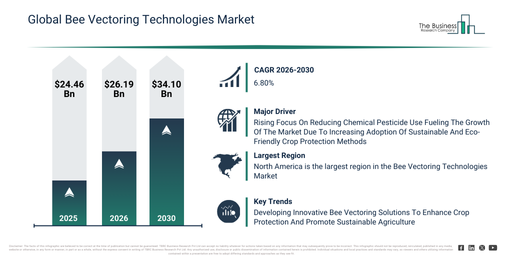
The bee vectoring technologies market size has shown robust growth over recent years. It is anticipated to expand from $24.46 billion in 2025 to $26.19 billion in 2026, exhibiting a compound annual growth rate (CAGR) of 7.1%. This historical expansion is attributed to the increasing adoption of biological crop protection, growing awareness of sustainable farming, a rising need for targeted pest control, the expanding use of pollination-based delivery methods, and a significant shift away from chemical pesticides.
The bee vectoring technologies market size is anticipated to experience substantial growth over the next few years. It is forecast to expand to $34.10 billion in 2030, achieving a compound annual growth rate (CAGR) of 6.8%. This projected increase within the forecast period can be attributed to a rising demand for eco-friendly pest management solutions, an increased focus on residue-free agricultural practices, the expanding prevalence of commercial farming, the growing adoption of precision agriculture tools, and increased investment in controlled environment agriculture. Prominent trends for this period include technological improvements in microbial delivery systems, innovations concerning pollination-linked application methods, new developments in biological agent formulations, ongoing research and development into sustainable crop protection, and advancements in the integration of precision agriculture.
Get A Free Sample Report With In-Depth Market Insights:
Bee Vectoring Technologies Market Demand Drivers Opening New Revenue Streams
The increasing focus on diminishing chemical pesticide application is expected to drive the expansion of the bee vectoring technologies market going forward. Chemical pesticide use relates to the shift towards reducing synthetic chemical inputs in agriculture to lessen environmental impact, minimize health risks, and prevent pests from developing resistance. This heightened emphasis on lowering chemical pesticide use is driven by rising environmental worries and increasing consumer demand for organic and residue-free food products. Bee vectoring technologies aid in reducing chemical pesticide use by utilizing pollinators such as bees to deliver biological control agents directly to crops, enabling precise pest and disease management while significantly decreasing the requirement for chemical pesticides. For instance, in July 2025, according to the Food and Agriculture Organization of the United Nations, an international organization based in Italy, global agricultural pesticide use dropped to 3.73 million tonnes of active ingredients in 2023, a 2% decline from 2022, with application intensity at 2.40 kilograms per hectare of cropland; concurrently, total pesticide exports decreased by 3% in volume to 6.7 million tonnes of formulated products and fell by 12% in value to $42.8 billion. Therefore, the rising focus on reducing chemical pesticide use is propelling the growth of the bee vectoring technologies market.
Bee Vectoring Technologies Market Segmentation And Category Overview
The bee vectoring technologies market covered in this report is segmented –
1) By Type: Chemical, Mechanical, Biological, Other Types
2) By Crop Type: High-Value Fruits, Vegetables, Berries, Nuts, Oilseeds, Ornamentals, Row Crops, Seed Crops
3) By Technology: Bee Vectoring Technology System, Vectoring Agents, Integrated Service Model
4) By Distribution Channel: Direct Sales, Distributors, Agricultural Supply Stores, Online Channels
5) By Application: Commercial, Residential, Agriculture, Industrial, Other Applications
Subsegments:
1) By Chemical: Organic Chemical Assessments, Inorganic Chemical Assessments, Synthetic Chemical Assessments, Analytical Chemical Assessments
2) By Mechanical: Structural Mechanical Evaluations, Functional Mechanical Assessments, Dynamic Mechanical Testing, Mechanical Stress Analysis
3) By Biological: Cognitive Biological Assessments, Behavioral Biological Evaluations, Neurological Biological Testing, Physiological Biological Measurements
4) By Other Types: Multidisciplinary Assessments, Integrated Testing Solutions, Hybrid Evaluation Methods, Specialized Custom Assessments
Bee Vectoring Technologies Market Trends Powering Strategic Industry Growth
Leading companies in the bee vectoring technologies market are focused on developing innovative solutions, such as biological agent delivery systems and crop protection monitoring tools. These advancements aim to enhance pest and disease management, boost crop yields, and reinforce sustainable agricultural practices. Biological agent delivery systems and crop protection monitoring tools are technologies employed for applying beneficial microorganisms, monitoring crop health, and enabling timely interventions at both individual plant and field levels. For instance, in August 2024, Vectorite with Clonostachys Rosea CR-7 (CR-7), developed by Bee Vectoring Technologies International Inc., a Canada-based provider of pollination and crop protection solutions, received approval from Mexico’s COFEPRIS (The Federal Commission for Protection from Sanitary Risks). This biological control solution targets fungal pathogens in berry and orchard crops, utilizing the company’s proprietary bee vectoring system and integrated field monitoring software. CR 7 Spray ensures precise agent distribution and real-time crop health data, empowering growers to optimize disease management and minimize chemical pesticide usage. The approval permits CR-7 to be applied by both bumble bees and honeybees on a variety of high-value crops, including berry crops and greenhouse-grown vegetables.
Bee Vectoring Technologies Market Competitive Landscape: Who Leads The Industry?
Major companies operating in the bee vectoring technologies market are Rentokil Initial plc, Biobest Group NV, Beewise Inc., Koppert Biological Systems B.V., Bio-Bee Agricultural Industries Ltd., Terramera Inc., BeeHero Technologies Ltd., BioWorks Inc., Andermatt Biocontrol AG, HiveTracks Inc., Bee Vectoring Technologies International Inc.
View The Full Bee Vectoring Technologies Market Report:
Bee Vectoring Technologies Market Geographic Landscape: Which Region Leads Industry Growth?
North America was the largest region in the bee vectoring technologies market in 2025. Asia-Pacific is expected to be the fastest-growing region in the forecast period. The regions covered in the bee vectoring technologies market report are Asia-Pacific, South East Asia, Western Europe, Eastern Europe, North America, South America, Middle East, Africa.
Reach Out To Our Team:
The Business Research Company: https://www.thebusinessresearchcompany.com/
Americas: +1 310-496-7795
Asia: +44 7882 955267 & +91 8897263534
Europe: +44 7882 955267
Email us at: marketing@tbrc.info
Follow us on:
LinkedIn: https://in.linkedin.com/company/the-business-research-company
YouTube: https://www.youtube.com/channel/UC24_fI0rV8cR5DxlCpgmyFQ
Global Market Model: https://www.thebusinessresearchcompany.com/global-market-model

Wasay has over a decade of experience in market research, data modelling, and analytics, with prior experience at GlobalData and Decision Tree Consulting Services. At The Business Research Company , he leads research operations across syndicated studies, customized consulting engagements, and the Global Market Model platform. His professional experience includes supporting organizations such as Boston Consulting Group, KPMG, and Ernst & Young. Wasay holds a degree in Electronics and Communications Engineering, postgraduate management qualifications from International Management Institute Belgium and Indian School of Business and Entrepreneurship, and completed the Integrated Program in Business Analytics from Indian Institute of Management Indore.