Backed by market attractiveness analysis, total addressable market sizing, company benchmarking matrices, interactive Excel dashboards, wider supply chain intelligence, emerging startup coverage, and detailed product-level insights, The Business Research Company’s 2026 market reports are designed to offer research that is more actionable and strategically valuable than ever.
Bio-Based Surfactants Market Growth From $20.74 Billion In 2026 To $28.34 Billion By 2030 At A CAGR Of 8.1%
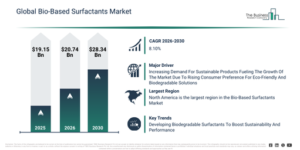
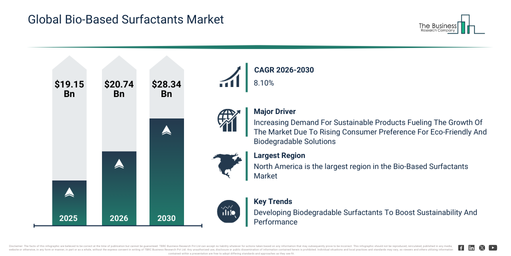
The bio-based surfactants market has shown robust expansion in recent years. It is forecast to grow from $19.15 billion in 2025 to $20.74 billion in 2026, driven by a compound annual growth rate (CAGR) of 8.3%. The historical period’s growth can be attributed to several factors, including an escalating demand for eco-friendly detergents, a rising preference for natural ingredients in personal care, increasing regulatory pressure on petro-based surfactants, the expanding availability of bio-based raw materials, and the growing adoption of green cleaning products.
The bio-based surfactants market size is anticipated to undergo significant expansion in the coming years. It is projected to grow to $28.34 billion in 2030 at a compound annual growth rate (CAGR) of 8.1%. This projected growth throughout the forecast period can be attributed to the increasing commercialization of microbial biosurfactants, the greater integration of bio-based surfactants into industrial and institutional cleaning solutions, a rise in brand commitments towards sustainability targets, and the expanding utilization of bio-based ingredients in agriculture and food processing. Prominent trends expected in the forecast period include advancements in fermentation and bioprocessing technology, the development of high-performance specialty biosurfactants, innovations in hybrid bio-synthetic surfactant systems, increased research and development efforts in polymeric biosurfactants, and the emergence of circular bioeconomy production models.
Get A Free Sample Report With In-Depth Market Insights:
Bio-Based Surfactants Market Demand Drivers: What’s Powering Industry Growth?
The growing requirement for sustainable products is projected to fuel the expansion of the bio-based surfactants market moving forward. Sustainable products are defined as items created and utilized responsibly to minimize environmental damage and promote long-term resource efficiency. The increasing demand for sustainable products is spurred by rising environmental awareness, as consumers opt for goods that lessen ecological impact and support resource conservation. Bio-based surfactants support sustainable products by offering eco-friendly and biodegradable alternatives to petroleum-based chemicals. They reduce environmental footprint while maintaining effective cleaning, emulsification, and wetting performance, thereby enhancing the sustainability of personal care, household, and industrial formulations. For instance, in July 2025, according to the Department for Environment, Food and Rural Affairs, a UK-based government organization, the recycling rate for household waste (including incinerator bottom ash metal) reached 44.6% in 2023, an increase from 44.1% in 2022. Therefore, the increasing demand for sustainable products is propelling the growth of the bio-based surfactants market.
Bio-Based Surfactants Market Segment Landscape And Growth Outlook
The bio-based surfactants market covered in this report is segmented –
1) By Product: Glycolipids, Lipopeptides, Phospholipids, Polymeric Biosurfactants, Methyl Ester Sulfonates, Sorbitan Esters, Other Products
2) By Form: Liquid, Powder Or Granules, Paste Or Pellets
3) By Source: Plant-Derived Surfactants, Microbial-Derived Surfactants, Bio-Engineered Or Synthetic Biology–Derived Surfactants
4) By Distribution Channel, Direct Sales, Distributors Or Wholesalers, Online Sales And Specialty Chemical Platforms
5) By Application, Household Detergents Or Cleaners, Personal Care, Industrial And Institutional Cleaners, Food Processing, Oilfield Or Petroleum Chemicals, Agricultural Chemicals, Textiles And Leather, Other Applications
Subsegments:
1) By Glycolipids: Rhamnolipids, Sophorolipids, Trehalose Lipids, Mannosylerythritol Lipids
2) By Lipopeptides: Surfactin, Iturin, Fengycin, Lichenysin
3) By Phospholipids: Lecithin, Phosphatidylcholine, Phosphatidylethanolamine, Phosphatidylserine
4) By Polymeric Biosurfactants: Polysaccharide-Based Biosurfactants, Protein-Based Biosurfactants, Cellulose-Derived Biosurfactants, Xanthan Gum Biosurfactants
5) By Methyl Ester Sulfonates: Palm Oil–Derived Methyl Ester Sulfonates, Coconut Oil–Derived Methyl Ester Sulfonates, Rapeseed Oil–Derived Methyl Ester Sulfonates, Soybean Oil–Derived Methyl Ester Sulfonates
6) By Sorbitan Esters: Sorbitan Monolaurate, Sorbitan Monostearate, Sorbitan Monopalmitate, Sorbitan Monooleate
7) By Other Products: Alkyl Polyglucosides, Fatty Acid Esters, Sucrose Esters, Amino Acid–Based Surfactants
Bio-Based Surfactants Market Innovation Trends: What Developments Are Reshaping The Industry?
Leading companies within the bio-based surfactants market are concentrating on developing advanced products, such as biodegradable surfactants, to bolster their sustainability profiles, improve performance in cold water, and lessen dependence on ingredients derived from fossil fuels. Biodegradable surfactants are surface-active agents that naturally decompose through microorganisms like bacteria, fungi, or algae into water, carbon dioxide, and biomass, leaving no harmful environmental residues. For instance, in September 2023, Dow Inc., a US-based materials science company, introduced EcoSense 2470 Surfactant as a breakthrough solution. This product is a 100% bio-based, non-ionic surfactant sourced from renewable origins, designed to deliver robust cleaning performance in heavy-duty formulations. It features a unique structure that ensures excellent hard-surface cleaning and effective removal of oily soil, particularly in challenging cold-water conditions. Its readily biodegradable formula complies with stringent ecological and regulatory standards for environmental safety. Moreover, it contains a high bio-content that directly replaces conventional petrochemical-based surfactants, empowering formulators to create next-generation consumer and industrial cleaning products with a significantly enhanced sustainability profile without compromising cleaning power.
Bio-Based Surfactants Market Leading Players And Competitive Positioning
Major companies operating in the bio-based surfactants market are Kaneka Corporation, BASF SE, KLK Kolb, Dow Inc., Evonik Industries AG, Univar Solutions Inc., Kao Corporation, Arkema S.A., Givaudan SA, Solvay S.A., TensioGreen Corp., Clariant AG, Werner & Mertz GmbH, Lion Corporation, Stepan Company, Croda International plc, Corbion N.V., Saraya Co. Ltd., GlycoSurf LLC, Nouryon, Jeneil Biotech Inc.
View The Full Bio-Based Surfactants Market Report:
Bio-Based Surfactants Market Regional Distribution: Which Areas Power Market Growth?
North America was the largest region in the bio-based surfactants market in 2025. Asia-Pacific is expected to be the fastest-growing region in the forecast period. The regions covered in the bio-based surfactants market report are Asia-Pacific, South East Asia, Western Europe, Eastern Europe, North America, South America, Middle East, Africa.
Reach Out To Our Team:
The Business Research Company: https://www.thebusinessresearchcompany.com/
Americas: +1 310-496-7795
Asia: +44 7882 955267 & +91 8897263534
Europe: +44 7882 955267
Email us at: marketing@tbrc.info
Follow us on:
LinkedIn: https://in.linkedin.com/company/the-business-research-company
YouTube: https://www.youtube.com/channel/UC24_fI0rV8cR5DxlCpgmyFQ
Global Market Model: https://www.thebusinessresearchcompany.com/global-market-model

Wasay has over a decade of experience in market research, data modelling, and analytics, with prior experience at GlobalData and Decision Tree Consulting Services. At The Business Research Company , he leads research operations across syndicated studies, customized consulting engagements, and the Global Market Model platform. His professional experience includes supporting organizations such as Boston Consulting Group, KPMG, and Ernst & Young. Wasay holds a degree in Electronics and Communications Engineering, postgraduate management qualifications from International Management Institute Belgium and Indian School of Business and Entrepreneurship, and completed the Integrated Program in Business Analytics from Indian Institute of Management Indore.