Built to provide research that’s more actionable and strategically valuable, The Business Research Company’s 2026 market reports include market attractiveness analysis, total addressable market sizing, company benchmarking matrices, interactive Excel dashboards, broader supply chain intelligence, emerging startup tracking, and in-depth product insights.
Cellular Agriculture Market Expansion Outlook: What Revenue Opportunities Are Ahead?
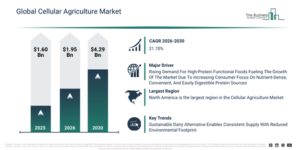
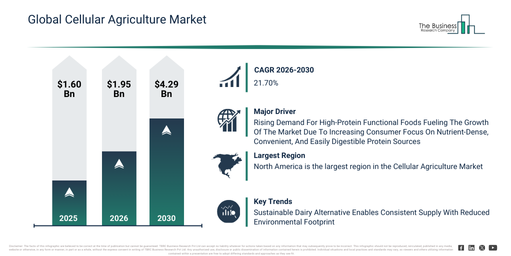
The cellular agriculture market has experienced substantial growth in recent years. Its value is expected to rise from $1.60 billion in 2025 to $1.95 billion in 2026, demonstrating a compound annual growth rate (CAGR) of 22.0%. This historical expansion can be attributed to factors such as the increasing demand for sustainable protein, a heightened awareness of ethical food choices, growing investment in cell-based technologies, the proliferation of cultured meat startups, and an escalating consumer interest in plant-based alternatives.
The cellular agriculture market is anticipated to experience substantial growth in the upcoming years. It is projected to expand to $4.29 billion by 2030, demonstrating a compound annual growth rate (CAGR) of 21.7%. This expansion during the forecast period is primarily driven by the increasing integration of cellular agriculture, augmented government support and financial backing, a heightened focus on ecological sustainability, the scaling up of commercial production, and a rise in research-based collaborations and partnerships. Significant trends expected during this period include advancements in cell cultivation technologies, innovative bioreactor designs, progress in protein scaffolding, ongoing research and development in tissue engineering, and the implementation of automated and artificial intelligence (AI)-driven production systems.
Get A Free Sample Report With In-Depth Market Insights:
Cellular Agriculture Market Expansion Drivers: What’s Shaping Future Growth?
The cellular agriculture market is anticipated to grow significantly, driven by the increasing demand for high-protein functional foods. These foods, fortified with proteins and essential nutrients, contribute to muscle development, weight management, and general metabolic health. This rise in demand stems from a greater consumer focus on healthier eating patterns, as individuals look for nutrient-rich, convenient options that align with active lifestyles, fitness ambitions, and everyday energy needs. Cellular agriculture supports high-protein functional foods by offering nutrient-dense, animal-free protein sources, making them ideal for health-conscious and fitness-oriented consumers. It also improves product quality by delivering complete, easily digestible proteins, which enhances their nutritional value and dietary convenience. For instance, in June 2024, the International Food Information Council, a US-based nonprofit organization, reported that the proportion of Americans prioritizing protein consumption has steadily increased from 59% in 2022 to 67% in 2023 and 71% in 2024. Additionally, about 50% of consumers are focused on increasing their intake of fresh foods, considered the healthiest option. Therefore, the escalating demand for high-protein functional foods is a key driver for the growth of the cellular agriculture market.
Cellular Agriculture Market Segment Trends And Revenue Contributors
The cellular agriculture market covered in this report is segmented –
1) By Product Type: Cell-Based Meat, Cell-Based Dairy, Cell-Based Egg Products, Cell-Based Seafood, Cellular Ingredients
2) By Source: Animal Cells, Microbial Fermentation, Plant Cells, Other Sources
3) By Technology: Bioreactors, 3D Bioprinting, Stem Cell Technology, Fermentation Technology, Cell Culture Techniques
4) By Distribution Channel: Direct Sales, Online Retail, Third-Party Distributors, Foodservice Channels, Wholesale Markets
5) By End-User: Food Manufacturers, Retail Chains, Restaurants And Food Service Providers, Research Institutions, Agricultural Producers
Subsegments:
1) By Cell-Based Meat: Cultivated Beef, Cultivated Pork, Cultivated Poultry, Cultivated Lamb, Cultivated Exotic Meat
2) By Cell-Based Dairy: Cell-Cultured Milk, Cell-Cultured Cheese, Cell-Cultured Butter, Cell-Cultured Yogurt, Cell-Cultured Cream
3) By Cell-Based Egg Products: Cultured Whole Eggs, Cultured Egg Whites, Cultured Egg Yolks, Cultured Egg Powders
4) By Cell-Based Seafood: Cultivated Fish, Cultivated Shrimp, Cultivated Crab, Cultivated Lobster, Cultivated Shellfish
5) By Cellular Ingredients: Bioengineered Proteins, Bioengineered Collagen, Bioengineered Gelatin, Bioengineered Enzymes, Bioengineered Fats
Cellular Agriculture Market Strategic Trends: What Defines The Next Growth Phase?
Leading companies within the cellular agriculture market are concentrating their efforts on creating sophisticated products, such as beta-lactoglobulin proteins. This initiative aims to improve nutritional content, foster greater sustainability, and lessen dependence on traditional animal farming. These beta-lactoglobulin proteins, which constitute the primary whey proteins found in cow’s milk, deliver essential nutrition and functional benefits and can now be generated through precision fermentation, offering an animal-free alternative to dairy proteins. A notable example is Vivici B.V., a Netherlands-based company specializing in animal-free dairy ingredients, which introduced its Vivitein BLG product in March 2025. This product is a pure, animal-free beta-lactoglobulin protein that mirrors the nutritional and functional characteristics of natural whey protein. Its production method, precision fermentation, ensures a reliable and sustainable supply while significantly lowering its environmental impact. Characterized by high purity and a minimal ingredient list, it provides excellent solubility and a neutral flavor. This allows for effortless incorporation into performance nutrition items, various beverages, and dairy alternative products, maintaining their original taste and texture. Furthermore, it holds non-GMO project verification and has achieved regulatory self-affirmed GRAS status, which is expected to expedite its uptake by food and beverage manufacturers in search of scalable and sustainable protein options.
Cellular Agriculture Market Competitive Analysis Of Leading Industry Participants
Major companies operating in the cellular agriculture market are Formo GmbH, Perfect Day Inc., Eat Just Inc., UPSIDE Foods Inc., Mosa Meat B.V., BlueNalu Inc., Forsea Foods Ltd., Imagindairy Ltd., Finless Foods Inc., Meatiply Pte. Ltd., Aleph Farms Ltd., Biomilq Inc., Bene Meat Technologies s.r.o., Real Vegan Cheese, New Age Meats Inc., Wildtype Foods Inc., SuperMeat The Essence of Meat Ltd., Avant Meats Company Limited, Clever Carnivore Inc., Mission Barns Inc., IntegriCulture Inc., Jellatech Inc., Matrix Meats Inc.
View The Full Cellular Agriculture Market Report:
Cellular Agriculture Market Geographic Spread And Regional Opportunities
North America was the largest region in the cellular agriculture market in 2025. Asia-Pacific is expected to be the fastest-growing region in the forecast period. The regions covered in the cellular agriculture market report are Asia-Pacific, South East Asia, Western Europe, Eastern Europe, North America, South America, Middle East, Africa.
Reach Out To Our Team:
The Business Research Company: https://www.thebusinessresearchcompany.com/
Americas: +1 310-496-7795
Asia: +44 7882 955267 & +91 8897263534
Europe: +44 7882 955267
Email us at: marketing@tbrc.info
Follow us on:
LinkedIn: https://in.linkedin.com/company/the-business-research-company
YouTube: https://www.youtube.com/channel/UC24_fI0rV8cR5DxlCpgmyFQ
Global Market Model: https://www.thebusinessresearchcompany.com/global-market-model

Wasay has over a decade of experience in market research, data modelling, and analytics, with prior experience at GlobalData and Decision Tree Consulting Services. At The Business Research Company , he leads research operations across syndicated studies, customized consulting engagements, and the Global Market Model platform. His professional experience includes supporting organizations such as Boston Consulting Group, KPMG, and Ernst & Young. Wasay holds a degree in Electronics and Communications Engineering, postgraduate management qualifications from International Management Institute Belgium and Indian School of Business and Entrepreneurship, and completed the Integrated Program in Business Analytics from Indian Institute of Management Indore.