Built to provide research that’s more actionable and strategically valuable, The Business Research Company’s 2026 market reports include market attractiveness analysis, total addressable market sizing, company benchmarking matrices, interactive Excel dashboards, broader supply chain intelligence, emerging startup tracking, and in-depth product insights.
3D Printing Cultured Meat Market Value Growth And Long-Term Outlook
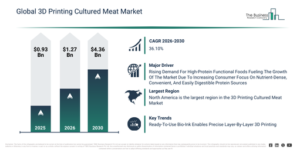
The 3D printing cultured meat market has experienced considerable expansion in recent years. Its value is projected to increase from $0.93 billion in 2025 to $1.27 billion in 2026, reflecting a compound annual growth rate (CAGR) of 36.4%. The historical progress can be linked to factors such as a rising consumer demand for alternative proteins, increasing interest from foodservice and restaurant operators in novel protein options, growing investment from venture capital and private equity in cultured meat ventures, an increase in strategic partnerships between startups and established food companies, and rising government and public funding for sustainable food projects.
The 3D printing cultured meat market size is poised for significant expansion in the coming years, with an expectation to reach $4.36 billion by 2030, exhibiting a compound annual growth rate (CAGR) of 36.1%. This anticipated growth is primarily driven by an increasing consumer willingness to invest in premium cultured meat products, the development of clearer regulatory frameworks by food safety authorities, the expansion of manufacturing capabilities through contract and shared facilities, a surge in private and institutional investments for commercialization, and a growing adoption by foodservice chains and institutional buyers. Prominent trends for this period encompass technological advancements in bioreactor design and scaling for large-scale production, innovations leading to cost reduction via alternative growth media formulation and process optimization, the integration of automation and process control across production lines, improvements in cell line robustness and yield achieved through research and development, and the incorporation of precision fermentation to enhance flavor and texture.
Get A Free Sample Report With In-Depth Market Insights:
3D Printing Cultured Meat Market Demand Drivers Opening New Revenue Streams
The increasing consumer desire for high-protein functional foods is projected to drive the expansion of the 3D printing cultured meat market in the future. These foods are defined as items fortified with proteins and other essential nutrients, aiding in muscle growth, weight control, and general metabolic well-being. This surge in demand stems from consumers prioritizing healthier diets, searching for nutritious, easy-to-consume choices that align with active lives, exercise objectives, and energy requirements. 3D printed cultured meat complements high-protein functional foods by offering customizable and nutrient-dense protein sources, thus appealing to health-aware and fitness-oriented individuals. Furthermore, it enhances product utility through the provision of complete, readily digestible proteins with bespoke nutritional compositions, thereby boosting dietary ease and health advantages. As an illustration, data from the International Food Information Council, a US-based nonprofit, revealed in June 2024 that a growing majority of Americans are concentrating on greater protein intake, escalating from 59% in 2022 to 67% in 2023 and further to 71% in 2024. Moreover, around half of all consumers are looking to increase their consumption of fresh foods, which are broadly considered the healthiest choice. Consequently, the escalating need for high-protein functional foods is fueling the expansion of the 3D printing cultured meat market.
3D Printing Cultured Meat Market Segment Breakdown: Which Categories Lead On Revenue?
The 3D printing cultured meat market covered in this report is segmented –
1) By Product Type: Beef, Poultry, Pork, Seafood, Exotic Or Novel Meats
2) By Cell Source: Animal Muscle Cells, Fat Cells, Stem Cells, Hybrid Cell Lines
3) By Technology: Extrusion-Based Printing, Laser-Assisted Printing, Inkjet Printing, Bioprinting
4) By Application: Food Industry, Research And Development, Animal Feed, Pharmaceuticals
5) By End-User: Restaurants, Retailers, Catering Services, Households
Subsegments:
1) By Beef: Whole Cut Fillet, Ground And Minced Meat, Patties And Burgers, Marbled Steak Cuts
2) By Poultry: Chicken Nuggets And Strips, Ground Poultry Products, Whole Breast Analogs, Turkey Breast Products
3) By Pork: Ground Pork Sausage, Bacon Analogs, Loin Cut Products, Ham And Deli Slices
4) By Seafood: Salmon Fillet Analogs, Shrimp Scampi Analogs, Tuna Steak Products, Calamari Rings
5) By Exotic Or Novel Meats: Wagyu Beef Analogs, Duck Breast Products, Fowl Ground Products, Other Novel Species Cuts
3D Printing Cultured Meat Market Trends Powering Strategic Industry Growth
Leading firms within the 3D printed cultured meat market are prioritizing the creation of sophisticated bio-materials, like specialized bio-inks, to improve product authenticity, strengthen structural integrity, and simplify production processes. These specialized bio-inks are sophisticated, edible mixtures comprising cultured animal cells and various components, formulated for exact layer-by-layer application by 3D printers to form structured, whole-cut meat items. An example of this is the SH Beef Steak Ink, introduced in September 2023 by Steakholder Foods Ltd., an Israel-based deep-tech food enterprise. This product is a ready-to-use, specialized bio-ink specifically engineered for the 3D printing of cultivated beef steaks. Its formulation aims to mimic the texture and mouthfeel of traditional beef, incorporating a patented mixture of cultivated beef cells and plant-based constituents that form the essential support structure. The ink possesses specific rheological properties vital for accurate printing and subsequent maturation, facilitating the development of intricate marbled textures and a fibrous consistency without demanding proprietary printing equipment from the manufacturer. Furthermore, it contains a scalable formula crafted for manufacturing efficiency, which promotes the commercial feasibility and market penetration of whole-cut cultivated steaks for both food service and retail collaborators.
3D Printing Cultured Meat Market Leading Players And Competitive Positioning
Major companies operating in the 3D printing cultured meat market are JBS S.A, Tyson Foods Inc., SIGMAXYZ Holdings Inc., TOPPAN Inc., Mosa Meat B.V., Shimadzu Corporation, Biokraft Foods, Upside Foods Inc., Novameat Tech S.L., Redefine Meat Ltd., BlueNalu Inc., Tender Food Inc., Aleph Farms Ltd., Steakholder Foods Ltd., CellX, Believer Meats Inc., Fork & Goode Inc., Avant Meats Company Limited, SavorEat Ltd., Revo Foods GmbH
View The Full 3D Printing Cultured Meat Market Report:
3D Printing Cultured Meat Market Regional Split: Which Areas Are Fueling Growth?
North America was the largest region in the 3D printing cultured meat market in 2025. Asia-Pacific is expected to be the fastest-growing region in the forecast period. The regions covered in the 3D printing cultured meat market report are Asia-Pacific, South East Asia, Western Europe, Eastern Europe, North America, South America, Middle East, Africa.
Reach Out To Our Team:
The Business Research Company: https://www.thebusinessresearchcompany.com/
Americas: +1 310-496-7795
Asia: +44 7882 955267 & +91 8897263534
Europe: +44 7882 955267
Email us at: marketing@tbrc.info
Follow us on:
LinkedIn: https://in.linkedin.com/company/the-business-research-company
YouTube: https://www.youtube.com/channel/UC24_fI0rV8cR5DxlCpgmyFQ
Global Market Model: https://www.thebusinessresearchcompany.com/global-market-model

Wasay has over a decade of experience in market research, data modelling, and analytics, with prior experience at GlobalData and Decision Tree Consulting Services. At The Business Research Company , he leads research operations across syndicated studies, customized consulting engagements, and the Global Market Model platform. His professional experience includes supporting organizations such as Boston Consulting Group, KPMG, and Ernst & Young. Wasay holds a degree in Electronics and Communications Engineering, postgraduate management qualifications from International Management Institute Belgium and Indian School of Business and Entrepreneurship, and completed the Integrated Program in Business Analytics from Indian Institute of Management Indore.