Featuring market attractiveness scoring, total addressable market sizing, company benchmarking matrices, interactive Excel dashboards, deeper supply chain intelligence, emerging startup tracking, and granular product-level insights, The Business Research Company’s 2026 market reports are built to deliver research that is both more actionable and more strategically valuable.
Artificial Intelligence (AI) In Powered Direct-To-Device Market Value Growth And Long-Term Outlook
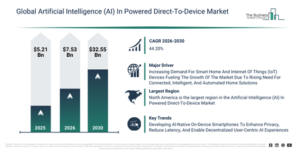
The artificial intelligence (AI) in powered direct-to-device market has observed substantial growth in recent years. This market is anticipated to expand from $5.21 billion in 2025 to $7.53 billion in 2026, demonstrating a compound annual growth rate (CAGR) of 44.5%. The historical rise can be attributed to several factors, including the increasing deployment of edge artificial intelligence (AI) processors in consumer devices, the rising demand for real-time on-device inference, the growing adoption of privacy-preserving artificial intelligence (AI) models, the increasing integration of artificial intelligence (AI) functions in smartphones and wearables, and the rising popularity of voice-enabled smart assistants.
The artificial intelligence (AI) in powered direct-to-device market is anticipated to experience substantial growth in the forthcoming years, with its valuation projected to reach $32.55 billion in 2030 at a compound annual growth rate (CAGR) of 44.2%. This expansion during the forecast period is primarily driven by factors such as the increasing demand for low-latency decision-making capabilities at the device level, the expanding availability of optimized on-device neural networks, the rising adoption of artificial intelligence (AI)-enabled cameras and imaging systems, a notable transition from cloud-dependent artificial intelligence (AI) to hybrid edge architectures, and a growing focus on energy-efficient artificial intelligence (AI) hardware accelerators. Major developments expected in this period include advancements in lightweight on-device artificial intelligence (AI) models, innovations in artificial intelligence (AI)-optimized chipsets for edge processing, the integration of multimodal artificial intelligence (AI) capabilities into consumer devices, the progress of federated learning frameworks for enhanced privacy, and breakthroughs in TinyML techniques for ultra-low-power artificial intelligence (AI) applications.
Get A Free Sample Report With In-Depth Market Insights:
Artificial Intelligence (AI) In Powered Direct-To-Device Market Demand Drivers: What’s Powering Industry Growth?
A growing need for smart home and Internet of Things (IoT) devices is anticipated to fuel the expansion of the artificial intelligence (AI) in powered direct-to-device (D2D) market moving forward. These smart home and Internet of Things (IoT) devices are defined as internet-connected appliances, sensors, and electronic items that facilitate automation, remote management, and data-driven insights to enhance convenience, energy efficiency, and security. The surge in demand for these products is a result of consumers increasingly preferring seamless connectivity and intelligent home management solutions. Artificial intelligence (AI) in powered direct-to-device (D2D) supports the demand for smart home and Internet of Things (IoT) devices by offering integrated on-device intelligence, which enables real-time processing, autonomous decision-making, predictive maintenance, and customized user experiences without needing to rely entirely on cloud connectivity. For example, in November 2023, the Consumer Technology Association, a US-based industry organization for consumer technologies, reported that the installed base of United States smart home devices reached 432.6 million units, with smart appliances accounting for 37.7 million units owned by 19% of householders, and smart home security cameras reaching 55.8 million units, owned by 25% of householders. Therefore, the escalating demand for smart home and Internet of Things (IoT) devices is propelling the growth of the artificial intelligence (AI) in powered direct-to-device (D2D) market.
Artificial Intelligence (AI) In Powered Direct-To-Device Market Segmentation: How Does The Market Break Down By Category?
The artificial intelligence (AI) in powered direct-to-device market covered in this report is segmented –
1) By Component: Hardware, Software, Services
2) By Technology Type: Natural Language Processing (NLP), Machine Learning (ML), Computer Vision, Edge Artificial Intelligence (AI), Other Technology Types
3) By Device Type: Smartphones And Tablets, Wearables, Edge Computing Devices, Connected Consumer Devices, Other Device Types
4) By Industry Vertical: Healthcare, Information Technology (IT) And Telecom, Consumer Electronics, Manufacturing, Automotive, Retail And E-Commerce, Defense And Aerospace, Other Industry Verticals
Subsegments:
1) By Hardware: Artificial Intelligence (AI) -Enabled Processors, Sensors, Connectivity Modules, Embedded Systems, Storage And Memory Units, Cameras And Microphones
2) By Software: On-Device Artificial Intelligence (AI) Models, Operating Systems And Firmware, Edge Inference Engines, Artificial Intelligence (AI) Optimization Tools, Security And Encryption Software, Device Management Platforms
3) By Services: Deployment And Integration Services, Artificial Intelligence (AI) Model Training Services, Device Monitoring And Maintenance, Managed Edge Artificial Intelligence (AI) Services, Consulting And Customization, Technical Support Services
Artificial Intelligence (AI) In Powered Direct-To-Device Market Innovation Trends: What Developments Are Reshaping The Industry?
Major companies within the artificial intelligence (AI) in powered direct-to-device (D2D) market are prioritizing advanced technology, such as sustainable decentralized artificial intelligence (AI) infrastructure, to enhance data privacy, reduce latency, and empower user-controlled artificial intelligence (AI) experiences. Decentralized artificial intelligence (AI) infrastructure refers to distributed networks that spread AI data processing, model training, and computation across multiple nodes without central authority control. For instance, in September 2025, Gaia Inc., a US-based artificial intelligence (AI) infrastructure company, launched the Gaia AI Phone, promoted as the first smartphone designed for full AI sovereignty. This device processes artificial intelligence (AI) tasks locally through its proprietary Gaia AI Platform, operates as a full network node, and enables users to contribute computational resources to the decentralized artificial intelligence (AI) infrastructure while earning token rewards for participation. The phone compresses enterprise-grade artificial intelligence (AI) models to run efficiently on mobile hardware and includes exclusive partner integrations for a comprehensive ecosystem. This launch signifies a substantial technological advancement by combining on-device artificial intelligence (AI) processing with decentralized network participation, thereby extending artificial intelligence (AI) capabilities while preserving privacy and creating a user-centric artificial intelligence (AI) infrastructure.
Artificial Intelligence (AI) In Powered Direct-To-Device Market Company Landscape And Competitive Strategy
Major companies operating in the artificial intelligence (AI) in powered direct-to-device market are Apple Inc., Google LLC, Samsung Electronics Co. Ltd., NVIDIA Corporation, Intel Corporation, Qualcomm Incorporated, Advanced Micro Devices Inc., MediaTek Inc., NXP Semiconductors N.V., VeriSilicon Microelectronics (Shanghai) Co. Ltd., Ambarella Inc., Tenstorrent Inc., EdgeCortix Inc., Hailo Technologies Ltd., Axelera AI B.V., SiMa.ai Inc., Orbbec 3D Technology International, Nexa AI, Syntiant Corporation, Blaize Inc.
View The Full Artificial Intelligence (AI) In Powered Direct-To-Device Market Report:
Artificial Intelligence (AI) In Powered Direct-To-Device Market Largest Region: Which Geography Holds The Biggest Share?
North America was the largest region in the artificial intelligence (AI) in powered direct-to-device market in 2025. Asia-Pacific is expected to be the fastest-growing region in the forecast period. The regions covered in the artificial intelligence (AI) in powered direct-to-device market report are Asia-Pacific, South East Asia, Western Europe, Eastern Europe, North America, South America, Middle East, Africa.
Reach Out To Our Team:
The Business Research Company: https://www.thebusinessresearchcompany.com/
Americas: +1 310-496-7795
Asia: +44 7882 955267 & +91 8897263534
Europe: +44 7882 955267
Email us at: marketing@tbrc.info
Follow us on:
LinkedIn: https://in.linkedin.com/company/the-business-research-company
YouTube: https://www.youtube.com/channel/UC24_fI0rV8cR5DxlCpgmyFQ
Global Market Model: https://www.thebusinessresearchcompany.com/global-market-model

Wasay has over a decade of experience in market research, data modelling, and analytics, with prior experience at GlobalData and Decision Tree Consulting Services. At The Business Research Company , he leads research operations across syndicated studies, customized consulting engagements, and the Global Market Model platform. His professional experience includes supporting organizations such as Boston Consulting Group, KPMG, and Ernst & Young. Wasay holds a degree in Electronics and Communications Engineering, postgraduate management qualifications from International Management Institute Belgium and Indian School of Business and Entrepreneurship, and completed the Integrated Program in Business Analytics from Indian Institute of Management Indore.