Featuring market attractiveness scoring, total addressable market sizing, company benchmarking matrices, interactive Excel dashboards, deeper supply chain intelligence, emerging startup tracking, and granular product-level insights, The Business Research Company’s 2026 market reports are built to deliver research that is both more actionable and more strategically valuable.
Artificial Intelligence (AI) Interactive Display Market Set To Climb From $9.22 Billion In 2026 To $15.81 Billion By 2030
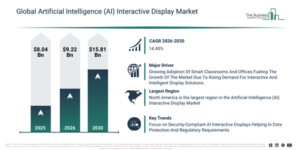
The artificial intelligence (AI) interactive display market has experienced substantial expansion in recent times. Projections indicate its valuation will ascend from $8.04 billion in 2025 to $9.22 billion by 2026, demonstrating a compound annual growth rate (CAGR) of 14.7%. This historical growth is largely due to factors such as the greater uptake of smart classroom solutions, the increasing need for digital collaboration tools, the growing incorporation of touch-based display technologies, the wider application of artificial intelligence (AI)-powered content management systems, and the increased rollout of interactive kiosks.
The artificial intelligence (AI) interactive display market is set for rapid expansion in the coming years. It is projected to grow to $15.81 billion in 2030, achieving a compound annual growth rate (CAGR) of 14.4%. This growth during the forecast period is fueled by factors such as the increasing demand for personalized interactive learning, the wider adoption of artificial intelligence (AI)-driven corporate collaboration systems, a growing need for automation in retail engagement, the expansion of digital transformation initiatives across various sectors, and heightened investment in artificial intelligence (AI)-powered healthcare displays. Prominent trends anticipated over this period include advancements in artificial intelligence (AI)-powered gesture recognition, innovations in large-format smart displays, developments in cloud-integrated interactive platforms, an increase in machine learning-based content personalization, and rising research and development efforts in immersive display technologies.
Get A Free Sample Report With In-Depth Market Insights:
Artificial Intelligence (AI) Interactive Display Market Development Factors: What’s Supporting Demand?
The future expansion of the artificial intelligence (AI) interactive display market is anticipated to be driven by the increasing integration of smart classrooms and offices. These environments, known as smart classrooms and offices, are educational and professional settings outfitted with sophisticated digital tools, robust connectivity, and intelligent systems designed to foster cooperation, participation, and live interactions. The growing uptake of smart classrooms and offices stems from the accelerated digital transformation within the education and business sectors, as these setups improve collaboration, engagement, and dynamic interactive learning experiences. Artificial intelligence (AI) interactive displays facilitate this trend by using AI capabilities for features like gesture recognition, tailored content presentation, immediate annotations, and smooth integration with other digital platforms, thereby boosting engagement and output. An illustration of this trend is seen in November 2025 data from the Department for Education, a UK government department responsible for national education policy and standards, which indicated an increase in interactive whiteboard adoption in classrooms; primary school usage rose from 96% in 2023 to 98% in 2025, and secondary school usage climbed from 76% in 2023 to 80% in 2025 for at least one lesson. Consequently, the expanding use of smart classrooms and offices is fueling the expansion of the artificial intelligence (AI) interactive display market.
Artificial Intelligence (AI) Interactive Display Market Segments: Where Is Growth Concentrated?
The artificial intelligence (AI) interactive display market covered in this report is segmented –
1) By Component: Hardware, Software, Services
2) By Technology: Capacitive, Infrared (IR), Resistive, Optical Imaging, Electromagnetic, Other Technologies
3) By Panel Type: Liquid-Crystal Display (LCD), Light-Emitting Diode (LED), Organic Light-Emitting Diode (OLED)
4) By Screen Size: 41–65 Inches, Above 65 Inches, Below 40 Inches
5) By Application: Retail, Education, Corporate
Subsegments:
1) By Hardware: Display Panels, Touch Sensors, Processing Units, Graphic Controllers, Connectivity Modules
2) By Software And Platform: Interactive Display Software, Artificial Intelligence Algorithms, Content Management Platforms, Collaboration Software, Operating Systems
3) By Services: Installation Services, Maintenance Services, Consulting Services, Training Services, Integration Services
Artificial Intelligence (AI) Interactive Display Market Transformation Trends: What Innovations Are Driving Change?
Leading companies in the artificial intelligence (AI) interactive display market are prioritizing advanced technology, such as crystal-clear 4K Ultra HD displays, to enhance data protection, ensure regulatory compliance, and support sensitive workflows. A crystal-clear 4K Ultra HD display specifically refers to a screen with 3840 by 2160 pixels that delivers exceptionally sharp, highly detailed, and lifelike images, even on large panels. For instance, in June 2024, SMART Technologies, a Canada-based interactive-tech company, unveiled its M Pro series interactive display. This cutting-edge panel meets strict Trade Agreements Act (TAA) requirements and is offered in a High-Secure configuration to maximize information protection. The TAA-compliant M Pro series features a sharp 4K Ultra HD screen, SMART’s proprietary touch technology, and an intuitive interface for collaboration and training, while its High-Secure model incorporates additional safeguards like blocking USB data transfer and removing the built-in microphone array to better secure sensitive areas.
Artificial Intelligence (AI) Interactive Display Market Competitive Overview And Top Companies
Major companies operating in the artificial intelligence (AI) interactive display market are Google LLC, Microsoft Corporation, Samsung Electronics Co. Ltd., Sony Group Corporation, Cisco Systems Inc., NEC Corporation, LG Display Co. Ltd., Qisda Corporation, Zebra Technologies Corporation, Diebold Nixdorf Incorporated, Panasonic Holdings Corporation, Guangzhou Shiyuan Electronic Technology Co. Ltd., ViewSonic Corporation, Leyard Optoelectronic Co. Ltd., NetDragon Websoft Holdings Limited, Hisense Group Co. Ltd., NCR Voyix Corporation, Newline Interactive Inc., HiteVision Tech Asia Pacific Co. Ltd., Avalue Technology Incorporation
View The Full Artificial Intelligence (AI) Interactive Display Market Report:
Artificial Intelligence (AI) Interactive Display Market Leading Geography: Which Region Contributes The Most Revenue?
North America was the largest region in the artificial intelligence (AI) interactive display market in 2025. Asia-Pacific is expected to be the fastest-growing region in the forecast period. The regions covered in the artificial intelligence (AI) interactive display market report are Asia-Pacific, South East Asia, Western Europe, Eastern Europe, North America, South America, Middle East, Africa.
Reach Out To Our Team:
The Business Research Company: https://www.thebusinessresearchcompany.com/
Americas: +1 310-496-7795
Asia: +44 7882 955267 & +91 8897263534
Europe: +44 7882 955267
Email us at: marketing@tbrc.info
Follow us on:
LinkedIn: https://in.linkedin.com/company/the-business-research-company
YouTube: https://www.youtube.com/channel/UC24_fI0rV8cR5DxlCpgmyFQ
Global Market Model: https://www.thebusinessresearchcompany.com/global-market-model

Wasay has over a decade of experience in market research, data modelling, and analytics, with prior experience at GlobalData and Decision Tree Consulting Services. At The Business Research Company , he leads research operations across syndicated studies, customized consulting engagements, and the Global Market Model platform. His professional experience includes supporting organizations such as Boston Consulting Group, KPMG, and Ernst & Young. Wasay holds a degree in Electronics and Communications Engineering, postgraduate management qualifications from International Management Institute Belgium and Indian School of Business and Entrepreneurship, and completed the Integrated Program in Business Analytics from Indian Institute of Management Indore.