
Backed by market attractiveness analysis, total addressable market sizing, company benchmarking matrices, interactive Excel dashboards, wider supply chain intelligence, emerging startup coverage, and detailed product-level insights, The Business Research Company’s 2026 market reports are designed to offer research that is more actionable and strategically valuable than ever.
Voluntary Carbon Credit Market Expansion Outlook: What Revenue Opportunities Are Ahead?
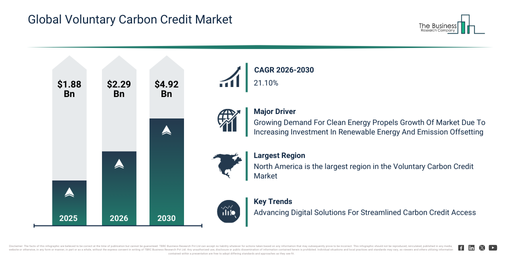
The voluntary carbon credit market has seen substantial expansion in recent years. Its valuation is expected to rise from $1.88 billion in 2025 to $2.29 billion in 2026, at a compound annual growth rate (CAGR) of 21.5%. Historically, this increase can be linked to factors such as corporate sustainability commitments, the early adoption of voluntary offset initiatives, the expansion of renewable energy projects, the creation of forestry-based credits, and the development of independent verification standards.
The voluntary carbon credit market size is projected to experience substantial growth in the coming years. It is forecast to expand to $4.92 billion by 2030, achieving a compound annual growth rate (CAGR) of 21.1%. This anticipated growth is driven by increasing net-zero pledges from corporations, the rising integration of blockchain within carbon markets, the expansion of global carbon registries, growing investment in removal-based credits, and increasing regulatory alignment with voluntary markets. Key trends during this period are expected to include a heightened demand for high-integrity carbon credits, wider adoption of digital carbon trading platforms, a growing focus on nature-based credit projects, the expansion of corporate voluntary offset programs, and an enhanced emphasis on transparency and verification.
Get A Free Sample Report With In-Depth Market Insights:
Voluntary Carbon Credit Market Growth Backed By Core Demand Fundamentals
The increasing need for clean energy is projected to fuel the expansion of the voluntary carbon credit market in the future. Clean energy is characterized as power derived from sources that have minimal ecological effects and release negligible greenhouse gases. The impetus for clean energy stems from environmental preservation, advantages for public health, enhanced energy security and autonomy, and various regulatory and policy encouragements. This escalating requirement for clean energy stimulates investment in renewable sources, which in turn generates carbon credits through emission reductions. These credits enable companies to compensate for their carbon footprint, thereby bolstering the carbon market and fostering the development of green energy. For example, in March 2024, data from the US-based American Clean Power Association indicated that America’s clean power sector committed nearly $80 billion to energy infrastructure and manufacturing in 2024. Developers deployed 49 gigawatts of new domestic capacity, an increase of 33% over the record established in 2023. Consequently, the rising demand for clean energy is a key driver for the growth of the voluntary carbon credit market.
Voluntary Carbon Credit Market Segment Breakdown: Which Categories Lead On Revenue?
The voluntary carbon credit market covered in this report is segmented –
1) By Type: Forestry, Renewable Energy, Waste Disposal, Other Types
2) By Project Type: Removal Or Sequestration Projects, Avoidance Or Reduction Projects
3) By Application: Industrial, Household Devices, Energy, Agriculture, Other Applications
4) By End Use: Government Agencies, Non-Governmental Organizations (NGOs), Private Companies, Individuals
Subsegments:
1) By Forestry: Afforestation, Reforestation, Avoided Deforestation, Forest Management
2) By Renewable Energy: Wind Energy Projects, Solar Energy Projects, Hydropower Projects, Biomass Energy Projects, Geothermal Energy Projects
3) By Waste Disposal: Methane Capture From Landfills, Waste-To-Energy Projects, Composting Projects, Recycling And Circular Economy Initiatives
4) By Other Types: Blue Coastal and Marine Ecosystem Restoration (Carbon), Soil Carbon Sequestration, Carbon Capture and Storage (CCS), Biochar Projects
Voluntary Carbon Credit Market Growth Trends Reshaping The Competitive Landscape
Major companies operating in the voluntary carbon credit market are focusing on developing advanced solutions such as digital carbon credit sourcing to streamline carbon credit access, supporting companies’ sustainability and emissions reduction efforts. Digital carbon credit sourcing involves utilizing online platforms and technologies to identify, purchase, and trade carbon credits, thereby simplifying access to certified carbon offset projects. For instance, in September 2024, the ERM International Group Limited, a UK-based sustainability consultancy, unveiled the ERM Carbon Credit Portal, intended to facilitate client access to the voluntary carbon market. This initiative aims to simplify the selection and purchasing process for carbon credits, enabling organizations to effectively complement their greenhouse gas emissions reduction strategies. The portal features pre-screened projects, allowing users to evaluate climate benefits and associated risks, which enhances transparency and trust in the carbon credit procurement process. This launch forms part of ERM’s broader strategy to support corporate decarbonization efforts.
Voluntary Carbon Credit Market Leading Players And Competitive Positioning
Major companies operating in the voluntary carbon credit market report are Ambipar Group, Rubicon Carbon, South Pole, EKI Energy Services Ltd., The Carbon Trust, 3Degrees, Climate Impact Partners, Allcot Group, Green Mountain Energy, First Climate, ClimeCo LLC, Aera Group, Forliance, ComBio Energia, BioCarbon Partners, CarbonBetter, Atmosfair, NativeEnergy, NatureOffice GmbH, Carbon Credit Capital LLC, Finite Carbon, GreenTrees LLC, Puro.earth, Tasman Environmental Markets, TerraPass, CarbonClear, BURN
View The Full Voluntary Carbon Credit Market Report:
Voluntary Carbon Credit Market Top Region By Revenue And Market Share
North America was the largest region in the voluntary carbon credit market in 2025. Asia-Pacific is expected to be the fastest-growing region in the forecast period. The regions covered in the voluntary carbon credit market report are Asia-Pacific, South East Asia, Western Europe, Eastern Europe, North America, South America, Middle East, Africa.
Reach Out To Our Team:
The Business Research Company: https://www.thebusinessresearchcompany.com/
Americas: +1 310-496-7795
Asia: +44 7882 955267 & +91 8897263534
Europe: +44 7882 955267
Email us at: marketing@tbrc.info
Follow us on:
LinkedIn: https://in.linkedin.com/company/the-business-research-company
YouTube: https://www.youtube.com/channel/UC24_fI0rV8cR5DxlCpgmyFQ
Global Market Model: https://www.thebusinessresearchcompany.com/global-market-model

Wasay has over a decade of experience in market research, data modelling, and analytics, with prior experience at GlobalData and Decision Tree Consulting Services. At The Business Research Company , he leads research operations across syndicated studies, customized consulting engagements, and the Global Market Model platform. His professional experience includes supporting organizations such as Boston Consulting Group, KPMG, and Ernst & Young. Wasay holds a degree in Electronics and Communications Engineering, postgraduate management qualifications from International Management Institute Belgium and Indian School of Business and Entrepreneurship, and completed the Integrated Program in Business Analytics from Indian Institute of Management Indore.