Featuring market attractiveness scoring, total addressable market sizing, company benchmarking matrices, interactive Excel dashboards, deeper supply chain intelligence, emerging startup tracking, and granular product-level insights, The Business Research Company’s 2026 market reports are built to deliver research that is both more actionable and more strategically valuable.
Satellite Reconnaissance Market Forecast: What Value Will The Market Reach By 2030?
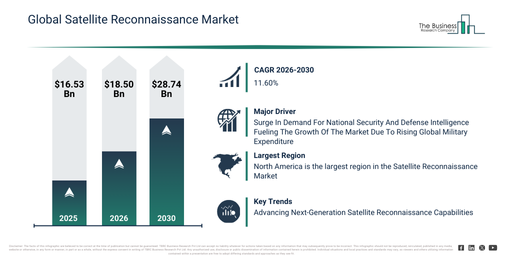
The satellite reconnaissance market has experienced significant expansion in recent years. It is anticipated to grow from $16.53 billion in 2025 to $18.50 billion in 2026, demonstrating a compound annual growth rate (CAGR) of 11.9%. This historical growth can be linked to factors such as increasing defense spending, a growing demand for earth observation, the rising need for border surveillance, the expansion of military modernization programs, and the increasing use of satellite imaging for disaster management.
The satellite reconnaissance market is projected to experience substantial expansion in the coming years. This market is forecast to reach $28.74 billion by 2030, exhibiting a compound annual growth rate (CAGR) of 11.6%. Factors contributing to this growth during the forecast period include increased investment in intelligence capabilities, the escalating adoption of small satellites, a heightened demand for real-time imaging, the expansion of commercial satellite operators, and the expanding application of satellite data in environmental monitoring. Key trends anticipated over the forecast period encompass technological advancements in remote sensing, breakthroughs in satellite imaging systems, the evolution of artificial intelligence (AI)-based image analytics, dedicated research and development into small-satellite constellations, and progress in hyperspectral and SAR imaging.
Get A Free Sample Report With In-Depth Market Insights:
Satellite Reconnaissance Market Growth Factors Behind Sustained Expansion
The growing requirement for national security and defense intelligence is projected to propel the expansion of the satellite reconnaissance market in the future. National security and defense intelligence encompasses the need for countries to acquire strategic information, including imagery and signals from orbit, to oversee threats, conflicts, and security developments. The surge in demand for national security and defense intelligence stems from the escalation of geopolitical tensions and conflicts worldwide, prompting governments to allocate more resources towards defense and surveillance. Satellite reconnaissance supports national security and defense intelligence by providing the necessary space-based observation capabilities to fulfill these enhanced surveillance needs. For instance, in April 2025, according to the Stockholm International Peace Research Institute (SIPRI), a Sweden-based research institute, world military expenditure rose by 9.4% in real terms from 2023 to reach a record total of $2.7 trillion in 2024, with average military spending reaching 7.1 percent of total government expenditure in 2024. Therefore, the increasing demand for national security and defense intelligence is acting as a key driver for the growth of the satellite reconnaissance market.
Satellite Reconnaissance Market Segment Analysis: What Are The Core Market Categories?
The satellite reconnaissance market covered in this report is segmented –
1) By Type: Optical Reconnaissance Satellites, Radar Reconnaissance Satellites, Electronic Reconnaissance Satellites, Signals Intelligence (SIGINT) Satellites, Other Satellite
2) By Platform: Earth Observation Satellites, Reconnaissance Drones
3) By Orbit: Low Earth Orbit (LEO), Geosynchronous Earth Orbit (GEO), Medium Earth Orbit (MEO), Other Orbits
4) By Application: Intelligence, Surveillance, And Reconnaissance (ISR), Earth Observation and Mapping, Signal Intelligence (SIGINT), Electronic Intelligence (ELINT), Communications Intelligence (COMINT), Other Applications
5) By End User: Défense And Intelligence Agencies, Government And Civil Agencies, Commercial Enterprises
Subsegments:
1) By Optical Reconnaissance Satellites: High Resolution Imaging Satellites, Multispectral Imaging Satellites, Hyperspectral Imaging Satellites, Infrared Imaging Satellites, Panchromatic Imaging Satellites
2) By Radar Reconnaissance Satellites: Synthetic Aperture Radar Satellites, Side Looking Airborne Radar Satellites, Interferometric Radar Satellites, Moving Target Indicator Radar Satellites
3) By Electronic Reconnaissance Satellites: Electronic Signal Interception Satellites, Radar Signal Monitoring Satellites, Electronic Emission Mapping Satellites, Electronic Threat Detection Satellites
4) By Signals Intelligence Satellites: Communication Signal Interception Satellites, Signal Monitoring Satellites, Command And Control Signal Analysis Satellites, Frequency Analysis Satellites
5) By Other Satellites: Early Warning Satellites, Measurement And Signature Intelligence Satellites, Multisensor Fusion Satellites, Special Purpose Reconnaissance Satellites
Satellite Reconnaissance Market Industry Trends Fueling Future Revenue Growth
Leading companies within the satellite reconnaissance market are directing their efforts towards sophisticated technology platforms, such as high-resolution swath platforms, to elevate detection abilities, imaging precision, and operational scope. High-resolution swath platforms refer to Earth observation or radar imaging systems that capture exceptionally detailed images across a broad ground area in one pass, blending fine spatial resolution with extensive coverage. For instance, in March 2025, ICEYE Oy, an Earth observation company from Finland, launched four new synthetic aperture radar (SAR) satellites, including its Generation 4 (Gen4) model featuring 25 cm resolution. This new platform effectively doubles both antenna size and transmit power, expanding high-resolution swath platforms from 150 to 400 kilometers and increasing information density by about 30%, while improved orbit control and increased imaging capacity enable better coverage of high-priority, congested regions in a single pass. The Gen4 launch, designed to provide sharper detection and classification of vessels, vehicles, and aircraft, aims to offer defense, intelligence, and other customers enhanced situational awareness, quicker decision-making, and more impactful mission outcomes.
Satellite Reconnaissance Market Competitive Analysis Of Leading Industry Participants
Major companies operating in the satellite reconnaissance market are Boeing Co., Airbus SE, BAE Systems, Northrop Grumman Corp., L3Harris Technologies Inc., Surrey Satellite Technology Ltd (SSTL), Planet Labs PBC, ICEYE, EarthDaily Analytics, BlackSky Technology Inc., Capella Space, True Anomaly Inc., Pixxel, Kongsberg Satellite Services, GHGSat Inc., SpaceKnow Inc., Satellogic Inc., OHB SE, Albedo Space Corp., Ursa Space Systems Inc., Turion Space, Earth-i Ltd., SI Imaging Services Co. Ltd., ImageSat International NV, Maxar Technologies
View The Full Satellite Reconnaissance Market Report:
Satellite Reconnaissance Market Geographic Spread And Regional Opportunities
North America was the largest region in the satellite reconnaissance market in 2025. Asia-Pacific is expected to be the fastest-growing region in the forecast period. The regions covered in the satellite reconnaissance market report are Asia-Pacific, South East Asia, Western Europe, Eastern Europe, North America, South America, Middle East, Africa.
Reach Out To Our Team:
The Business Research Company: https://www.thebusinessresearchcompany.com/
Americas: +1 310-496-7795
Asia: +44 7882 955267 & +91 8897263534
Europe: +44 7882 955267
Email us at: marketing@tbrc.info
Follow us on:
LinkedIn: https://in.linkedin.com/company/the-business-research-company
YouTube: https://www.youtube.com/channel/UC24_fI0rV8cR5DxlCpgmyFQ
Global Market Model: https://www.thebusinessresearchcompany.com/global-market-model

Wasay has over a decade of experience in market research, data modelling, and analytics, with prior experience at GlobalData and Decision Tree Consulting Services. At The Business Research Company , he leads research operations across syndicated studies, customized consulting engagements, and the Global Market Model platform. His professional experience includes supporting organizations such as Boston Consulting Group, KPMG, and Ernst & Young. Wasay holds a degree in Electronics and Communications Engineering, postgraduate management qualifications from International Management Institute Belgium and Indian School of Business and Entrepreneurship, and completed the Integrated Program in Business Analytics from Indian Institute of Management Indore.