Backed by market attractiveness analysis, total addressable market sizing, company benchmarking matrices, interactive Excel dashboards, wider supply chain intelligence, emerging startup coverage, and detailed product-level insights, The Business Research Company’s 2026 market reports are designed to offer research that is more actionable and strategically valuable than ever.
Augmented Reality Market Revenue Growth On Track For A 41.4% CAGR Through 2030
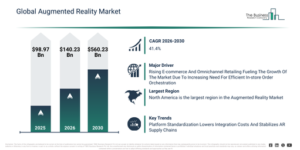
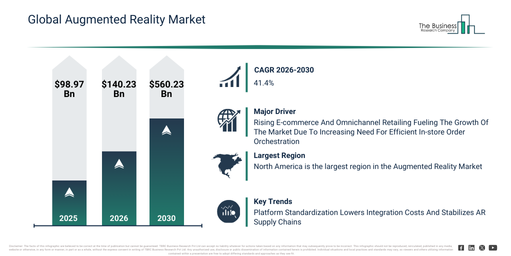
The augmented reality market size has experienced substantial growth in recent years. It is anticipated to expand from $98.97 billion in 2025 to $140.23 billion in 2026, exhibiting a compound annual growth rate (CAGR) of 41.7%. This historical progression can be ascribed to elements such as the increased adoption of mobile augmented reality technology, augmented investment by prominent technology firms, the expanding application of augmented reality in industrial and manufacturing operations, the development of immersive gaming and entertainment applications, and the heightened deployment of augmented reality in healthcare procedures.
The augmented reality market is anticipated to experience substantial growth over the upcoming years. It is projected to expand to $560.23 billion in 2030, registering a compound annual growth rate (CAGR) of 41.4%. This projected expansion is primarily driven by factors such as the increasing need for real-time augmented reality assistance, the rising integration of augmented reality into remote maintenance workflows, the growing adoption of augmented reality-enabled training and simulation, the broadening application of augmented reality in automotive head-up displays, and the increased utilization of augmented reality in educational and virtual learning settings. Furthermore, significant trends shaping this forecast period include advancements in augmented reality optics and display technology, innovations in spatial computing interaction models, ongoing developments in artificial intelligence-driven augmented reality content generation, research and development efforts in lightweight wearable augmented reality devices, and progress in three-dimensional object tracking and mapping.
Get A Free Sample Report With In-Depth Market Insights:
Augmented Reality Market Growth Backed By Core Demand Fundamentals
The increasing embrace of e-commerce and omnichannel retailing is anticipated to fuel the expansion of the augmented reality market in the future. These terms denote the unification of online and physical sales channels, allowing consumers to smoothly browse, acquire, and receive items via websites, applications, and brick-and-mortar stores. The surge in their adoption stems from consumers’ growing demand for convenient, around-the-clock shopping and uniform experiences across web platforms, mobile applications, and physical locations. E-commerce and omnichannel retailing bolster augmented reality by incorporating immersive digital encounters, enabling shoppers to preview products across both digital and physical avenues. They boost customer engagement and buying confidence through interactive and fluid shopping processes. As an illustration, the UK Office for National Statistics, a government agency based in the UK, reported in January 2025 that online spending values in Great Britain for December 2024 showed a 1.7% increase compared to December 2023, underscoring the yearly expansion in internet retail expenditure. Consequently, the expansion of e-commerce and omnichannel retailing is stimulating demand within the augmented reality market.
Augmented Reality Market Segment Performance And Emerging Opportunities
The augmented reality market covered in this report is segmented –
1) By Component: Hardware, Software, Services
2) By Display: Head-Mounted Display, Smart Glass, Cinema Display Glasses, Extended Reality (XR) Glasses, Head-Up Display (HUD), Handheld Devices
3) By Application: Remote Assistance And Maintenance, Product Visualisation And Configuration, Navigation And Mapping, Social And Communication Filters, Other Applications
4) By End Use Industry: Information Technology And Telecommunications, Healthcare And Life Sciences, Manufacturing, Automotive, Retail And Electronic Commerce, Education, Real Estate, Defense And Security, Media And Entertainment, Logistics And Transportation
Subsegments:
1) By Hardware: Augmented Reality Head Mounted Displays, Augmented Reality Smart Glasses, Augmented Reality Depth Sensing Cameras, Augmented Reality Sensors, Augmented Reality Input Devices, Augmented Reality Projection Systems
2) By Software: Augmented Reality Development Platforms, Augmented Reality Content Management Software, Augmented Reality Simulation Software, Augmented Reality Tracking And Mapping Software, Augmented Reality Visualization Software, Augmented Reality Analytics Software
3) By Services: Augmented Reality Integration Services, Augmented Reality Deployment Services, Augmented Reality Maintenance Services, Augmented Reality Content Creation Services, Augmented Reality Consulting Services, Augmented Reality Training Services
Augmented Reality Market Growth Trends Reshaping The Competitive Landscape
Major companies operating in the augmented reality market are prioritizing the advancement of platform standardization, such as OpenXR-based application frameworks. This focus aims to reduce development costs, shorten deployment cycles, and alleviate hardware supply constraints. OpenXR-based application frameworks refer to software frameworks built upon the OpenXR standard, which empower developers to create cross-platform virtual reality (VR) and augmented reality (AR) applications. For instance, in April 2024, The Khronos Group Inc., a US-based industry consortium dedicated to open standards, launched OpenXR 1.1. This updated cross-platform standard is designed to accelerate AR and mixed-reality adoption at scale. The update expanded standardized input and interaction profiles, improved runtime conformance requirements to reduce device-specific bugs, and strengthened support for enterprise deployment scenarios across headsets and mobile devices. By standardizing development frameworks, companies can streamline integration processes, stabilize supply planning, and enhance pricing discipline across the AR ecosystem.
Augmented Reality Market Key Participants And Competitive Landscape
Major companies operating in the augmented reality market are Apple Inc., Google LLC, Microsoft Corporation, Samsung Electronics, Meta Platforms Inc., Sony Group Corporation, Lenovo Group Ltd., Xiaomi Corporation, Qualcomm Technologies Inc., Snap Inc., Unity Technologies Inc., PTC Inc., Magic Leap Inc., Niantic Inc., HTC Corporation, EON Reality, Kopin Corporation, UlptraLeap, RealWear Inc., Scope AR, Blippar Ltd., Vuzix Corporation, Wikitude GmbH, Optinvent SA, Atheer Inc.
View The Full Augmented Reality Market Report:
Augmented Reality Market Geographic Analysis: Where Is Demand Accelerating Fastest?
North America was the largest region in the augmented reality market in 2025. Aisa-Pacific is expected to be the fastest-growing region in the forecast period. The regions covered in the augmented reality market report are Asia-Pacific, South East Asia, Western Europe, Eastern Europe, North America, South America, Middle East, Africa.
Reach Out To Our Team:
The Business Research Company: https://www.thebusinessresearchcompany.com/
Americas: +1 310-496-7795
Asia: +44 7882 955267 & +91 8897263534
Europe: +44 7882 955267
Email us at: marketing@tbrc.info
Follow us on:
LinkedIn: https://in.linkedin.com/company/the-business-research-company
YouTube: https://www.youtube.com/channel/UC24_fI0rV8cR5DxlCpgmyFQ
Global Market Model: https://www.thebusinessresearchcompany.com/global-market-model

Wasay has over a decade of experience in market research, data modelling, and analytics, with prior experience at GlobalData and Decision Tree Consulting Services. At The Business Research Company , he leads research operations across syndicated studies, customized consulting engagements, and the Global Market Model platform. His professional experience includes supporting organizations such as Boston Consulting Group, KPMG, and Ernst & Young. Wasay holds a degree in Electronics and Communications Engineering, postgraduate management qualifications from International Management Institute Belgium and Indian School of Business and Entrepreneurship, and completed the Integrated Program in Business Analytics from Indian Institute of Management Indore.