Backed by market attractiveness analysis, total addressable market sizing, company benchmarking matrices, interactive Excel dashboards, wider supply chain intelligence, emerging startup coverage, and detailed product-level insights, The Business Research Company’s 2026 market reports are designed to offer research that is more actionable and strategically valuable than ever.
Automotive Cockpit Domain Controller Market Forecast: What Value Will The Market Reach By 2030?
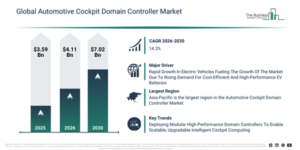
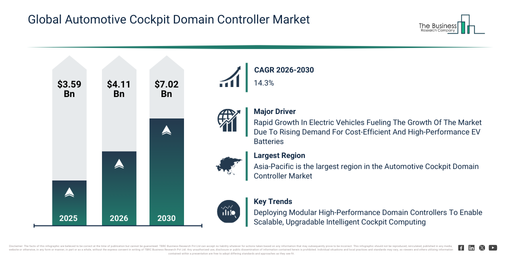
The automotive cockpit domain controller market has experienced rapid growth in its size over recent years. This market is projected to expand from $3.59 billion in 2025 to $4.11 billion in 2026, reflecting a compound annual growth rate (CAGR) of 14.6%. The expansion observed in the historical period can be linked to several drivers, including a heightened demand for digital cockpit systems, the growing integration of infotainment features, increasing adoption of connected car technologies, the expansion of in-vehicle display installations, and a rising need for centralized automotive electronics.
The automotive cockpit domain controller market is poised for significant expansion in the coming years. This sector is projected to reach $7.02 billion in 2030, demonstrating a compound annual growth rate (CAGR) of 14.3%. This projected growth is largely propelled by the increasing pivot towards software-defined vehicles, the wider adoption of centralized computing architectures, a heightened demand for advanced HMI functions, the broadening of over-the-air update capabilities, and the rising integration of AI-driven cockpit features. Throughout the forecast period, prominent trends are expected to include technological breakthroughs in high-performance automotive chipsets, innovations in digital cockpit platforms, progress in augmented reality display systems, ongoing research and development in human-machine interface technologies, and advancements in cloud-connected automotive services.
Get A Free Sample Report With In-Depth Market Insights:
Automotive Cockpit Domain Controller Market Industry Drivers: What’s Behind The Revenue Growth?
The future expansion of the automotive cockpit domain controller market is anticipated to be driven by the growing consumer interest in electric vehicles. Electric vehicles (EVs) are defined as cars that operate on electric motors, drawing power from rechargeable batteries, thereby providing a form of transport that is more environmentally friendly, silent, and efficient compared to conventional fuel-powered vehicles. This surge in EV demand stems from escalating fuel prices, positioning electric vehicles as a more economical option than traditional gasoline cars. Automotive cockpit domain controllers facilitate this rising demand for electric vehicles by combining infotainment systems, instrument displays, and driver assistance functions into one integrated unit. These controllers improve both user experience and vehicle efficiency by streamlining hardware, enhancing energy usage, and enabling specialized digital functionalities for electric transportation. As an illustration, in May 2025, the International Energy Agency, a France-based intergovernmental organization, reported that electric car sales surpassed 17 million units in 2024, showing a growth of over 25% and an increase of roughly 3.5 million vehicles compared to 2023. Consequently, the expanding market for electric vehicles is fueling the growth of the automotive cockpit domain controller market.
Automotive Cockpit Domain Controller Market Segments: Where Is Growth Concentrated?
The automotive cockpit domain controller market covered in this report is segmented –
1) By Type: Single-Domain Controller, Multi-Domain Controller, High-Performance Centralized Controller
2) By Vehicle: Passenger Cars, Commercial Vehicles
3) By Technology: Centralized Architecture, Distributed Architecture, Zonal Architecture, Hybrid Architecture
4) By Sales Channel: Original Equipment Manufacturer, Aftermarket
5) By Application: Infotainment Systems, Digital Instrument Cluster, Human Machine Interface, Head-Up Display Integration, Driver Monitoring Systems, Climate Control And Comfort Systems
Subsegments:
1) By Single-Domain Controller: Driver Assistance Controller, Infotainment Controller, Instrument Cluster Controller, Telematics Controller, Climate Control Controller
2) By Multi-Domain Controller: Integrated Infotainment And Cluster Controller, Integrated Telematics And Infotainment Controller, Integrated Driving And Safety Controller, Integrated Connectivity And Navigation Controller, Integrated Comfort And Convenience Controller
3) By High-Performance Centralized Controller: Central Compute Unit, Autonomous Driving Compute Node, Advanced Graphics Processing Unit, High-Speed Sensor Fusion Module, Vehicle Control And Management Unit
#Automotive Cockpit Domain Controller Market Growth Trends: What’s Shaping The Future Outlook?
Major companies operating in the automotive cockpit domain controller market are concentrating on modular, high-performance computing solutions, such as a modular domain controller, to enable scalable and upgradable in-vehicle computing across cockpit and advanced driver assistance applications. A modular domain controller describes a hardware platform that integrates powerful CPU and AI processing cores, allowing for flexible upgrades or expansions to meet evolving intelligent cockpit and driver assistance requirements beyond fixed, legacy ECUs. For instance, in April 2025, Horizon Robotics, a China-based automotive AI and compute solutions provider, launched the Journey 6P Domain Controller. This controller offers up to 560 TOPS of compute performance from its multi-core architecture, supports high-resolution sensor data, and features a pluggable design facilitating hardware upgradeability over a vehicle’s lifecycle to extend intelligent functionality and reduce long-term replacement costs.
Automotive Cockpit Domain Controller Market Competitive Landscape: Who Leads The Industry?
Major companies operating in the automotive cockpit domain controller market are Samsung Electronics Co. Ltd., Robert Bosch GmbH, LG Electronics Inc., Panasonic Corporation, Denso Corporation, Hyundai Mobis Co. Ltd., Continental AG, ZF Friedrichshafen AG, Magna International Inc., Qualcomm Technologies Inc., Valeo Société Anonyme (S.A.), Aptiv PLC, Texas Instruments Incorporated, Infineon Technologies AG, NXP Semiconductors N.V., Renesas Electronics Corporation, Harman International Industries Incorporated, Visteon Corporation, Thunder Software Technology Co. Ltd., BlackBerry Limited, Neusoft Reach Automotive Technology Co. Ltd.
View The Full Automotive Cockpit Domain Controller Market Report:
Automotive Cockpit Domain Controller Market Geographic Landscape: Which Region Dominates Industry Growth?
Asia-Pacific was the largest region in the automotive cockpit domain controller market in 2025. Asia-Pacific is expected to be the fastest-growing region in the forecast period. The regions covered in the automotive cockpit domain controller market report are Asia-Pacific, South East Asia, Western Europe, Eastern Europe, North America, South America, Middle East, Africa.
Reach Out To Our Team:
The Business Research Company: https://www.thebusinessresearchcompany.com/
Americas: +1 310-496-7795
Asia: +44 7882 955267 & +91 8897263534
Europe: +44 7882 955267
Email us at: marketing@tbrc.info
Follow us on:
LinkedIn: https://in.linkedin.com/company/the-business-research-company
YouTube: https://www.youtube.com/channel/UC24_fI0rV8cR5DxlCpgmyFQ
Global Market Model: https://www.thebusinessresearchcompany.com/global-market-model

Wasay has over a decade of experience in market research, data modelling, and analytics, with prior experience at GlobalData and Decision Tree Consulting Services. At The Business Research Company , he leads research operations across syndicated studies, customized consulting engagements, and the Global Market Model platform. His professional experience includes supporting organizations such as Boston Consulting Group, KPMG, and Ernst & Young. Wasay holds a degree in Electronics and Communications Engineering, postgraduate management qualifications from International Management Institute Belgium and Indian School of Business and Entrepreneurship, and completed the Integrated Program in Business Analytics from Indian Institute of Management Indore.