Backed by market attractiveness analysis, total addressable market sizing, company benchmarking matrices, interactive Excel dashboards, wider supply chain intelligence, emerging startup coverage, and detailed product-level insights, The Business Research Company’s 2026 market reports are designed to offer research that is more actionable and strategically valuable than ever.
Collaborative Robotic Joint Module Market Forecast: Value Set To Climb From $0.88 Billion To $1.57 Billion
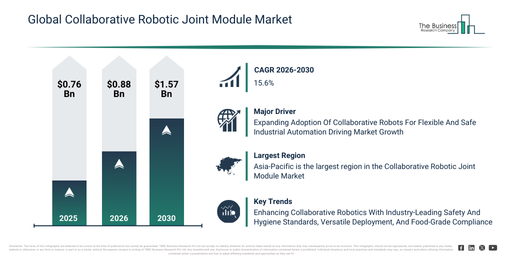
The collaborative robotic joint module market size has seen rapid growth in recent years. Its size is projected to expand from $0.76 billion in 2025 to $0.88 billion in 2026, achieving a compound annual growth rate (CAGR) of 15.8%. The market’s historic growth is due to several factors, including the increasing integration of collaborative robots in manufacturing, heightened automation in assembly lines, a greater demand for precision robotic components, a growing inclination towards human-robot collaboration, and the wider deployment of cobots in small and medium enterprises.
The collaborative robotic joint module market is projected to experience swift expansion in the coming years. It is forecast to reach $1.57 billion in 2030, showing a compound annual growth rate (CAGR) of 15.6%. This anticipated growth can be linked to factors such as the increasing integration of joint modules into future cobots, higher investments in flexible automation solutions, an increasing need for compact and lightweight robotic joints, the spread of industrial digitalization initiatives, and the broader acceptance of cobots in sectors like logistics and healthcare. Key trends anticipated during this period encompass technological progress in robotic joint design, breakthroughs in lightweight actuator systems, improvements in torque and force sensing modules, ongoing research and development into modular cobot designs, and enhancements in AI-powered motion control systems.
Get A Free Sample Report With In-Depth Market Insights:
Collaborative Robotic Joint Module Market Growth Catalysts And Demand Drivers
The widespread integration of robots into factories is anticipated to fuel the expansion of the collaborative robotic joint module market. Collaborative robot automation involves the strategic deployment of robots designed to work in conjunction with humans across industrial and logistics environments. These robots are equipped with integrated joint modules that allow for precise articulation, offer crucial force feedback, and ensure safe interaction. The increasing presence of collaborative robots in factories is a direct response to escalating labor shortages and the critical demand for enhanced operational efficiency across the manufacturing, healthcare, and logistics sectors. Supporting these collaborative robots, joint modules provide the fundamental motion, torque control, and safety features necessary for robotic arms to operate effectively and securely alongside human workers. For example, in December 2024, the International Federation of Robotics, a Germany-based robotics industry organization, stated that collaborative robots (cobots) comprised 10.5% of the 541,302 industrial robots installed in 2023. Consequently, the growing adoption of robots in factory settings serves as a significant impetus for the growth of the collaborative robotic joint module market.
Collaborative Robotic Joint Module Market Segmentation And Category Overview
The collaborative robotic joint module market covered in this report is segmented –
1) By Joint Type: Single-Axis Joints, Multi-Axis Joints, Custom And Hybrid Joints
2) By Payload Capacity: Light Duty, Medium Duty, Heavy Duty
3) By Robot Type: Articulated Robots, Collaborative Robots
4) By Application: Material Handling, Assembly And Disassembly, Welding And Soldering, Machine Tending, Quality Inspection And Testing, Packaging And Labelling
5) By End-User Industry: Automotive And Manufacturing, Electronics And Semiconductor, Healthcare And Pharmaceuticals, Food And Beverage, Logistics And Warehousing
Subsegments:
1) By Single-Axis Joints: Rotational Joint, Prismatic Joint, Revolute Joint
2) By Multi-Axis Joints: Spherical Joint, Cylindrical Joint, Universal Joint
3) By Custom And Hybrid Joints: Combination Joint, Adaptive Joint, Modular Joint
Collaborative Robotic Joint Module Market Trends Shaping Long-Term Demand
Leading companies operating in the collaborative robotic joint module market are concentrating on developing advanced automation solutions, including industry-leading safety and hygiene standards. These initiatives aim to support safe, efficient, and compliant operations in settings where humans and robots work side-by-side, especially in food processing, beverage production, and other regulated industries. Industry-leading safety and hygiene standards denote design criteria and certifications that ensure collaborative robots (cobots) meet stringent requirements for cleanability, contamination control, and operational safety, allowing their deployment in sensitive production areas without compromising product quality or workplace safety. As an example, in April 2023, Doosan Robotics Co. Ltd., a South Korea-based provider of collaborative automation technologies, launched its NSF-certified E-Series line of cobots, specifically dedicated to the food and beverage industry. The E-Series collaborative robots feature joint modules and components designed for easy cleaning, incorporate food-safe materials, and comply with international hygiene standards, all while delivering reliable performance and safe human-robot interaction in demanding production environments. This launch highlights the increasing emphasis on collaborative robotic systems that combine robust joint module performance with enhanced safety features and sanitation capabilities.
Collaborative Robotic Joint Module Market Leading Companies And Competitive Benchmarking
Major companies operating in the collaborative robotic joint module market are Nidec Corporation, Yaskawa Electric Corporation, Moog Inc., Nabtesco Corporation, Han’s Robot Co. Ltd., Kollmorgen Corporation, Estun Automation Co. Ltd., Siasun Robot & Automation Co. Ltd., Harmonic Drive Systems Inc., Maxon Group, JAKA Robotics Co. Ltd., DOBOT Technology Co. Ltd., AUBO Robotics Co. Ltd., ROBOTIS Co. Ltd, Harmonic Drive SE, Elite Robots Co. Ltd., Elephant Robotics Co. Ltd., Techman Robot Inc., Changzhou MyActuator Robot Technology Co. Ltd., Laifual Drive Co. Ltd.
View The Full Collaborative Robotic Joint Module Market Report:
Collaborative Robotic Joint Module Market Top Region By Revenue And Market Share
Asia-Pacific was the largest region in the collaborative robotic joint module market in 2025, and it is expected to be the fastest-growing region in the forecast period. The regions covered in the collaborative robotic joint module market report are Asia-Pacific, South East Asia, Western Europe, Eastern Europe, North America, South America, Middle East, Africa.
Reach Out To Our Team:
The Business Research Company: https://www.thebusinessresearchcompany.com/
Americas: +1 310-496-7795
Asia: +44 7882 955267 & +91 8897263534
Europe: +44 7882 955267
Email us at: marketing@tbrc.info
Follow us on:
LinkedIn: https://in.linkedin.com/company/the-business-research-company
YouTube: https://www.youtube.com/channel/UC24_fI0rV8cR5DxlCpgmyFQ
Global Market Model: https://www.thebusinessresearchcompany.com/global-market-model

Wasay has over a decade of experience in market research, data modelling, and analytics, with prior experience at GlobalData and Decision Tree Consulting Services. At The Business Research Company , he leads research operations across syndicated studies, customized consulting engagements, and the Global Market Model platform. His professional experience includes supporting organizations such as Boston Consulting Group, KPMG, and Ernst & Young. Wasay holds a degree in Electronics and Communications Engineering, postgraduate management qualifications from International Management Institute Belgium and Indian School of Business and Entrepreneurship, and completed the Integrated Program in Business Analytics from Indian Institute of Management Indore.