Featuring market attractiveness scoring, total addressable market sizing, company benchmarking matrices, interactive Excel dashboards, deeper supply chain intelligence, emerging startup tracking, and granular product-level insights, The Business Research Company’s 2026 market reports are built to deliver research that is both more actionable and more strategically valuable.
Fossil Energy Carbon Capture Solution Market Forecast: Value Set To Climb From $12.46 Billion To $21.28 Billion
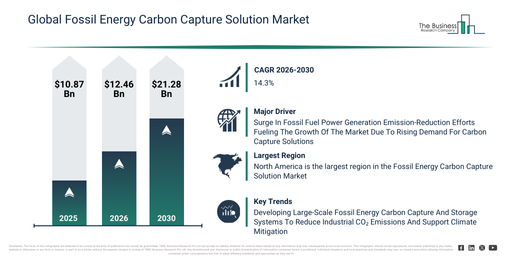
The market for fossil energy carbon capture solutions has seen substantial growth in recent years. This sector is anticipated to expand from $10.87 billion in 2025 to $12.46 billion in 2026, exhibiting a compound annual growth rate (CAGR) of 14.6%. The expansion observed historically can be linked to a heightened commitment to curbing industrial emissions, initial governmental incentives for carbon capture initiatives, increased reliance on fossil fuel-based power generation, innovations in carbon capture techniques, and an escalation of environmental regulations.
The fossil energy carbon capture solution market is projected to experience swift expansion in the coming years. This market is set to reach $21.28 billion by 2030, exhibiting a compound annual growth rate (CAGR) of 14.3%. Several factors are driving this anticipated growth, including the worldwide increase in CCS projects, more stringent net-zero pledges from governments, the rising adoption of low-carbon technologies, substantial investments in decarbonization infrastructure, and a growing need for clean fossil energy solutions. Key developments expected during this period involve a move towards modular and scalable capture systems, the advancement of direct air capture technologies, the incorporation of digital monitoring and AI optimization, increased collaborations between energy and technology companies, and the expansion of carbon transport and storage infrastructure.
Get A Free Sample Report With In-Depth Market Insights:
Fossil Energy Carbon Capture Solution Market Growth Momentum: What Factors Are Shaping Demand?
The growing imperative to curb emissions from fossil fuel-based power generation is anticipated to fuel the expansion of the fossil energy carbon capture solution market. Reducing emissions from these power plants involves restricting the release of carbon dioxide (CO₂) and other greenhouse gases generated from burning coal, oil, or natural gas for electricity. This demand for emission reduction is intensifying as governments worldwide implement stricter climate policies and carbon regulations to mitigate global warming and avert worsening environmental and health impacts. The fossil energy carbon capture solution addresses this by offering technologies that capture CO₂ directly at its source before it can enter the atmosphere. For example, as reported in March 2025 by the International Energy Agency, a France-based intergovernmental organization, energy-related carbon dioxide emissions in emerging market and developing economies rose by 1.5% (375 million tonnes) in 2024. This increase was driven by escalating energy demand due to rapid economic and population growth, with coal emissions climbing 2%, natural gas emissions up 3.7%, and oil emissions rising 0.3%, demonstrating a sustained dependence on fossil fuels for industrial activity and improved energy access. Consequently, the rising necessity to reduce emissions from fossil fuel-based power generation is a key driver for the fossil energy carbon capture solution market’s growth.
Fossil Energy Carbon Capture Solution Market Segment Breakdown: Which Categories Lead On Revenue?
The fossil energy carbon capture solution market covered in this report is segmented –
1) By Type: Pre-Combustion Carbon Capture, Oxy-Fuel Carbon Capture, Post Combustion Carbon Capture
2) By Service And Value Chain Component: Capture, Transportation, Storage, Utilization
3) By Storage Method: Enhanced Oil Recovery, Dedicated Geological Storage, Deep Saline Formations, Depleted Oil And Gas Reservoirs, Carbon Mineralization
4) By End-User Industry: Power Generation, Oil And Gas, Iron And Steel, Chemical And Petrochemical, Cement, Other End-User Industrys
Subsegments:
1) By Pre-Combustion Carbon Capture: Integrated Gasification Combined Cycle, Hydrogen Production, Synthetic Fuel Production
2) By Oxy-Fuel Carbon Capture: Coal-Fired Oxy-Fuel, Gas-Fired Oxy-Fuel, Biomass Co-Firing Oxy-Fuel
3) By Post Combustion Carbon Capture: Amine-Based Solvents, Carbonate-Based Solvents, Membrane Separation, Adsorption-Based Capture
Fossil Energy Carbon Capture Solution Market Trends Redefining Industry Growth
Leading companies active in the fossil energy carbon capture market are concentrating on creating innovative solutions, such as expansive carbon capture and storage (CCS) systems, to lessen industrial CO₂ emissions, boost operational sustainability, and advance climate mitigation goals. Large-scale carbon capture and storage systems are technologies that draw CO₂ from flue gas streams at fossil fuel installations, compress and transfer the gas, then inject it into secure subterranean reservoirs to avert its atmospheric release. For example, in October 2024, Santos Ltd., an Australia-based energy corporation, introduced the Moomba Carbon Capture and Storage (CCS) project. This integrated CCS system, located next to the Moomba Gas Plant, achieved its first CO₂ injection in 2024 and is designed to securely store up to 1.7 million tonnes of CO₂ annually in depleted reservoirs near the Cooper Basin. This launch signifies a considerable technological advance by combining engineered capture, transport, and geological injection with operational integration, bridging pilot-scale demonstrations with full-scale industrial deployment. It offers an adaptable, efficient method for curbing fossil energy emissions and supporting enduring decarbonization strategies.
Fossil Energy Carbon Capture Solution Market Competitive Analysis Of Leading Industry Participants
Major companies operating in the fossil energy carbon capture solution market are Exxon Mobil Corporation, Shell Plc, TotalEnergies SE, Equinor ASA, Honeywell International Inc., Siemens Energy AG, GE Vernova Inc., Schlumberger Limited, Linde plc, Mitsubishi Heavy Industries Ltd., Air Liquide S.A., NRG Energy Inc., Fluor Corporation, CO₂ Solutions Inc., Air Products and Chemicals Inc., Aker Solutions ASA, Chart Industries Inc., Babcock & Wilcox Enterprises Inc., Pall Corporation, Dakota Gasification Company, Svante Technologies Inc., Carbon Clean Solutions Limited
View The Full Fossil Energy Carbon Capture Solution Market Report:
Fossil Energy Carbon Capture Solution Market Geographic Distribution And Regional Opportunities
North America was the largest region in the fossil energy carbon capture solutions market in 2025. Asia-Pacific is expected to be the fastest-growing region in the forecast period. The regions covered in the fossil energy carbon capture solution market report are Asia-Pacific, South East Asia, Western Europe, Eastern Europe, North America, South America, Middle East, Africa.
Reach Out To Our Team:
The Business Research Company: https://www.thebusinessresearchcompany.com/
Americas: +1 310-496-7795
Asia: +44 7882 955267 & +91 8897263534
Europe: +44 7882 955267
Email us at: marketing@tbrc.info
Follow us on:
LinkedIn: https://in.linkedin.com/company/the-business-research-company
YouTube: https://www.youtube.com/channel/UC24_fI0rV8cR5DxlCpgmyFQ
Global Market Model: https://www.thebusinessresearchcompany.com/global-market-model

Wasay has over a decade of experience in market research, data modelling, and analytics, with prior experience at GlobalData and Decision Tree Consulting Services. At The Business Research Company , he leads research operations across syndicated studies, customized consulting engagements, and the Global Market Model platform. His professional experience includes supporting organizations such as Boston Consulting Group, KPMG, and Ernst & Young. Wasay holds a degree in Electronics and Communications Engineering, postgraduate management qualifications from International Management Institute Belgium and Indian School of Business and Entrepreneurship, and completed the Integrated Program in Business Analytics from Indian Institute of Management Indore.