Built to provide research that’s more actionable and strategically valuable, The Business Research Company’s 2026 market reports include market attractiveness analysis, total addressable market sizing, company benchmarking matrices, interactive Excel dashboards, broader supply chain intelligence, emerging startup tracking, and in-depth product insights.
Cloud Computing In Oil And Gas Market Poised To Hit $21.45 Billion By 2030 With A 11.5% CAGR
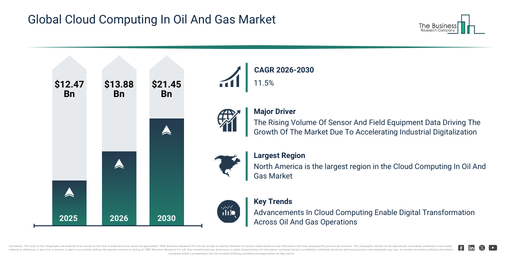
The market size for cloud computing in oil and gas has experienced swift expansion in recent years. This market is set to increase from $12.47 billion in 2025 to $13.88 billion in 2026, achieving a compound annual growth rate (CAGR) of 11.3%. Historically, this expansion has been propelled by the need for cost optimization, the proliferation of digital oilfields, wider sensor deployment, early cloud migration efforts, and the intricacies of operational processes.
The market size for cloud computing in the oil and gas sector is poised for substantial expansion over the next few years. It is forecasted to reach $21.45 billion by 2030, with a compound annual growth rate (CAGR) of 11.5%. This growth throughout the forecast period can be attributed to advancements such as AI-driven exploration analytics, the widespread adoption of digital twin technology, enhanced automation of field operations, a heightened focus on cybersecurity, and more robust data-driven decision-making processes. Significant trends anticipated during this period include the use of cloud-based reservoir analytics, remote asset monitoring capabilities, strategies for predictive maintenance, real-time production optimization, and streamlined centralized data management.
Get A Free Sample Report With In-Depth Market Insights:
Cloud Computing In Oil And Gas Market Growth Drivers: What’s Behind The Acceleration?
An increasing quantity of data originating from sensors and field equipment is anticipated to drive the expansion of cloud computing within the oil and gas market in the future. This data, derived from sensors and field equipment, constitutes real-time insights produced by networked devices utilized throughout oil and gas operations for tracking asset performance, environmental states, and operational effectiveness. This surge in data volume is a consequence of the swift digitalization occurring in industrial processes and the extensive uptake of IoT-enabled solutions, which facilitate constant surveillance and quicker, data-informed decisions. Cloud computing in oil and gas facilitates this data expansion by providing a flexible infrastructure capable of storing, processing, and analyzing significant quantities of live sensor data, simultaneously allowing for remote accessibility, sophisticated analytics, and enhanced operational efficiency across upstream, midstream, and downstream segments. As an illustration, a November 2025 report from Ofcom, the UK-based government-approved regulatory and competition authority, reported around 24.9 million active IoT devices in 2023 and 26.5 million in 2024. This demonstrates the swift escalation in the volume of data produced by sensors across various industrial sectors, including energy and utilities. Consequently, the expanding volume of data from sensors and field equipment stands as a crucial element driving the advancement of cloud computing within the oil and gas market.
Cloud Computing In Oil And Gas Market Segment Trends And Revenue Contributors
The cloud computing in oil and gas market covered in this report is segmented –
1) By Service Model: Infrastructure As A Service (IaaS), Platform As A Service (PaaS), Software As A Service (SaaS)
2) By Deployment: Public Cloud, Private Cloud, Hybrid Cloud
3) By Application Or Use Case: Data Storage And Management, Seismic Data Processing, Reservoir Simulation And Modeling, Predictive Maintenance, Production Optimization, Supply Chain Management, Real-Time Monitoring And Analytics, Asset Management Systems, Disaster Recovery And Backup
4) By End-User Industry Segment: Upstream, Midstream, Downstream, Oilfield Services And Equipment Providers
Subsegments:
1) By Infrastructure As A Service (IaaS): Compute Resources, Storage Solutions, Networking Services, Backup And Recovery Services, Security And Compliance Services
2) By Platform As A Service (PaaS): Application Development Platform, Database Management Platform, Integration And Middleware Platform, Analytics And Monitoring Platform, Deployment And Orchestration Platform
3) By Software As A Service (SaaS): Enterprise Resource Planning Software, Customer Relationship Management Software, Asset Management Software, Collaboration And Communication Software, Data Analytics And Reporting Software
Cloud Computing In Oil And Gas Market Trends: What’s Defining The Industry’s Next Phase?
Leading entities within the cloud computing sector for the oil and gas market are concentrating efforts on creating cloud-powered data management platforms. This initiative aims to boost operational effectiveness, improve asset productivity, and facilitate data-informed choices throughout upstream, midstream, and downstream operations. Such platforms represent software solutions hosted in the cloud, enabling organizations to centralize storage, integration, processing, and management of data from various origins. They provide scalable and secure entry to both current and past data, simultaneously supporting analytics, data governance, and teamwork among geographically dispersed teams. An illustrative example is KBC, a Belgian firm specializing in advanced process optimization and industrial software solutions, which introduced the KBC Acuity Industrial Cloud Suite in October 2023. This extensive cloud-native platform is specifically engineered to speed up digital transformation in sectors with high energy consumption, such as oil and gas. This particular solution facilitates centralized data handling, sophisticated process modeling, and performance improvement through the utilization of cloud analytics. It assists operators in enhancing operational transparency, decreasing expenses, and fostering more efficient and sustainable plant activities.
Cloud Computing In Oil And Gas Market Key Players Shaping Industry Direction
Major companies operating in the cloud computing in oil and gas market are Alphabet Inc, Microsoft Corporation, Alibaba Group Holding Limited, Amazon Web Services Inc, Accenture plc, International Business Machines Corporation, Cisco Systems Inc, Oracle Corporation, SAP SE, Salesforce Inc, Capgemini SE, Cognizant Technology Solutions Corporation, Infosys Limited, Workday Inc, Dassault Systèmes SE, Infor Inc, Sage Group plc, Bentley Systems Inc, Aspen Technology Inc, TIBCO Software Inc, Quorum Software LLC, Seven Lakes Technologies LLC, Risk Edge Solutions Private Limited, PetroDE LLC
View The Full Cloud Computing In Oil And Gas Market Report:
Cloud Computing In Oil And Gas Market Regional Analysis: Which Geography Leads On Revenue?
North America was the largest region in the cloud computing in the oil and gas market in 2025. Asia-Pacific is expected to be the fastest-growing region in the forecast period. The regions covered in the cloud computing in oil and gas market report are Asia-Pacific, South East Asia, Western Europe, Eastern Europe, North America, South America, Middle East, Africa.
Reach Out To Our Team:
The Business Research Company: https://www.thebusinessresearchcompany.com/
Americas: +1 310-496-7795
Asia: +44 7882 955267 & +91 8897263534
Europe: +44 7882 955267
Email us at: marketing@tbrc.info
Follow us on:
LinkedIn: https://in.linkedin.com/company/the-business-research-company
YouTube: https://www.youtube.com/channel/UC24_fI0rV8cR5DxlCpgmyFQ
Global Market Model: https://www.thebusinessresearchcompany.com/global-market-model

Wasay has over a decade of experience in market research, data modelling, and analytics, with prior experience at GlobalData and Decision Tree Consulting Services. At The Business Research Company , he leads research operations across syndicated studies, customized consulting engagements, and the Global Market Model platform. His professional experience includes supporting organizations such as Boston Consulting Group, KPMG, and Ernst & Young. Wasay holds a degree in Electronics and Communications Engineering, postgraduate management qualifications from International Management Institute Belgium and Indian School of Business and Entrepreneurship, and completed the Integrated Program in Business Analytics from Indian Institute of Management Indore.