Built to provide research that’s more actionable and strategically valuable, The Business Research Company’s 2026 market reports include market attractiveness analysis, total addressable market sizing, company benchmarking matrices, interactive Excel dashboards, broader supply chain intelligence, emerging startup tracking, and in-depth product insights.
Onboard Carbon Capture System Market Size, Value And Growth Trajectory Through 2030
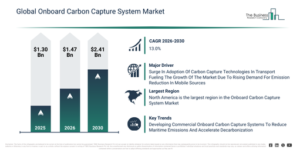
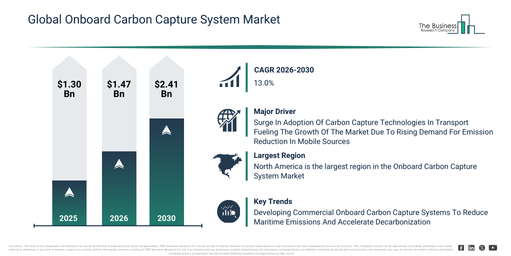
The market size for onboard carbon capture systems has experienced rapid growth in recent years. It is projected to expand from $1.30 billion in 2025 to $1.47 billion in 2026, achieving a compound annual growth rate (CAGR) of 13.3%. The historical increase can be attributed to several factors, including the escalation of maritime emission regulations, mounting pressure to decarbonize shipping fleets, an increase in the adoption of exhaust treatment systems, an expanding emphasis on low-carbon maritime operations, and a heightened awareness of environmental compliance.
The onboard carbon capture system market size is anticipated to undergo significant expansion over the next few years. It is expected to reach $2.41 billion in 2030, growing at a compound annual growth rate (CAGR) of 13.0%. The projected growth in this period can be attributed to an increase in global carbon reduction mandates, a rise in investment in onboard decarbonization technologies, the increasing adoption of retrofittable carbon capture solutions, the expanding deployment of carbon capture pilot programs on large vessels, and a greater focus on carbon intensity reduction targets. Prominent trends anticipated during the forecast period include advancements in compact capture technologies, innovations in marine carbon dioxide storage systems, developments in energy-efficient absorption materials, ongoing research and development in solvent and sorbent chemistry, and progress in modular onboard capture designs.
Get A Free Sample Report With In-Depth Market Insights:
Onboard Carbon Capture System Market Demand Drivers Opening New Revenue Streams
The increasing utilization of carbon capture technologies in the transport and mobile sectors is anticipated to drive expansion within the onboard carbon capture system market moving forward. Transport carbon capture adoption involves the implementation of systems and methods that capture CO2 emissions directly from vehicles, ships, or mobile power units at their source to decrease greenhouse gas emissions. This rise in the uptake of carbon capture technologies in transport and mobile sources stems from more stringent global emission standards and decarbonization goals, which compel operators to reduce tailpipe CO2 while retaining their current vehicle fleets. The onboard carbon capture system aids carbon capture technologies in transport and mobile sources by developing and deploying CO2 capture solutions that can be integrated into mobile emission sources to meet emission targets and regulatory expectations. For instance, in March 2024, data from the International Energy Agency, a France-based intergovernmental organization, indicated that carbon dioxide capture capacity for 2030 grew by 35% in 2023 and storage capacity increased by 70%, bringing the total capture potential to over 430 million tonnes per year and storage capacity to approximately 620 million tonnes of carbon dioxide per year. Consequently, the growing adoption of transport carbon capture technologies is fueling the expansion of the onboard carbon capture system market. The escalating need for emissions reduction in the shipping and aviation industries is projected to stimulate the growth of the onboard carbon capture system market in the coming years. Emissions reduction demand refers to the heightened global focus on decreasing greenhouse gas emissions from significant climate-contributing sectors, including transport sectors such as shipping and aviation. This demand for emissions reduction in shipping and aviation is increasing because international regulations and climate objectives increasingly mandate operators to cut greenhouse gases, while both customers and investors advocate for demonstrably cleaner transport options. The onboard carbon capture system supports emissions reduction in shipping and aviation by providing technologies that capture CO2 at the point of emission from vessels and aircraft, enabling operators to comply with stricter emissions targets. For example, in July 2023, the International Maritime Organization (IMO), a UK-based United Nations specialized agency, reported that the 2023 IMO Strategy on Reduction of GHG Emissions from ships established targets to reduce carbon intensity by at least 40% by 2030, compared with 35% in 2022, and achieve net-zero greenhouse gas emissions by around 2050, clearly demonstrating a year-over-year increase in the ambition for decarbonization in the shipping sector. Therefore, the heightened demand for emissions reduction in shipping and aviation is driving the expansion of the Onboard Carbon Capture System market.
Onboard Carbon Capture System Market Segment Analysis Spotlighting Growth Areas
The onboard carbon capture system market covered in this report is segmented –
1) By Component And System: Capture Units, Compressors And Liquefaction Units, Storage Cylinders, Filtration Systems
2) By Service: Installation, Maintenance, Retrofitting, Monitoring, Engineering Consulting, System Integration, Testing And Inspection
3) By Vessel Type: Commercial Cargo Ships, Passenger Ships, Tankers, Offshore Support Vessels
4) By End-User Industry: Shipping And Maritime, Aviation, Freight And Logistics, Energy And Utilities, Oil And Gas
Subsegments:
1) By Capture Units: Chemical Absorption Capture Units, Physical Adsorption Capture Units, Membrane Separation Capture Units, Cryogenic Capture Units
2) By Compressors And Liquefaction Units: High Pressure Gas Compressors, Low Temperature Liquefaction Units, Integrated Compression And Cooling Units, Modular Compressor Skid Units
3) By Storage Cylinders: High Pressure Gas Storage Cylinders, Liquefied Carbon Dioxide Storage Tanks, Insulated Cryogenic Storage Cylinders, Modular Onboard Storage Modules
4) By Filtration Systems: Particulate Filtration Systems, Gas Purification Filter Systems, Moisture Removal Filter Systems, Multi Stage Filtration Systems
Onboard Carbon Capture System Market Trends Powering Strategic Industry Growth
Major companies operating in the onboard carbon capture system market are concentrating on developing innovative solutions, including commercially available onboard carbon capture and storage (CCS) systems for ships. These initiatives aim to reduce CO2 emissions at the point of combustion, facilitate regulatory compliance, and further maritime decarbonization. Commercial onboard CCS systems are technologies that capture CO2 directly from a vessel’s exhaust, storing it onboard for subsequent offloading or utilization, allowing shipowners to lower emissions without an immediate transition to alternative fuels. For example, in May 2025, Wärtsilä, a marine technology company based in Finland, introduced its commercially available onboard carbon capture solution. This system underwent validation through a full-scale installation trial onboard the Clipper Eris ethylene carrier and is designed to decrease vessel CO2 emissions by up to 70 percent while integrating smoothly with conventional fuel engines and existing exhaust treatment systems. This introduction signifies a notable technological advancement by providing operational CCS capability to commercial vessels, connecting trial-scale demonstrations with practical deployment, and offering a scalable, efficient solution for reducing maritime emissions.
Onboard Carbon Capture System Market Competitive Analysis Of Leading Industry Participants
Major companies operating in the onboard carbon capture system market are Shell Plc, TotalEnergies, Equinor ASA, Mitsubishi Heavy Industries Ltd., Baker Hughes Co., Mitsui O.S.K. Lines, Wartsila Corporation, Samsung Heavy Industries Co. Ltd., Hanwha Ocean Co. Ltd., Chart Industries Inc., Kawasaki Heavy Industries Ltd., Carbon Clean Solutions Ltd., DESMI, Linde Engineering, Alfa Laval Inc., Panasia Japan Corp., MAN Energy Solutions, Langh Tech, Capsol Technologies ASA, EverLoNG Project Consortium
View The Full Onboard Carbon Capture System Market Report:
Onboard Carbon Capture System Market Geographic Distribution And Regional Opportunities
North America was the largest region in the onboard carbon capture system market in 2025. Asia-Pacific is expected to be the fastest-growing region in the forecast period. The regions covered in the onboard carbon capture system market report are Asia-Pacific, South East Asia, Western Europe, Eastern Europe, North America, South America, Middle East, Africa.
Reach Out To Our Team:
The Business Research Company: https://www.thebusinessresearchcompany.com/
Americas: +1 310-496-7795
Asia: +44 7882 955267 & +91 8897263534
Europe: +44 7882 955267
Email us at: marketing@tbrc.info
Follow us on:
LinkedIn: https://in.linkedin.com/company/the-business-research-company
YouTube: https://www.youtube.com/channel/UC24_fI0rV8cR5DxlCpgmyFQ
Global Market Model: https://www.thebusinessresearchcompany.com/global-market-model

Wasay has over a decade of experience in market research, data modelling, and analytics, with prior experience at GlobalData and Decision Tree Consulting Services. At The Business Research Company , he leads research operations across syndicated studies, customized consulting engagements, and the Global Market Model platform. His professional experience includes supporting organizations such as Boston Consulting Group, KPMG, and Ernst & Young. Wasay holds a degree in Electronics and Communications Engineering, postgraduate management qualifications from International Management Institute Belgium and Indian School of Business and Entrepreneurship, and completed the Integrated Program in Business Analytics from Indian Institute of Management Indore.