Featuring market attractiveness scoring, total addressable market sizing, company benchmarking matrices, interactive Excel dashboards, deeper supply chain intelligence, emerging startup tracking, and granular product-level insights, The Business Research Company’s 2026 market reports are built to deliver research that is both more actionable and more strategically valuable.
Recommerce Market Size Forecast: How Big Could The Market Get By 2030?
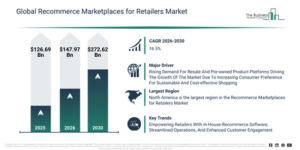
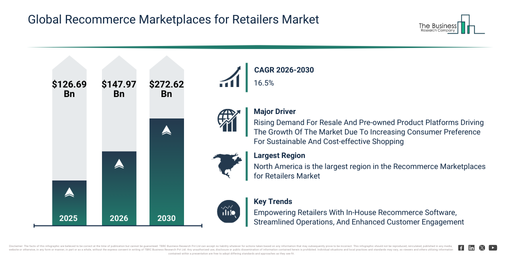
The market size for recommerce marketplaces serving retailers has experienced substantial growth in recent years. This market is projected to expand from $126.69 billion in 2025 to reach $147.97 billion by 2026, demonstrating a compound annual growth rate (CAGR) of 16.8%. The historical expansion of this market can be attributed to several factors, including growing consumer adoption of online shopping, an increasing demand for convenience and fast delivery, enhanced smartphone and internet penetration, the expansion of product variety on e-commerce platforms, and rising trust in digital payment systems.
The market size for recommerce marketplaces for retailers is anticipated to experience substantial expansion over the upcoming years. This sector is projected to reach $272.62 billion in 2030 at a compound annual growth rate (CAGR) of 16.5%. This projected increase during the forecast period is due to factors such as a heightened emphasis on personalization and AI-driven recommendations, the expanding adoption of omnichannel retail approaches, increased capital directed towards logistics and supply chain automation, the broadening of cross-border e-commerce, and a growing commitment to sustainability and circular economy principles. Key developments expected within this period encompass progress in artificial intelligence for predicting demand and tailoring experiences, breakthroughs in augmented reality and virtual try-on technologies, advancements in automated warehousing and robotics, ongoing research and innovation in secure payment and blockchain solutions, and the emergence of models for hyperlocal delivery and expedited same-day shipping.
Get A Free Sample Report With In-Depth Market Insights:
Recommerce Market Demand Drivers: What’s Powering Industry Growth?
The increasing demand for resale and previously owned product platforms is anticipated to fuel the expansion of the recommerce marketplaces for retailers market in the future. These platforms signify a growing consumer inclination to buy and sell items that have had prior owners, influenced by evolving perceptions of value, environmental responsibility, and affordability. Shopper interest in resale and pre owned platforms is on the rise as more individuals look for economical alternatives and prioritize sustainable purchasing habits, prompted by wider economic strains and ecological worries. Recommerce marketplaces for retailers facilitate these platforms by providing organized and verified resale channels, broadening access to a variety of pre owned goods, and simplifying transactions to meet consumer expectations. For instance, in 2025, ThredUp Inc., a US-based online resale platform, reported that 63% of consumers who bought secondhand apparel in 2023 made a purchase online, marking an increase of 17 percentage points from 2022. Additionally, 52% of all consumers shopped secondhand apparel, and new shoppers are projected to contribute 65% of incremental secondhand spend by 2028, with Generation Z and Millennials accounting for 65%, an increase of 5 percentage points from 2022. Consequently, the escalating demand for resale and pre owned product platforms is stimulating the growth of the recommerce marketplaces for retailers market.
Recommerce Market Segment Analysis Spotlighting Growth Areas
The recommerce marketplaces for retailers market covered in this report is segmented –
1) By Product Type: Apparel And Footwear, Electronics, Home Goods, Books And Media, Luxury Goods, Other Product Types
2) By Business Model: Business-To-Business (B2B), Business-To-Consumer (B2C), Consumer-To-Consumer (C2C)
3) By Platform: Online, Offline
4) By End-User: Retailers, Brands, Consumers
Subsegments:
1) By Apparel And Footwear: Casual Wear, Formal Wear, Sportswear, Footwear, Accessories, Outerwear
2) By Electronics: Smartphones, Laptops, Tablets, Televisions, Cameras, Wearable Devices, Home Appliances
3) By Home Goods: Furniture, Home Decor, Kitchenware, Bedding And Linen, Lighting, Storage Solutions
4) By Books And Media: Books, Magazines, Music Media, Movies, Video Games, Educational Materials
5) By Luxury Goods: Designer Clothing, Luxury Handbags, Watches, Jewelry, Footwear, Accessories
6) By Other Product Types: Sports Equipment, Toys And Games, Baby Products, Pet Supplies, Collectibles, Miscellaneous Items
Recommerce Market Innovation Trends: What Developments Are Reshaping The Industry?
Leading businesses in the recommerce marketplaces for retailers market are prioritizing the creation of sophisticated technology, including proprietary in-house software, aiming to enhance operational effectiveness, streamline inventory control, and elevate the customer journey in the realm of second-hand goods. This in-house software constitutes private digital platforms built and sustained by companies for the internal oversight of fundamental business functions, thereby facilitating greater personalization, command, and seamless connection with current systems. An illustrative example is BuyBay GmbH, an e-commerce solutions provider from Germany, which introduced its proprietary recommerce software tailored for retailers in May 2024. This platform empowers businesses to effectively handle products that are returned, pre-owned, or refurbished, integrate these items into their various sales channels, and refine the overall resale operation. Ultimately, this particular software enables retailers to simplify recommerce activities, boost customer contentment, and open up novel sources of income derived from environmentally friendly product lifespans.
Recommerce Market Leading Players And Competitive Positioning
Major companies operating in the recommerce marketplaces for retailers market are Farfetch UK Limited, Aptos Inc., ThredUp Inc., Upstream Commerce Ltd., Trove Recommerce Inc., Recommerce Group SAS, Yerdle Recommerce Services, Archive Resale Inc., Reflaunt S.A., Recurate Inc., reverse.supply GmbH, Troquer S.A. de C.V., ResaleAI Inc., Save Your Wardrobe Ltd., SuperCircle Inc., RecommerceX Ltd., Reshop Inc., Circularity.io, Sellier Knightsbridge Ltd., Sort A Brick Ltd.
View The Full Recommerce Market Report:
Recommerce Market Regional Distribution: Which Areas Power Market Growth?
North America was the largest region in the recommerce marketplaces for retailers market in 2025. Asia-Pacific is expected to be the fastest-growing region in the forecast period. The regions covered in the recommerce marketplaces for retailers market report are Asia-Pacific, South East Asia, Western Europe, Eastern Europe, North America, South America, Middle East, Africa.
Reach Out To Our Team:
The Business Research Company: https://www.thebusinessresearchcompany.com/
Americas: +1 310-496-7795
Asia: +44 7882 955267 & +91 8897263534
Europe: +44 7882 955267
Email us at: marketing@tbrc.info
Follow us on:
LinkedIn: https://in.linkedin.com/company/the-business-research-company
YouTube: https://www.youtube.com/channel/UC24_fI0rV8cR5DxlCpgmyFQ
Global Market Model: https://www.thebusinessresearchcompany.com/global-market-model

Wasay has over a decade of experience in market research, data modelling, and analytics, with prior experience at GlobalData and Decision Tree Consulting Services. At The Business Research Company , he leads research operations across syndicated studies, customized consulting engagements, and the Global Market Model platform. His professional experience includes supporting organizations such as Boston Consulting Group, KPMG, and Ernst & Young. Wasay holds a degree in Electronics and Communications Engineering, postgraduate management qualifications from International Management Institute Belgium and Indian School of Business and Entrepreneurship, and completed the Integrated Program in Business Analytics from Indian Institute of Management Indore.