Built to provide research that’s more actionable and strategically valuable, The Business Research Company’s 2026 market reports include market attractiveness analysis, total addressable market sizing, company benchmarking matrices, interactive Excel dashboards, broader supply chain intelligence, emerging startup tracking, and in-depth product insights.
Geosynthetics Grid Market Size Forecast: How Big Could The Market Get By 2030?
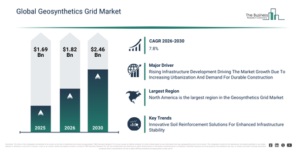
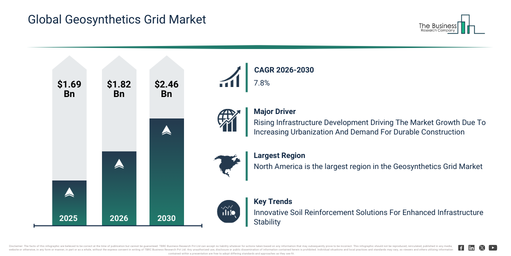
The geosynthetics grid market has experienced robust expansion over recent years. This market is projected to expand from $1.69 billion in 2025 to $1.82 billion in 2026, demonstrating a compound annual growth rate (CAGR) of 7.6%. Factors contributing to this historical growth include a rise in infrastructure development initiatives, the need for resilient road construction materials, wider integration of geosynthetics in agricultural practices, ongoing urbanization and demographic expansion, and the initial application of polymeric grids within the mining and construction sectors.
The geosynthetics grid market is projected to experience substantial expansion over the upcoming years. This market is forecast to reach $2.46 billion in 2030, demonstrating a compound annual growth rate (CAGR) of 7.8%. The anticipated growth during this period is largely driven by increasing government spending on sustainable infrastructure, the proliferation of smart city and transport initiatives, heightened consciousness regarding environmental preservation, innovations in composite grid technology, and wider adoption in waste management and drainage applications. Key trends characterizing the forecast period encompass the reinforcement and stabilization of soil, measures for erosion control and environmental safeguarding, the use of high-performance polymeric materials, a focus on the longevity and durability of infrastructure, and sophisticated installation and monitoring methodologies.
Get A Free Sample Report With In-Depth Market Insights:
Geosynthetics Grid Market Demand Drivers Opening New Revenue Streams
The future expansion of the geosynthetics grid market is anticipated to be driven by a rise in infrastructure development projects. These projects encompass efforts to construct, enhance, or sustain critical physical and organizational facilities vital for fostering economic progress and delivering public services. The surge in infrastructure development is a direct consequence of rapid urbanization, which in turn fuels the need for more transportation, energy, and public amenities to accommodate expanding populations and economic operations. Geosynthetic grids contribute to infrastructure advancement by preventing soil erosion, ensuring uniform load distribution, and reinforcing foundations, thereby enabling durable and economical construction. For example, in February 2024, the Infrastructure and Projects Authority, a government agency in the UK, indicated that the projected investment for significant infrastructure and construction initiatives in 2024–25 reached £164 billion (USD 214.18 billion), surpassing the amount from the previous year, 2023–24. Furthermore, total investment for the upcoming decade is forecast to be between £700 billion (USD 914.16 billion) and £775 billion (USD 1,012.11 billion). Consequently, the expanding volume of infrastructure development projects is propelling the expansion of the geosynthetics grid market.
Geosynthetics Grid Market Segment Trends And Revenue Contributors
The geosynthetics grid market covered in this report is segmented –
1) By Product Type: Geogrids, Geotextiles, Geonets, Geomembranes, Geocells, Composite Grids
2) By Functionality: Separation, Filtration, Reinforcement, Drainage, Protection
3) By Material Type: Polypropylene, Polyester, Geosynthetic Clay, Composite, Other Material Types
4) By Application: Waste Management, Soil Reinforcement, Road Construction, Drainage Systems, Environmental Protection
5) By End User Industry: Transportation, Construction, Agriculture, Mining, Environmental Protection
Subsegments:
1) By Geogrids: Uniaxial Geogrids, Biaxial Geogrids, Triaxial Geogrids
2) By Geotextiles: Woven Geotextiles, Non Woven Geotextiles, Knitted Geotextiles
3) By Geonets: Extruded Geonets, Woven Geonets
4) By Geomembranes: High Density Polyethylene Geomembranes, Linear Low Density Polyethylene Geomembranes, Polyvinyl Chloride Geomembranes, Ethylene Propylene Diene Monomer Geomembranes
5) By Geocells: High Density Polyethylene Geocells, Polypropylene Geocells
6) By Composite Grids: Geotextile Reinforced Composite Grids, Geomembrane Reinforced Composite Grids
Geosynthetics Grid Market Trends Powering Strategic Industry Growth
Leading firms within the geosynthetics grid market are concentrating on creating sophisticated offerings, including soil reinforcement geosynthetics, aimed at bolstering ground stability, mitigating erosion, and strengthening the resilience of infrastructure across construction and civil engineering endeavors. A soil reinforcement geosynthetic is defined as a specialized material engineered to fortify soil by effectively distributing applied loads, curtailing soil displacement, and consequently extending the structural integrity and lifespan of slopes, embankments, retaining walls, and various other civil engineering constructions. An illustrative example occurred in May 2023 when HUESKER Synthetic GmbH, a German manufacturer of geosynthetic products, launched its ecoLine geogrids. These products are crafted entirely from recycled PET derived from used bottles, yet they deliver a reinforcement performance on par with virgin PET alternatives. These particular geogrids are designed to offer superior load-bearing capability, resistance to creep, and consistent dimensional stability, making them ideal for reinforcing soil and stabilizing ground. Their sustainable composition supports circular economy principles without sacrificing operational effectiveness, thereby making them well-suited for infrastructure, transportation, and civil engineering projects demanding both structural dependability and a lower environmental impact.
Geosynthetics Grid Market Leading Companies And Competitive Benchmarking
Major companies operating in the geosynthetics grid market are E. I. du Pont de Nemours and Company, Officine Maccaferri S.p.A., Freudenberg SE., Koninklijke TenCate N.V., Solmax International Inc., NAUE GmbH & Co. KG., Tensar International Corporation, Huesker Synthetic GmbH, ACE Geosynthetics Enterprises Co. Ltd., Geofabrics Australasia Pty Ltd., SKAPS Industries Pvt. Ltd., Pietrucha Group Sp. z o.o., Thrace Group Holdings S.A., TechFab India Private Limited, Tenax S.p.A., Strata Systems Inc., Fibertex Nonwovens A/S, Propex Operating Company LLC, CTM Geosynthetics Ltd., Maharshee Geomembrane India Pvt. Ltd.
View The Full Geosynthetics Grid Market Report:
Geosynthetics Grid Market Top Region By Revenue And Market Share
North America was the largest region in the geosynthetics grid market in 2025. Asia-Pacific is expected to be the fastest-growing region in the forecast period. The regions covered in the geosynthetics grid market report are Asia-Pacific, South East Asia, Western Europe, Eastern Europe, North America, South America, Middle East, Africa.
Reach Out To Our Team:
The Business Research Company: https://www.thebusinessresearchcompany.com/
Americas: +1 310-496-7795
Asia: +44 7882 955267 & +91 8897263534
Europe: +44 7882 955267
Email us at: marketing@tbrc.info
Follow us on:
LinkedIn: https://in.linkedin.com/company/the-business-research-company
YouTube: https://www.youtube.com/channel/UC24_fI0rV8cR5DxlCpgmyFQ
Global Market Model: https://www.thebusinessresearchcompany.com/global-market-model

Wasay has over a decade of experience in market research, data modelling, and analytics, with prior experience at GlobalData and Decision Tree Consulting Services. At The Business Research Company , he leads research operations across syndicated studies, customized consulting engagements, and the Global Market Model platform. His professional experience includes supporting organizations such as Boston Consulting Group, KPMG, and Ernst & Young. Wasay holds a degree in Electronics and Communications Engineering, postgraduate management qualifications from International Management Institute Belgium and Indian School of Business and Entrepreneurship, and completed the Integrated Program in Business Analytics from Indian Institute of Management Indore.