Built to provide research that’s more actionable and strategically valuable, The Business Research Company’s 2026 market reports include market attractiveness analysis, total addressable market sizing, company benchmarking matrices, interactive Excel dashboards, broader supply chain intelligence, emerging startup tracking, and in-depth product insights.
Small Cell Poles Market CAGR Outlook And Future Development
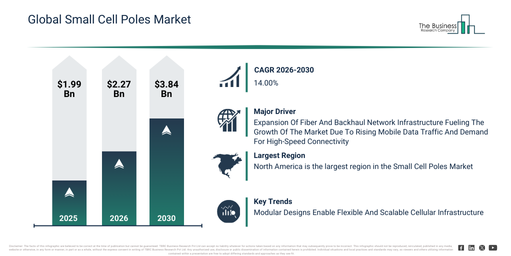
The small cell poles market size has experienced rapid growth in recent years. It is anticipated to expand from $1.99 billion in 2025 to $2.27 billion in 2026, achieving a compound annual growth rate (CAGR) of 14.2%. The expansion observed historically is attributable to an increase in mobile data usage, the rising adoption of 4G and early 5G networks, growing urban network congestion, the expanded deployment of densified cellular grids, and an increasing need for continuous indoor and outdoor connectivity.
The small cell poles market is anticipated to experience swift expansion over the next few years. By 2030, its valuation is forecast to reach $3.84 billion, exhibiting a compound annual growth rate (CAGR) of 14.0%. This growth during the projected period can be attributed to the increasing penetration of 5G subscribers, the growing demand for enhanced mobile broadband, the rising need for reliable connectivity in smart cities, the expanding deployment of edge-connected networks, and the heightened requirement for greater network density. Significant trends during the forecast period include technological advancements in integrated radio units, innovations in lightweight composite materials for poles, developments in modular small cell pole architecture, research and development in multi-band antenna systems, and technological progress in power-efficient pole designs.
Get A Free Sample Report With In-Depth Market Insights:
Small Cell Poles Market Demand Drivers: What’s Powering Industry Growth?
The increasing development of fiber and backhaul network infrastructure is projected to drive the growth of the small cell poles market moving forward. This infrastructure consists of systems, such as fiber-optic cables and microwave links, that transport data from access points to core networks, thereby delivering high-speed, reliable connectivity. The expansion of fiber and backhaul network infrastructure is a direct result of the rapid surge in mobile data traffic and the escalating demand for high-speed connectivity, as more users and devices require faster, low-latency network access. Small cell poles support the expansion of fiber and backhaul network infrastructure by providing compact, low-power connectivity points, making them ideal for dense urban areas and locations with high traffic. They enhance network performance by improving coverage, boosting capacity, and enabling faster, low-latency data transmission. For instance, in December 2024, according to the Office of Communications, a UK-based regulatory authority, full-fibre network adoption reached 35%, representing 7.5 million premises by July 2024, which was an increase from 28% in May 2023. Therefore, the expansion of fiber and backhaul network infrastructure is stimulating the growth of the small cell poles market.
Small Cell Poles Market Segments: Where Is Growth Concentrated?
The small cell poles market covered in this report is segmented –
1) By Type: Fully Concealed Poles, Partially Concealed Poles, Non-Concealed Poles, Integrated Poles, World Small Cell Poles Production
2) By Installation Environment: Urban Deployments, Suburban Deployments, Rural or Remote Deployments
3) By Technology Compatibility: 4G or LTE Small Cell Poles, 5G Sub-6 GHz Small Cell Poles, 5G mmWave Small Cell Poles, Future-Ready or 6G-Compatible Poles
4) By Application: Personal Small Cell Poles, Commercial Small Cell Poles, Public Small Cell Poles, World Small Cell Poles Production
5) By End-User: Telecom Operators, Government Agencies, Educational Institutions, Private Enterprises
Subsegments:
1) By Fully Concealed Poles: Completely Hidden Equipment Enclosures, Decorative Camouflaged Pole Structures, Internal Antenna Housing Designs, Stealth Urban Integration Poles, Aesthetically Blended Street Poles
2) By Partially Concealed Poles: Semi-Integrated Equipment Housings, Exposed Antenna Radome Structures, Partial Cable Concealment Designs, Hybrid Visible–Hidden Pole Formats, Selective Component Concealment Poles
3) By Non-Concealed Poles: Open Mounted Antenna Poles, Externally Attached Radio Cabinets, Visible Cable Routing Poles, Standard Utility Style Poles, Cost-Optimized Open Equipment Poles
4) By Integrated Poles: Multifunction Smart City Poles, Lighting and Connectivity Combined Poles, Sensor-Enabled Infrastructure Poles, Surveillance and Communication Integrated Poles, Energy Charging and Connectivity Poles
5) By World Small Cell Poles Production: Steel Small Cell Pole Production, Aluminum Small Cell Pole Production, Composite Material Pole Production, Hybrid Material Pole Production, Custom Fabricated Small Cell Pole Production
Small Cell Poles Market Innovation Trends: What Developments Are Reshaping The Industry?
Leading companies within the small cell poles market are concentrating on developing sophisticated products, such as modular pole toppers, to enhance deployment efficiency, improve network performance, and reduce installation time and site complexity. These modular pole toppers are advanced, configurable units specifically designed for the tops of poles or streetlights to house and protect radio equipment for 4G and 5G cellular networks. For instance, in June 2023, Raycap, a US-based telecom infrastructure solutions company, unveiled a new line of modular pole toppers for 4G/5G cellular networks. These toppers feature a patented, modular design, allowing for flexible and scalable configurations to meet specific carrier requirements and site conditions. They include integrated RF shielding and advanced thermal management systems, which facilitate optimal equipment performance and reliability while minimizing visual impact. Moreover, they incorporate future-proofing elements and streamlined mounting solutions, accelerating deployment schedules and reducing overall lifecycle costs for network operators.
Small Cell Poles Market Competitive Landscape: Who Leads The Industry?
Major companies operating in the small cell poles market are Telefonaktiebolaget LM Ericsson, Nokia Corporation, ZTE Corporation, CommScope Holding Company Inc., Valmont Telecom India Pvt. Ltd., Sabre Industries Inc., Comba Telecom Systems Holdings Limited, Tessco Technologies, Ameron Pole Products, Charles Industries LLC, Huawei Technologies Co. Ltd., Raycap, Millerbernd Manufacturing Company, Hapco Pole Products, Nova Pole International, Alpha Wireless, Flexsol, Trident Structures Inc., Strong Pole Industries LLC, Fortis Composite Poles Inc.
View The Full Small Cell Poles Market Report:
Small Cell Poles Market Geographic Landscape: Which Region Dominates Industry Growth?
North America was the largest region in the small cell poles market in 2025. Asia-Pacific is expected to be the fastest-growing region in the forecast period. The regions covered in the small cell poles market report are Asia-Pacific, South East Asia, Western Europe, Eastern Europe, North America, South America, Middle East, Africa.
Reach Out To Our Team:
The Business Research Company: https://www.thebusinessresearchcompany.com/
Americas: +1 310-496-7795
Asia: +44 7882 955267 & +91 8897263534
Europe: +44 7882 955267
Email us at: marketing@tbrc.info
Follow us on:
LinkedIn: https://in.linkedin.com/company/the-business-research-company
YouTube: https://www.youtube.com/channel/UC24_fI0rV8cR5DxlCpgmyFQ
Global Market Model: https://www.thebusinessresearchcompany.com/global-market-model

Wasay has over a decade of experience in market research, data modelling, and analytics, with prior experience at GlobalData and Decision Tree Consulting Services. At The Business Research Company , he leads research operations across syndicated studies, customized consulting engagements, and the Global Market Model platform. His professional experience includes supporting organizations such as Boston Consulting Group, KPMG, and Ernst & Young. Wasay holds a degree in Electronics and Communications Engineering, postgraduate management qualifications from International Management Institute Belgium and Indian School of Business and Entrepreneurship, and completed the Integrated Program in Business Analytics from Indian Institute of Management Indore.