Featuring market attractiveness scoring, total addressable market sizing, company benchmarking matrices, interactive Excel dashboards, deeper supply chain intelligence, emerging startup tracking, and granular product-level insights, The Business Research Company’s 2026 market reports are built to deliver research that is both more actionable and more strategically valuable.
Grid Automation System Market Set To Climb From $39.68 Billion In 2026 To $51.89 Billion By 2030
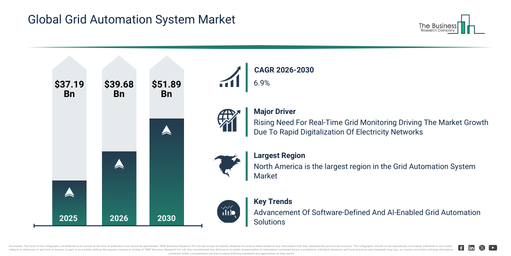
The grid automation system market has experienced robust expansion over recent years. This market is projected to expand from $37.19 billion in 2025 to $39.68 billion in 2026, demonstrating a compound annual growth rate (CAGR) of 6.7%. Factors contributing to this historical growth include increasing demand for reliable electricity supply, the adoption of SCADA systems, the integration of smart sensors in power grids, rising urbanization and electricity consumption, and early automation initiatives in transmission and distribution networks.
The grid automation system market size is projected to expand considerably over the next few years. It will grow to $51.89 billion in 2030 at a compound annual growth rate (CAGR) of 6.9%. This expansion during the forecast period is primarily driven by factors such as increased penetration of renewable energy sources, rising investments in smart grid technologies, the integration of AI and predictive analytics for grid management, the expansion of microgrid deployments, and supportive regulatory frameworks for grid modernization and automation. Key developments expected in this period will encompass real-time grid monitoring, automated fault detection and isolation, optimization of load balancing, enhanced renewable energy integration, and advanced predictive maintenance and diagnostics.
Get A Free Sample Report With In-Depth Market Insights:
Grid Automation System Market Growth Catalysts And Demand Drivers
The increasing demand for real-time grid monitoring is anticipated to drive the expansion of the grid automation system market in the future. Real-time grid monitoring involves the ongoing observation and assessment of an electrical power grid’s operational status, offering instant insight into electricity flow, equipment efficiency, and overall system well-being. This growing requirement for real-time grid monitoring stems from the escalating complexity and electrification of grids, where utilities and operators are increasingly incorporating renewable energy sources, distributed energy assets, and intelligent infrastructure to improve grid reliability, minimize service interruptions, and guarantee effective, safe, and responsive power supply. Grid automation systems facilitate real-time grid monitoring through continuous data gathering and automated analytical processes, as smart sensors, communication networks, and control software deliver immediate insight into grid conditions, thereby boosting operational awareness, dependability, and quick decision-making. For example, by December 2025, the International Energy Agency (IEA), an autonomous intergovernmental organization based in France, projects that worldwide renewable power capacity will grow by almost 4,600 GW between 2025 and 2030, which is approximately twice the capacity additions seen in the preceding five years. Consequently, the increased demand for real-time grid monitoring is propelling the expansion of the grid automation system market.
Grid Automation System Market Segment Landscape And Growth Outlook
The grid automation system market covered in this report is segmented –
1) By Component: Hardware, Software, Services
2) By Deployment Mode: On Premise Deployment, Cloud Based Deployment, Hybrid Deployment
3) By Technology: Supervisory Control And Data Acquisition, Distribution Management System, Advanced Metering Infrastructure, Energy Management System
4) By Application: Transmission, Distribution, Renewable Integration, Microgrid Management
5) By End Use: Utilities, Industrial, Commercial, Residential
Subsegments:
1) By Hardware: Intelligent Electronic Devices, Remote Terminal Units, Sensors, Communication Equipment, Control Panels
2) By Software: Energy Management System, Distribution Management System, Outage Management System, Grid Analytics Software, Advanced Metering Infrastructure Software
3) By Services: Installation And Integration Services, Maintenance And Support Services, Consulting And Advisory Services, Training And Education Services, System Upgradation Services
Grid Automation System Market Trends Shaping Long-Term Demand
Leading companies in the grid automation system market are concentrating on developing innovative solutions, such as software-defined automation platforms, to address the increasing need for resilient and efficient grid management. This demand is fueled by greater integration of renewable energy, upgrades to aging infrastructure, and the drive towards decarbonization. These software-defined automation platforms leverage advanced computing, analytics, and communication protocols to automate decision-making across the grid, offering enhanced flexibility, visibility, and cybersecurity compared to older, hardware-centric systems that rely on manual configuration and isolated control logic. For example, in February 2024, GE Vernova, a US-based energy technology company, introduced GridBeats, an innovative software-defined grid automation portfolio designed to modernize and digitalize grid operations across utility networks. GridBeats features multiple digital solutions that facilitate zonal autonomous control for improved system resilience, integrated digital substation functions for streamlined protection and control, predictive diagnostics using digital twins of assets, and comprehensive device and network management for better operational visibility and efficiency. By combining AI/ML-based automation with fast, dependable communications, GridBeats empowers utilities to boost grid performance, adapt to fluctuating renewable inputs, and accelerate the transition to sustainable energy systems, surpassing legacy automation solutions that lack real-time analytics and remote provisioning.
Grid Automation System Market Industry Leaders And Competitive Landscape
Major companies operating in the grid automation system market are Siemens AG, Hitachi Energy Ltd., Cisco Systems Inc., GE Grid Solutions LLC, Schneider Electric SE, Honeywell International Inc., ABB Ltd. (Asea Brown Boveri Ltd.), Larsen & Toubro Limited, Toshiba Energy Systems & Solutions Corporation, Eaton Corporation plc, Thales Group, Emerson Electric Company, Rockwell Automation Inc., CHINT Group Corporation, Itron Inc., S&C Electric Company, PSI Software AG, Trilliant Holdings Inc., Hyosung HICO Ltd., NARI Technology Co. Ltd., and Alfanar Company.
View The Full Grid Automation System Market Report:
Grid Automation System Market Regional Analysis And Leading Geography
North America was the largest region in the grid automation system market in 2025. Asia-Pacific is expected to be the fastest-growing region in the forecast period. The regions covered in the grid automation system market report are Asia-Pacific, South East Asia, Western Europe, Eastern Europe, North America, South America, Middle East, Africa.
Reach Out To Our Team:
The Business Research Company: https://www.thebusinessresearchcompany.com/
Americas: +1 310-496-7795
Asia: +44 7882 955267 & +91 8897263534
Europe: +44 7882 955267
Email us at: marketing@tbrc.info
Follow us on:
LinkedIn: https://in.linkedin.com/company/the-business-research-company
YouTube: https://www.youtube.com/channel/UC24_fI0rV8cR5DxlCpgmyFQ
Global Market Model: https://www.thebusinessresearchcompany.com/global-market-model

Wasay has over a decade of experience in market research, data modelling, and analytics, with prior experience at GlobalData and Decision Tree Consulting Services. At The Business Research Company , he leads research operations across syndicated studies, customized consulting engagements, and the Global Market Model platform. His professional experience includes supporting organizations such as Boston Consulting Group, KPMG, and Ernst & Young. Wasay holds a degree in Electronics and Communications Engineering, postgraduate management qualifications from International Management Institute Belgium and Indian School of Business and Entrepreneurship, and completed the Integrated Program in Business Analytics from Indian Institute of Management Indore.