Featuring market attractiveness scoring, total addressable market sizing, company benchmarking matrices, interactive Excel dashboards, deeper supply chain intelligence, emerging startup tracking, and granular product-level insights, The Business Research Company’s 2026 market reports are built to deliver research that is both more actionable and more strategically valuable.
Smart Defrost Control Market Value Analysis: What Growth Lies Ahead Over The Forecast Period?
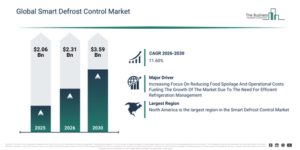
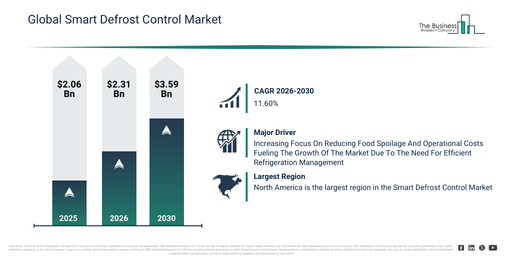
The smart defrost control market size has experienced swift expansion in recent years. This market is projected to grow from $2.06 billion in 2025 to $2.31 billion in 2026, achieving a compound annual growth rate (CAGR) of 11.9%. The historical growth can be linked to the increasing adoption of smart home safety devices, a growing awareness about fire protection, the rising integration of Wi-Fi-enabled monitoring systems, an expanding use of sensor-based fire detection, and an increasing government emphasis on residential safety standards.
The smart defrost control market is anticipated to experience substantial growth in the upcoming years, with projections indicating a rise to $3.59 billion by 2030, supported by a compound annual growth rate (CAGR) of 11.6%. This expansion during the forecast period is primarily driven by the increasing demand for connected fire-safe storage solutions, greater integration of AI-driven hazard alerts, expanding deployment of smart home ecosystems, wider adoption of real-time remote monitoring features, and a heightened focus on automated emergency notifications. Furthermore, significant trends expected over this period include technological advancements in smart fire detection sensors, innovations in Wi-Fi-enabled safety automation, developments in integrated home safety ecosystems, ongoing research and development in battery-efficient fire monitoring, and progress in cloud-based fire incident analytics.
Get A Free Sample Report With In-Depth Market Insights:
Smart Defrost Control Market Growth Catalysts And Demand Drivers
The smart defrost control market is anticipated to expand due to an increasing emphasis on decreasing food spoilage and operational costs. This focus encompasses the growing initiatives from food retailers, cold storage operators, and commercial kitchens to enhance refrigeration efficiency, minimize waste, and reduce energy consumption. Businesses are increasingly prioritizing the reduction of food spoilage and operational costs to minimize waste and boost profitability through improved monitoring and management of perishable items. Smart defrost control contributes to these efforts by automatically optimizing defrost cycles based on real-time temperature and usage data. This technology enhances efficiency and reliability by preventing redundant defrosting, ensuring stable cooling performance, and decreasing energy usage. For example, in March 2024, data from the Waste and Resources Action Programme, a UK-based non-governmental organisation, indicated that self-reported food waste decreased from 21.7% in June 2023 to 20.2% in November 2023, representing a 6.9% reduction. Consequently, the rising focus on curbing food spoilage and operational costs is a key factor propelling the growth of the smart defrost control market. The increasing integration of the Internet of Things (IoT) and remote monitoring is projected to fuel the expansion of the smart defrost control market moving forward. IoT and remote monitoring involve linking devices to internet-enabled platforms, enabling real-time tracking, automation, and control of system performance from various distant locations. The adoption of IoT and remote monitoring is on the rise due to the benefits of obtaining real-time insights and managing systems proactively from anywhere. Smart defrost control facilitates this integration by allowing for real-time data collection, enhanced connectivity, and automated control of refrigeration systems. This capability boosts operational efficiency and reliability through features like predictive maintenance, optimized energy usage, and remote performance management within interconnected environments. For instance, in November 2025, the Office of Communications, a UK-based independent regulator, reported that the number of active IoT devices in the UK rose from approximately 24.9 million in 2023 to 26.5 million in 2024, eventually reaching about 27.7 million in 2025. Hence, the increasing integration of IoT and remote monitoring is significantly contributing to the growth of the smart defrost control market.
Smart Defrost Control Market Segment Performance And Emerging Opportunities
The smart defrost control market covered in this report is segmented –
1) By Product Type: Adaptive Defrost Control, Demand Defrost Control, Time-Based Defrost Control, Other Product Types
2) By Component: Sensors, Controllers, Software, Other Components
3) By Distribution Channel: Original Equipment Manufacturers (OEMs), Aftermarket, Online, Offline
4) By Application: Commercial Refrigeration, Residential Refrigeration, Industrial Refrigeration, Automotive, Other Applications
Subsegments:
1) By Adaptive Defrost Control: Sensor Based Defrost Systems, Real Time Frost Detection Units, Energy Optimized Defrost Modules, Temperature Responsive Control Devices, Smart Algorithm Driven Defrost Platforms
2) By Demand Defrost Control: Humidity Sensing Defrost Units, Load Based Defrost Systems, Usage Pattern Responsive Modules, Intelligent Frost Monitoring Devices, Automatic Defrost Activation Platforms
3) By Time-Based Defrost Control: Fixed Interval Defrost Timers, Programmable Defrost Scheduling Units, Periodic Cycle Control Devices, Mechanical Timer Based Modules, Electronic Time Controlled Systems
4) By Other Product Types: Hybrid Defrost Control Modules, Multi Sensor Integrated Devices, Cloud Connected Defrost Management Systems, Advanced Predictive Control Units, Smart Remote Monitoring Platforms
Smart Defrost Control Market Leading Companies And Competitive Benchmarking
Major companies operating in the smart defrost control market are Schneider Electric SE, Honeywell International Inc., Daikin Industries Ltd., Parker-Hannifin Corporation, Emerson Electric Co., Danfoss A/S, GEA Group Aktiengesellschaft, Sub-Zero Group Inc., Carel Industries S.p.A., Autonics Corporation, ASCON TECNOLOGIC S.r.l., Truma Gerätetechnik GmbH & Co. KG, EVCO S.p.A., Capable Controls Inc., Business Social Compliance Initiative, Accio, Manik Engineers, Thermokon Sensortechnik GmbH, Refrigeration Technologies LLC, Ako Electromecanica S.A., KIOUR
View The Full Smart Defrost Control Market Report:
Smart Defrost Control Market Top Region By Revenue And Market Share
North America was the largest region in the smart defrost control market in 2025. Asia-Pacific is expected to be the fastest-growing region in the forecast period. The regions covered in the smart defrost control market report are Asia-Pacific, South East Asia, Western Europe, Eastern Europe, North America, South America, Middle East, Africa.
Reach Out To Our Team:
The Business Research Company: https://www.thebusinessresearchcompany.com/
Americas: +1 310-496-7795
Asia: +44 7882 955267 & +91 8897263534
Europe: +44 7882 955267
Email us at: marketing@tbrc.info
Follow us on:
LinkedIn: https://in.linkedin.com/company/the-business-research-company
YouTube: https://www.youtube.com/channel/UC24_fI0rV8cR5DxlCpgmyFQ
Global Market Model: https://www.thebusinessresearchcompany.com/global-market-model

Wasay has over a decade of experience in market research, data modelling, and analytics, with prior experience at GlobalData and Decision Tree Consulting Services. At The Business Research Company , he leads research operations across syndicated studies, customized consulting engagements, and the Global Market Model platform. His professional experience includes supporting organizations such as Boston Consulting Group, KPMG, and Ernst & Young. Wasay holds a degree in Electronics and Communications Engineering, postgraduate management qualifications from International Management Institute Belgium and Indian School of Business and Entrepreneurship, and completed the Integrated Program in Business Analytics from Indian Institute of Management Indore.